Video Editing for Manufacturing Companies
Video editing for manufacturing companies turns factory tours, machine demos, and safety training into clear, on-brand assets buyers will actually watch.
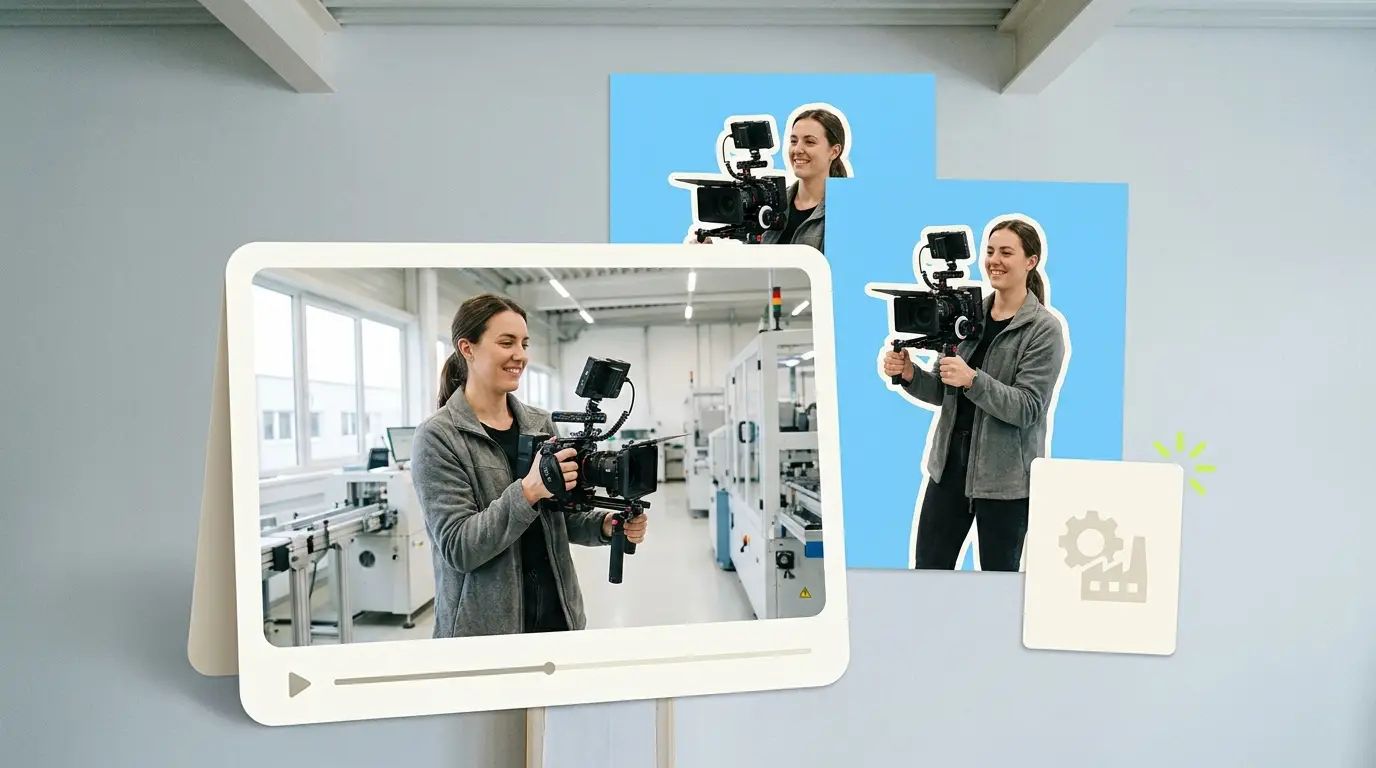
Video editing for manufacturing companies is no longer a nice-to-have. Buyers, recruits, and regulators all expect to see your operation in motion before they trust it. A plant manager wants to watch your machine run before signing a purchase order. A safety officer needs a training clip new hires can replay. A prospect three states away wants a factory tour without booking a flight. Manufacturing and industrial firms now sit on hours of raw footage, and the bottleneck is rarely shooting it. The bottleneck is turning that footage into clear, captioned, watchable video on a schedule.
This guide covers how industrial companies actually use video, what makes editing manufacturing footage different from editing a typical talking-head clip, what the work costs, and why a subscription editor handles both your steady weekly output and the burst around a trade show or product launch.
Why manufacturers are filming more than ever
The shift is partly buyer behavior. According to Wyzowl, 91% of businesses use video as a marketing tool, and 82% say a video convinced them to buy a product or service. In a long industrial sales cycle, where a single line of equipment can cost six or seven figures, that proof matters. A written spec sheet tells a buyer what a machine does. A two-minute demo shows them it actually does it.
There is also a practical reason. Phones and plant cameras make capture cheap. A floor supervisor can record a process in minutes. What does not scale is the editing. Raw factory footage is long, repetitive, noisy, and often shot without much thought about framing. Someone has to cut it down, add captions, label the steps, drop in b-roll of the line running, and export it in the formats your sales team and recruiters need. That is the gap, and it is where editing capacity becomes the real constraint.
How manufacturing and industrial companies use video
The footage tends to fall into a handful of repeatable categories. Each has its own editing pattern, which is part of why a dedicated editor who learns your operation pays off.
Factory and facility tours
A factory tour answers the question every serious buyer eventually asks: can you actually produce this at the quality and volume we need? A good tour walks through the line, shows certifications and clean rooms where relevant, and gives a sense of scale. Editing here is about pacing and orientation. Viewers who have never set foot in a plant need on-screen labels, clear transitions between areas, and captions that name what they are seeing. This is also strong material for your website and sales decks, the same way a polished corporate video production subscription keeps a library of brand assets fresh and consistent.
Product and machine demos

Demos are the workhorse of industrial video. A prospect wants to see the machine cut, weld, fill, or pack at speed. The editing job is to show the process clearly without making the viewer sit through dead time. That means tightening long runs, using close-ups and slow motion on the critical moment, and adding callouts for throughput, tolerances, and materials. These demos do double duty in sales conversations, which is why many teams treat them as B2B sales enablement video assets that reps can send mid-deal to keep momentum.
Safety and operator training

Training video is where editing quality directly affects outcomes. A new operator should be able to watch a clip, pause, replay, and follow along. That demands clean step-by-step structure, on-screen text for every action, and captions for floors that are loud or where English is a second language. Consistency matters too. When every training video uses the same intro, the same caption style, and the same labeling, your library feels like a system rather than a pile of one-off clips.
Trade show and event recaps

Trade shows produce a flood of footage in a few days: booth demos, customer interviews, product reveals, floor energy. The value of that footage drops fast, so the edit needs to happen quickly while the show is still relevant. A recap video posted within a day or two keeps the momentum going with prospects you met. This is the classic burst-output problem, and it is hard to staff for with one in-house editor who is already busy.
Recruitment and culture
Manufacturing has a hiring challenge, and video helps. A short piece showing real people on a real floor, talking about the work, does more for recruiting than a job posting. Editing here leans on b-roll of operations, employee interviews cut for warmth and clarity, and captions so the video works on silent social feeds where most people scroll.
What makes editing industrial footage different
Editing manufacturing video is not the same as editing a webinar or a founder interview. A few things consistently come up.
Process clarity over polish. The goal is usually to explain a sequence: how a part is made, how a machine is operated, how a safety procedure works. That puts the weight on structure, labeling, and pacing rather than flashy motion graphics. The clearest industrial videos look a lot like good explainer video production, where the priority is making a complex thing understandable.
Captions are not optional. Plant floors are loud, and a lot of industrial video gets watched on phones in noisy environments or on social feeds with the sound off. Accurate captions and on-screen labels are core to the edit, not an afterthought.
B-roll of operations carries the story. Talking-head footage alone is dull in this space. The editor needs to weave in shots of the line running, close-ups of the work, and wide shots of the facility to keep the viewer oriented and engaged.
Noise and lighting are rough. Footage shot on a factory floor often has harsh lighting, machine noise, and inconsistent audio. Part of the editing job is cleaning that up: balancing audio, ducking machine noise under narration, and color-correcting so the footage looks professional.
Output formats multiply. One shoot often needs to become a long-form tour for the website, a 60-second cut for LinkedIn, a vertical clip for social, and a captioned segment for a sales deck. A dedicated editor who knows your brand can produce all of those from one set of raw files without re-briefing every time, which is the everyday value of a done-for-you video editing service.
What video editing costs for manufacturers
Cost is usually the deciding factor, so here is the honest range of options.
Hiring in-house. A full-time video editor in the United States runs roughly $55,000 to $75,000 per year according to ZipRecruiter, before benefits, software, and hardware. That can make sense if you produce video every single day. For most manufacturers, whose volume comes in waves around launches and shows, a full-time hire sits idle part of the year and gets overwhelmed during the bursts.
Freelancers. A freelance editor typically charges $75 to $250 per video depending on length and complexity. Freelancers are flexible and good for one-off projects. The trouble is consistency and availability. The freelancer who edited your last factory tour may be booked when your trade show footage lands, and each new freelancer has to relearn your brand and your operation.
Agencies. A production agency might charge $500 to $5,000 or more per project. You get a team and polish, but the per-project pricing makes steady output expensive and slow, and turnaround is rarely fast.
Subscription editing. A monthly subscription gives you a dedicated editor and a fixed cost. Market subscription editing generally runs $500 to $3,000 per month depending on volume and turnaround. This model fits manufacturing well because your editing need is both steady (weekly demos, training clips, social cuts) and bursty (a trade show or launch). You pay one predictable fee and the same editor handles both. For a fuller comparison of the models, this breakdown of a video editing service for businesses is a useful reference.
Why a subscription editor fits manufacturing output
The pattern that makes subscription editing a strong match is the shape of manufacturing demand. Most months you have a steady trickle: a new machine demo, a training update, a few social cuts. Then a trade show or product launch hits and you suddenly need a dozen videos in a week. Neither a single in-house hire nor a stack of freelancers handles both shapes well. The in-house editor is bored half the year and buried the other half. The freelancer roster is inconsistent and slow to brief.
A subscription editor smooths that out. You have one editor who already knows your facility, your brand standards, your caption style, and your machine names. During quiet weeks they work through your steady queue and build out your library. During the burst they prioritize the time-sensitive recap and turn it around fast. Because the cost is fixed, you can plan your video budget for the year instead of guessing per project. And because the editor is dedicated, the quality and labeling stay consistent across hundreds of clips, which is exactly what training libraries and sales decks need.
What Pixel8 Production offers
Pixel8 Production is a done-for-you B2B video editing subscription built for companies that produce video regularly, including manufacturers and industrial firms. You send raw footage, your factory tour, machine demo, training session, or trade show clips, and a dedicated editor turns it into finished, captioned, on-brand video.
The pricing is flat: $2,000 to $3,200 per month depending on volume and turnaround needs. That includes a dedicated editor who learns your operation and your brand, so you are not re-briefing a new person every time. Turnaround is 48 hours on standard edits, which matters when a trade show recap loses value by the day. You get clear process explainers, accurate captions, operations b-roll integration, and exports in every format your sales, marketing, and recruiting teams need, all from one predictable monthly cost.
The model is designed for exactly the steady-plus-burst pattern manufacturing runs on. Quiet weeks build your library. Busy weeks get the fast turnaround. The cost does not change.
Bottom line
Manufacturing and industrial companies are filming more than ever, and the real constraint is editing capacity, not footage. Factory tours, machine demos, safety training, trade show recaps, and recruitment videos each need clear structure, accurate captions, and operations b-roll, and they arrive in a steady-plus-burst rhythm that is hard to staff with a single in-house hire or a roster of freelancers. A subscription editor matches that rhythm: one dedicated person who knows your operation, a fixed monthly cost, and fast turnaround when it counts. If that fits how your company produces video, Pixel8 Production offers a done-for-you B2B editing subscription at $2,000 to $3,200 per month with a dedicated editor and 48-hour turnaround. For broader context on video buying behavior, HubSpot's video marketing statistics are worth a look.
Where to go from here
Frequently asked questions
How much does video editing for manufacturing companies cost?
It depends on the model. A full-time in-house editor runs about $55,000 to $75,000 per year, freelancers charge $75 to $250 per video, and agencies bill $500 to $5,000 or more per project. Subscription editing generally runs $500 to $3,000 per month. Pixel8 Production charges $2,000 to $3,200 per month for a dedicated editor. A $900 trial is available to test the service before committing to a monthly plan.
What types of video do manufacturers need edited most?
The common categories are factory and facility tours, product and machine demos, safety and operator training, trade show recaps, and recruitment videos. Each has a repeatable editing pattern, which is why a dedicated editor who learns your operation becomes more efficient over time.
Why are captions so important for industrial video?
Plant floors are loud, and much industrial video is watched on phones or on social feeds with the sound off. Accurate captions and on-screen labels make the video usable in noisy environments and for operators who read English as a second language. For training video especially, clear labeling directly affects how well people learn the process.
How fast can a subscription editor turn around a trade show recap?
With Pixel8 Production, standard edits come back in 48 hours. That speed matters for trade shows and launches, where footage loses value quickly. A recap posted within a day or two keeps momentum with the prospects you met, while a recap that takes two weeks arrives after the moment has passed.
Is a subscription cheaper than hiring an in-house editor?
For most manufacturers, yes. An in-house editor costs $55,000 to $75,000 per year plus benefits and software, and sits idle during slow periods. A subscription at $2,000 to $3,200 per month gives you a dedicated editor without the fixed overhead, and it scales with your actual output rather than a fixed salary.
Can one editor handle both steady output and trade show bursts?
That is the main reason the subscription model fits manufacturing. A dedicated editor works through your steady queue of demos and training clips during quiet weeks, then prioritizes the time-sensitive recap during a burst. You get both shapes of work from one person who already knows your operation, at one fixed cost.
Do I need professional footage, or can I send phone video?
You can send phone or plant-camera footage. Part of the editing job is cleaning up rough audio, balancing harsh lighting, color-correcting, and adding the structure and captions that make raw footage look professional. Good editing closes a lot of the gap between casual capture and polished output.

Prakhar Mehta
Pixel8 is a done-for-you video editing subscription, giving SaaS companies, agencies, and founders a dedicated editing team with 48-hour turnaround.
Ready to stop doing this yourself?
Get a dedicated video editing team. 48-hour turnaround, unlimited revisions, month-to-month.