VEED vs Hiring a Video Editor: Which Wins?
VEED vs hiring a video editor: compare DIY browser editing against a dedicated pro on time, cost, quality, and scale to find the right fit for your team.
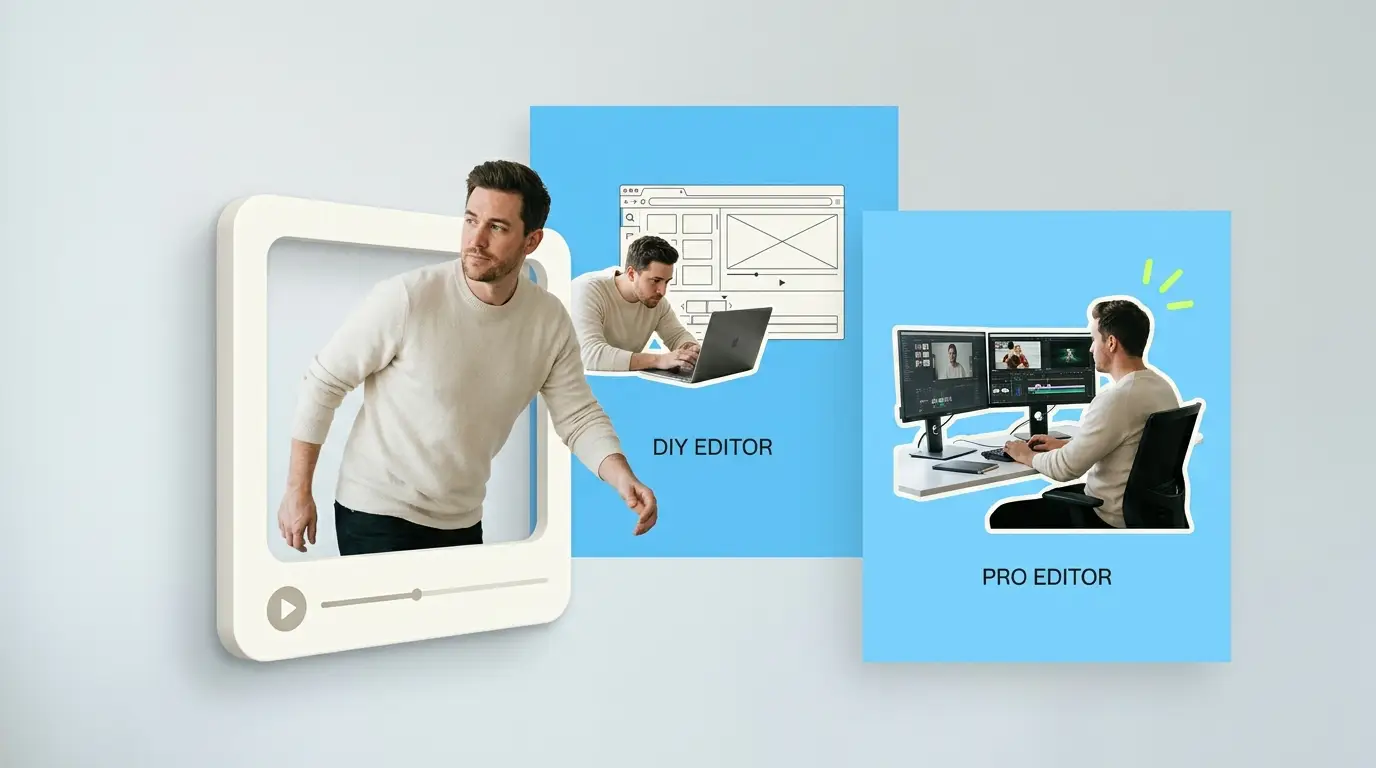
The choice of VEED vs hiring a video editor comes down to one honest question: how much of your own time is the edit actually worth? VEED is a browser-based, AI-assisted editor that lets you cut clips, add auto-subtitles, and drop in templates without installing anything. Hiring a video editor, whether a freelancer or a subscription service, hands that work to someone who does it all day. Both paths produce finished video. They just charge you in different currencies, one in dollars and one in hours.
This guide treats VEED fairly. It is a genuinely useful tool for the right job. The goal here is to help you figure out where that line sits for your business, so you stop forcing one approach onto every project.
What VEED actually is
VEED is an online video editor you run in a web browser. There is nothing to download, and projects live in the cloud, so you can start an edit on a laptop and finish it on another machine. It pitches itself at marketers, social media managers, and small teams who want to make decent video quickly without learning a heavy desktop program.
Its standout features are practical. Auto-subtitles transcribe your audio and generate captions you can style and correct. A template library gives you pre-built intros, lower thirds, and social formats. The timeline is simplified compared to professional software, so the learning curve is short. There are AI helpers for things like background removal, filler-word cleanup, and resizing for different platforms.
VEED runs on a freemium model. There is a free tier with limits, watermarks, and export caps, plus paid subscription tiers that remove those restrictions and add features. Exact prices change and vary by plan and billing cycle, so check their current pricing directly rather than trusting a number in a blog post. The point to hold onto is that the software cost is modest. The real cost of the DIY route is your time.
The hidden price tag: your time

When people compare VEED vs hiring a video editor, they usually look only at the subscription fee and conclude VEED is cheaper. That math ignores the most expensive input in the equation, which is the hours you or your team spend in the editor.
A simple talking-head clip with captions might take a confident user 30 to 45 minutes in VEED. That is fine once. But video rarely stays a one-off. The data backs that up: Wyzowl reports that 91% of businesses use video as a marketing tool, and that 82% of people say a video convinced them to buy a product or service. Demand for video keeps climbing, which means a "quick edit now and then" tends to become a steady weekly drip.
Run the numbers on a marketing manager earning a real salary. If that person spends six hours a week wrestling with edits, exports, and re-uploads, you are spending a meaningful chunk of a senior salary on production work they were not hired to do, and probably are not the fastest at. The subscription fee is the small part. The opportunity cost is the big part. According to HubSpot's marketing research, video consistently ranks as one of the highest-return content formats, which is exactly why it deserves attention rather than scraps of leftover time.
Where VEED genuinely shines
Being fair means being specific about what VEED does well. There are clear situations where reaching for a tool like VEED beats hiring anyone.
Quick, simple, internal edits are the sweet spot. Trimming a webinar recording, captioning a short clip for LinkedIn, or chopping a long demo into a 60-second teaser are all jobs VEED handles in minutes. If the output does not need to be perfectly polished or tightly on-brand, the speed is hard to beat.
Captions are another strong area. The auto-subtitle feature is fast and accurate enough that fixing the occasional error is quicker than typing the whole thing. For accessibility and silent-autoplay social feeds, that alone earns its keep.
Speed and control matter too. When you need something out today and there is no time to brief an external editor, doing it yourself in VEED keeps you unblocked. You also keep full control, with no back-and-forth and no waiting on a queue. For founders and small teams in the early scrappy phase, that immediacy is worth a lot.
Where a human editor wins

The case flips the moment quality, brand, or volume enters the picture. A dedicated editor brings judgment that no template menu can replicate.
Complex and branded work is the obvious example. Multi-camera footage, motion graphics, color grading, sound mixing, paced storytelling, and consistent brand styling are craft skills. A template can fake the look of polish, but it cannot make pacing decisions or know which three seconds of a 20-minute interview actually land. That is taste, and taste is the thing you are really hiring.
Scale is the second factor. One video a month is a DIY job. Twelve videos a month, cut into dozens of platform-specific clips, is a production pipeline. Trying to run that volume through your own hands in VEED quietly eats your week. This is the exact problem that pushes teams toward outsourcing, and we cover the mechanics of that shift in our guide on how to outsource video editing.
The third factor is the cost of bad video. A clumsy edit on a customer-facing campaign can undercut the credibility of an otherwise strong message. A professional editor protects the brand, while DIY edits carry a quiet risk that the work looks amateur to the exact audience you are trying to win.
What hiring a video editor actually costs
If you decide the work deserves a pro, there are three common routes, each with a different price shape.
Hiring in-house gives you a full-time editor on staff. ZipRecruiter puts the typical video editor salary in the range of $55,000 to $75,000 per year, before benefits, software, and equipment. That makes sense only when you have constant, full-time volume to justify it. We break down the trade-offs in dedicated video editor vs in-house hire.
Freelancers are the flexible middle. Expect roughly $75 to $250 per video for straightforward work, more for complex projects. The catch is consistency and availability. Good freelancers get busy, and managing several of them becomes its own job.
Agencies handle big, polished projects, often charging $500 to $5,000 or more per project. The quality is high, but so is the price, and the turnaround is rarely fast. Across the market, project-based work tends to land somewhere between $500 and $3,000 depending on scope.
Then there is the subscription model, which sits between freelance flexibility and agency quality. You pay a flat monthly fee for a dedicated editor and predictable output. For a side-by-side of the options, our roundup of the best video editing services compared lays them out.
The middle path most teams miss

The VEED-versus-hiring debate is often framed as DIY tool against expensive agency. That framing hides the option that fits most growing B2B teams: a done-for-you subscription.
A subscription service gives you a dedicated human editor without the overhead of a full-time hire and without the per-project unpredictability of freelancers or agencies. You send footage, you get back finished, on-brand video on a schedule. It removes the time cost of VEED while staying far cheaper and faster than an agency. If the model is new to you, our video editing subscription services guide explains how it works and who it suits.
The honest read is that many teams should use both. Keep VEED for the throwaway internal clip you need in ten minutes. Route the customer-facing, brand-critical, high-volume work to a dedicated editor. Using the right tool for each job beats forcing every project through one channel.
What Pixel8 Production offers
Pixel8 Production is a done-for-you B2B video editing subscription built for teams that have outgrown DIY but do not want the cost or commitment of an in-house hire.
You get a dedicated editor who learns your brand, so you are not re-explaining your style on every project. Turnaround is 48 hours on standard edits, which keeps your content calendar moving instead of stalling in a queue. Revisions are unlimited, so the work gets refined until it is right rather than until a clock runs out.
Pricing is flat and predictable at $2,000 to $3,200 per month. That is more than a VEED subscription, and that is the point. You are not paying for software, you are paying to get your own time back and to ship video that looks like a brand chose it on purpose. Compared with a $55,000 to $75,000 salaried hire, it is a fraction of the cost with none of the management burden. You can read more about the model in our overview of the done-for-you video editing service.
Bottom line
VEED vs hiring a video editor is not really a contest to crown one winner. VEED is an excellent tool for fast, simple, in-house edits and captions, and it earns its place in most marketing toolkits. The moment work becomes brand-critical, complex, or high-volume, the cost stops being the subscription fee and starts being your time and your reputation. That is when a dedicated editor pays for itself. For most growing B2B teams, the smart answer is to keep VEED for the quick stuff and hand the important work to a pro, ideally through a predictable subscription like Pixel8 Production that gives you professional output without the overhead of a full-time hire.
Where to go from here
Frequently asked questions
Is VEED good enough for professional marketing videos?
VEED is good enough for simple, fast, caption-driven content and internal clips. For complex, branded, customer-facing work, it has limits, because polish, pacing, and brand consistency come from an editor's judgment rather than templates. Many teams use VEED for quick jobs and a pro for the work that represents the brand.
How much does VEED cost?
VEED uses a freemium model, with a free tier that has watermarks and export limits plus several paid subscription tiers that add more features. Exact prices change over time and depend on the plan and billing cycle, so check VEED's current pricing directly. The bigger cost to weigh is the time you spend editing yourself.
Is it cheaper to use VEED or hire a video editor?
On software fees alone, VEED is cheaper. Once you count the hours you or a salaried team member spend editing, the math often flips, especially at higher volume. If a senior employee spends several hours a week on edits, the opportunity cost can exceed the price of a dedicated editor.
When should I hire a video editor instead of using VEED?
Hire an editor when video is customer-facing, needs to be tightly on-brand, involves complex elements like motion graphics or multi-camera footage, or when volume is high enough that DIY eats your week. Those are the moments where taste, speed, and consistency justify paying a professional.
What are my options for hiring a video editor?
You can hire in-house at roughly $55,000 to $75,000 per year, use freelancers at about $75 to $250 per video, work with agencies at $500 to $5,000 or more per project, or use a subscription service for a flat monthly fee. Subscriptions sit between freelance flexibility and agency quality.
Can I use VEED and a hired editor at the same time?
Yes, and most efficient teams do. Use VEED for quick internal clips and captions you need immediately, and route brand-critical, high-volume work to a dedicated editor. Matching the tool to the job beats forcing everything through one channel.
How fast can a video editing subscription deliver?
It varies by provider, but a good subscription service delivers far faster than an agency. Pixel8 Production, for example, turns around standard edits in 48 hours with unlimited revisions, which keeps a content calendar moving without the delays of a project-based agency.

Prakhar Mehta
Pixel8 is a done-for-you video editing subscription, giving SaaS companies, agencies, and founders a dedicated editing team with 48-hour turnaround.
Ready to stop doing this yourself?
Get a dedicated video editing team. 48-hour turnaround, unlimited revisions, month-to-month.