Upwork vs Video Editing Subscription: Compared
Upwork vs video editing subscription compared for B2B teams: control and niche skills versus zero hiring overhead, consistency, and predictable monthly cost.
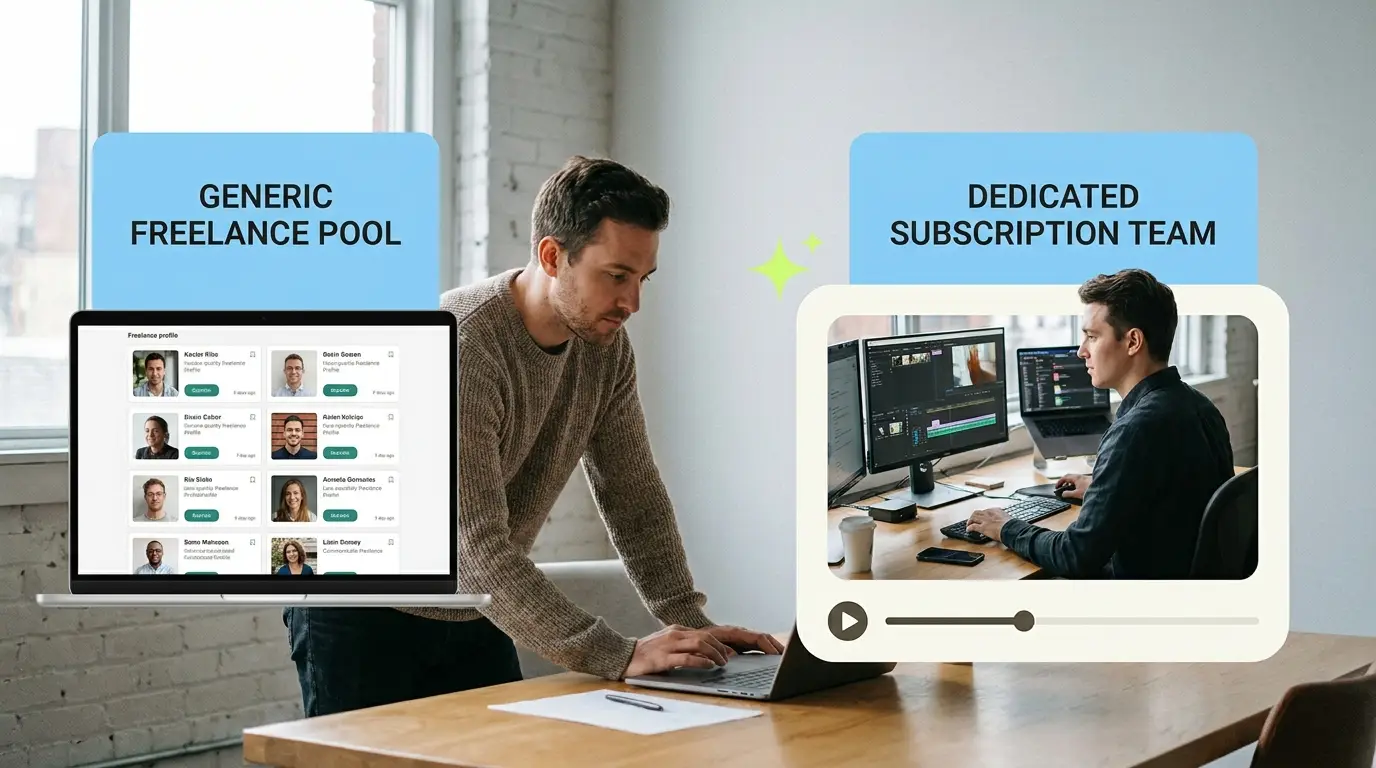
If you are weighing Upwork vs video editing subscription options for your B2B brand, you are really choosing between two different ways of working. Upwork is a freelance marketplace where you post a job, vet applicants, and hire an editor on an hourly or fixed contract. A done-for-you subscription is a fixed monthly service where a provider supplies the editor, the process, and the management for you. Both can produce great video. The right pick depends on how much control you want versus how much overhead you are willing to carry.
Video is no longer optional for serious marketing teams. Wyzowl reports that 91% of businesses use video as a marketing tool, and 82% of people say a video convinced them to buy a product or service. When demand for video is that high, how you source your editing capacity becomes a real operational decision, not a side task.
This guide breaks down both models fairly, so you can decide which fits your team, your budget, and your output goals.
How hiring video editors on Upwork actually works
Upwork is a global freelance platform. You create an account, post a job description, and freelancers submit proposals. You review portfolios, message candidates, agree on a rate, and then manage the contract yourself. Payment runs through Upwork, which adds a service fee on top of the freelancer's rate.
The key thing to understand is that Upwork is a marketplace, not a service. It connects you to independent editors, but it does not vet skills for you, manage timelines, or guarantee quality. That work falls to you. Rates vary widely by freelancer, location, and experience, so there is no single price. You set a budget and the market responds.
For context on the wider freelance market, individual video editors typically charge somewhere in the range of $75 to $250 per finished video, though specialists and high-end editors can charge far more. Some Upwork editors price hourly instead, and hourly rates swing dramatically depending on skill.
What Upwork is good at
Upwork shines when you need control and specific skills. You can search for an editor who has done exactly the kind of work you need, such as motion graphics, documentary-style cuts, or short-form social edits. You see their portfolio before you commit. You can hire one person for one project and walk away when it is done.
That makes Upwork a strong fit for:
- One-off projects with a clear start and end
- Niche skills you only need occasionally
- Teams that already have someone to manage editors
- Experiments where you want to test a creative direction before committing
If you want to understand the broader tradeoffs here, our breakdown of a video editing subscription vs freelancer model goes deeper on when each one pays off.
Where Upwork gets harder

The friction with Upwork is rarely the editing itself. It is everything around it. You write the job post. You sort through proposals, some of which are low quality. You run interviews or test projects. You negotiate rate and scope. Then you manage revisions, deadlines, and communication, often across time zones.
When the editor is great, this is worth it. When they are not, you start over. Freelancers also take other clients, go on vacation, and sometimes disappear mid-project. Consistency depends entirely on the individual you found, and finding the right individual takes time you may not have. If you want a structured approach to vetting and managing this kind of work, our guide on how to outsource video editing lays out a repeatable process.
How a done-for-you video editing subscription works
A subscription flips the model. Instead of hiring a person, you subscribe to a service. The provider assigns you a dedicated editor, runs the workflow, and handles the management. You send footage and a brief, and edited video comes back inside an agreed turnaround. You pay a flat monthly fee regardless of how many small revisions or requests come up.
The mental shift is important. With Upwork you are an employer for a short stretch. With a subscription you are a client. The vetting, onboarding, and project management that you would normally own are bundled into the price. You can read more about how this works end to end in our overview of a done-for-you video editing service.
What a subscription is good at

A subscription is built for teams that need video regularly and do not want to manage the people producing it. The strengths are consistency, predictability, and removed overhead.
- No hiring, vetting, or interviewing on your side
- One dedicated editor who learns your brand over time
- Predictable monthly cost with no surprise invoices
- A defined process for briefs, turnaround, and revisions
- Continuity even when one person is out, because the provider manages coverage
For a marketing team pushing out weekly social cuts, sales videos, webinar edits, and ad variations, this removes a large amount of recurring coordination work. The output stays steady because the process, not a single freelancer's availability, drives it.
Where a subscription is a weaker fit

A subscription is not built for one-off needs. If you need a single high-end brand film once a year, paying a monthly fee makes little sense. A project-based hire or agency is a better match for that.
You also trade some direct control. You do not pick the individual editor the way you would on Upwork, and very niche or experimental creative work may sit outside a provider's standard wheelhouse. For most ongoing B2B content, that tradeoff is fine. For a specialized one-time creative project, it may not be.
Upwork vs video editing subscription: a direct comparison
Here is how the two models line up on the factors that matter most to a B2B team.
Cost structure. Upwork costs vary by freelancer and project, with the broader market running roughly $500 to $3,000 depending on scope and editor. A Pixel8 subscription is a flat $2,000 to $3,200 per month for ongoing output. Upwork can be cheaper for a single small job. A subscription is more predictable for steady volume.
Hiring and vetting. Upwork puts vetting on you. You read portfolios, run tests, and make the call. A subscription removes that step entirely. The provider has already vetted the editor.
Management overhead. Upwork requires you to manage scope, deadlines, revisions, and communication. A subscription absorbs most of that into its process. This is often the deciding factor for busy teams.
Consistency. Upwork consistency depends on the individual freelancer and their availability. A subscription is designed for consistency, with coverage when your editor is unavailable.
Control and niche skills. Upwork wins here. You can hire a very specific specialist for a very specific job. A subscription gives you a capable generalist editor for ongoing work, not a hand-picked niche expert.
Turnaround. On Upwork, turnaround is negotiated per job and varies. A subscription like Pixel8 commits to a 48-hour turnaround as part of the service.
If you want a wider field of options beyond these two, we compare more providers in our roundup of the best video editing services compared.
What about hiring in-house instead?
Some teams skip both options and hire a full-time editor. That can make sense at high volume, but the cost is real. According to ZipRecruiter salary data, an in-house video editor typically earns $55,000 to $75,000 per year, before benefits, software, equipment, and management time.
An in-house hire gives you the most control and the deepest brand knowledge, but it is also the largest fixed commitment. For most teams producing a steady but not enormous volume of video, a subscription lands in a useful middle ground: more consistent than freelance, far cheaper and lower commitment than a full-time hire. We compare these tradeoffs directly in our guide on a dedicated video editor vs in-house hire.
The demand pressure is real here too. HubSpot's video marketing research shows how central video has become across the funnel, which means the question for most teams is not whether to invest in editing capacity, but how to source it efficiently.
What Pixel8 Production offers
Pixel8 Production is a done-for-you B2B video editing subscription built for teams that need consistent output without the management load.
Here is what comes with it:
- A dedicated editor. You work with the same editor who learns your brand, your style, and your preferences over time, rather than briefing a new person on every project.
- 48-hour turnaround. Edited video comes back within 48 hours, so your content calendar keeps moving.
- Unlimited revisions. You refine until the cut is right, with no per-change fees and no awkward scope negotiations.
- Flat monthly pricing. Pixel8 is $2,000 to $3,200 per month, a predictable cost with no surprise invoices and no platform fees layered on top.
- No hiring or vetting. We handle the editor, the process, and the coverage. You send footage and a brief, and finished video comes back.
The model is designed for the team that has decided video is a recurring need and wants to stop spending time managing the people who make it. Instead of running an Upwork search every time a project comes up, you have a standing capacity that scales with your content plan.
Which one should you choose?
Choose Upwork when you need control, a niche skill, or a one-off project, and you have someone on your side who can vet and manage a freelancer. It is flexible, project-based, and can be cost-effective for occasional work.
Choose a subscription when video is a steady, ongoing need and you want consistency, predictable cost, and zero hiring or management overhead. It is built for teams that would rather direct creative work than coordinate it.
Many teams actually use both over time. They might keep a Pixel8 subscription for their weekly and recurring content, then hire a specialist on Upwork for a one-time creative project that sits outside the usual flow. The two models are not mutually exclusive. They solve different problems.
Bottom line
The Upwork vs video editing subscription choice comes down to control versus overhead. Upwork gives you the freedom to hand-pick editors and pay per project, which is ideal for niche or one-off work, as long as you are ready to vet and manage the people you hire. A subscription removes that overhead entirely, delivering consistent output, predictable cost, and a dedicated editor who learns your brand.
If video is an occasional need, Upwork is a smart, flexible option. If video is a recurring part of how your B2B team markets and sells, a done-for-you subscription like Pixel8, at $2,000 to $3,200 per month with a dedicated editor, 48-hour turnaround, and unlimited revisions, is built to keep that engine running without adding a management job to your plate.
Where to go from here
Frequently asked questions
Is Upwork cheaper than a video editing subscription?
It depends on volume. For a single small project, hiring on Upwork can cost less than a monthly subscription. Freelance video editing rates often fall in the $75 to $250 per video range, though they vary widely. For steady, ongoing output, a flat subscription is usually more predictable and can work out cheaper per video once you account for your own management time.
Does Upwork guarantee video editing quality?
No. Upwork is a marketplace that connects you with freelancers. It does not vet skills, manage your project, or guarantee the quality of the work. You review portfolios and make the hiring call yourself, which gives you control but also puts the risk on you.
What is included in a Pixel8 video editing subscription?
Pixel8 includes a dedicated editor, a 48-hour turnaround, and unlimited revisions, all for a flat $2,000 to $3,200 per month. The provider handles vetting, process, and coverage, so you do not manage the editor directly.
How long does it take to find a good editor on Upwork?
It varies. Writing the job post, reviewing proposals, running tests, and onboarding the right freelancer can take anywhere from a few days to a few weeks. The time you spend depends on how specific your needs are and how many candidates you screen.
Can a subscription handle niche or specialized video work?
A subscription is best for ongoing, brand-consistent content rather than highly specialized one-off creative work. For a single niche project, such as a high-end brand film, a hand-picked specialist on Upwork or a project-based agency may be a better fit.
How does a subscription compare to hiring in-house?
An in-house editor typically costs $55,000 to $75,000 per year before benefits and overhead, and is the largest fixed commitment. A subscription at $2,000 to $3,200 per month offers consistency at a lower commitment, which suits teams with steady but not enormous video volume.
Can I use both Upwork and a subscription?
Yes. Many teams keep a subscription for recurring content and hire freelancers on Upwork for occasional specialized projects. The two models solve different problems, so combining them can cover both steady output and one-off niche needs.

Prakhar Mehta
Pixel8 is a done-for-you video editing subscription, giving SaaS companies, agencies, and founders a dedicated editing team with 48-hour turnaround.
Ready to stop doing this yourself?
Get a dedicated video editing team. 48-hour turnaround, unlimited revisions, month-to-month.