Series A Startup Video Editing: Top 5 Agencies (2026)
The 5 best video editing agencies for Series A startups, ranked by fit for a repeatable content engine, with real pricing and the agency vs subscription call.
Series A startup video editing is a different problem than the one you solved at seed. By Series A you have product-market fit, paying customers, and a board expecting predictable go-to-market. The scrappy one-off video that proved a channel is no longer enough; you need a repeatable engine turning out polished demos, sales-enablement clips, and steady social content week after week. This guide ranks five agencies by how well they fit that engine, with honest pricing and the agency-versus-subscription call at the centre.
The Series A shortlist looks different from the seed one. Budget exists now, so the free tools and cheapest freelancers drop off. But the discipline is not to overspend on prestige either: the right partner scales output reliably, not the one with the most cinematic reel. This list is ordered by fit for a content engine, not by fame.
A note on method: every company below was verified against its own live website, and the descriptions reflect each one's public positioning. Pixel8 Production is our own service, and we have said so plainly rather than quietly placing ourselves first.
The 5 best video editing agencies for Series A startups
1. Pixel8 Production
Best for: the weekly content engine. Editing-led.
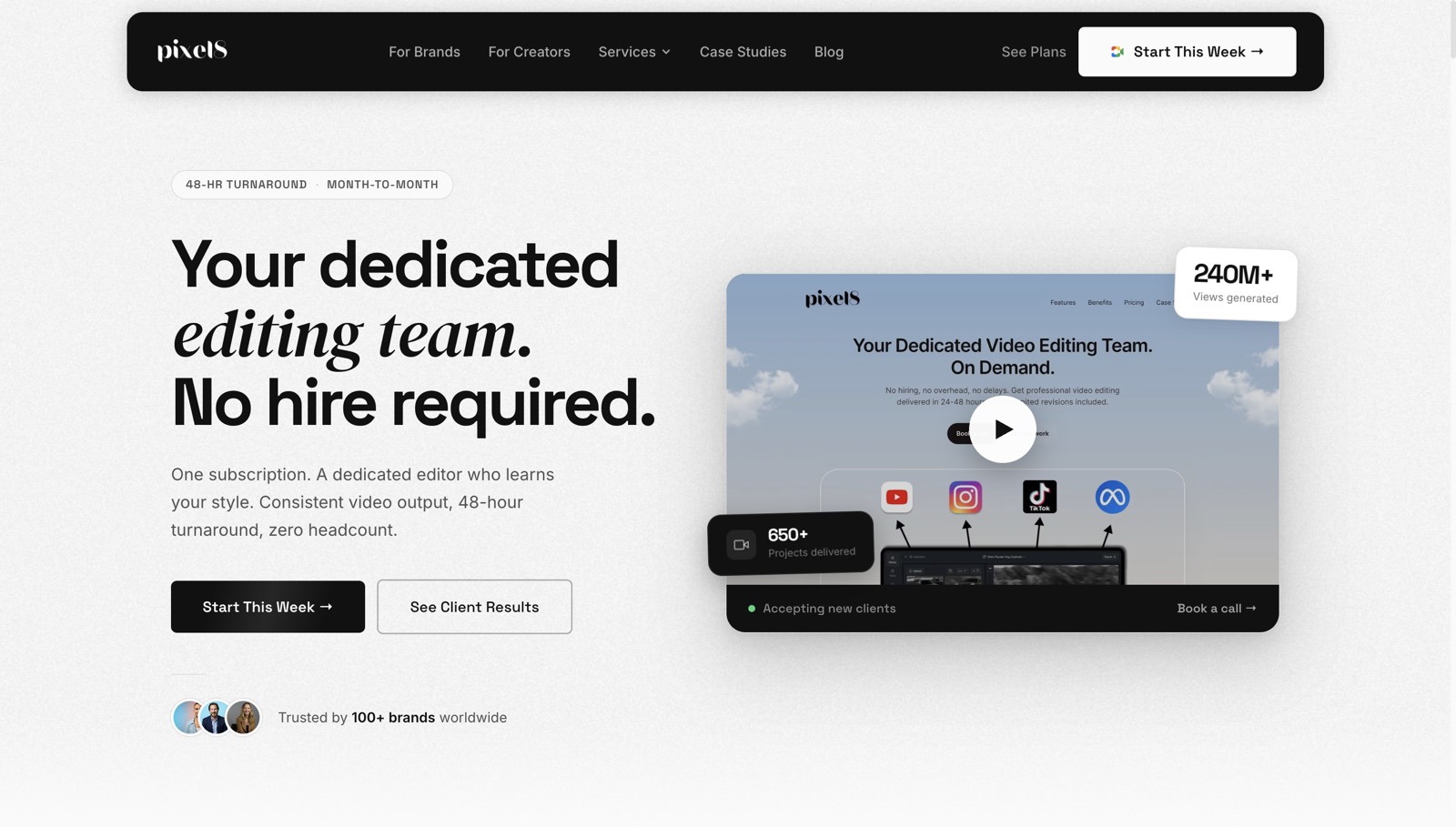
A remote video editing subscription built for teams shipping demos, sales clips, social content, and edited webinars continuously. A dedicated editor learns your product, standard edits turn around in 48 hours, and pricing is a flat $2,000 to $3,200 per month. The fit is the repeatable output a Series A go-to-market motion runs on, where footage already exists and the bottleneck is finishing it. Not the tool for a one-off animated brand film.
Source: pixel8production.com
2. Lemonlight

Best for: full-service production at scale from one partner. Production-led. Positions itself around world-class video production made simple, enabling brands to create any video they need through a single trusted partner, with a fast and transparent process and a client roster spanning Amazon, Google, and Tesla. The fit for a Series A company that wants a flagship campaign and a steady stream of produced assets from the same shop. Source: lemonlight.com
3. Levitate Media

Best for: video measured against a marketing number. Production-led. Describes its work as video production built for business results, promising to boost visibility, engage audiences, and deliver measurable ROI through full-service production, and reports being trusted by more than 3,000 companies including NVIDIA, Autodesk, and Verizon. The fit when a Series A marketing team has to justify video spend against pipeline rather than impressions. Source: levitatemedia.com
4. Thinkmojo

Best for: product and SaaS storytelling with high craft. Production-led. A video and motion studio positioning itself for the world's top companies, working across product video, motion, and brand storytelling. The fit for a Series A software company whose next milestone needs a genuinely well-crafted product story rather than volume, particularly where motion and animation carry the explanation. Source: thinkmojo.com
5. Epipheo

Best for: making a complex product finally make sense. Production-led. Describes itself as the studio that pioneered explainer video, citing 15-plus years, more than 6,000 videos, and over 3,000 brands. The fit is the specific job of turning an abstract or technical product into a clear narrative, which is a common Series A need as the buyer base widens beyond early adopters who already understood the pitch. Source: epipheo.com
Agency vs subscription vs in-house at Series A
Three models are genuinely on the table now that budget exists, and they solve different problems.
A production agency is the right tool for the flagship: a launch film, a brand piece, an animated explainer that has to be excellent. It is project-priced, slower, and expensive per deliverable, which is fine for two or three hero pieces a year and wrong for weekly volume.
A subscription is the right tool for the engine: the demos, sales clips, and social content that ship every week. A dedicated editor, a flat rate, and a fast turnaround match the cadence a Series A go-to-market motion actually runs at.
In-house becomes defensible at Series A for the first time, but carefully. A video editor costs $55,000 to $75,000 per year before benefits per ZipRecruiter, plus equipment, and gives you one person's capacity and one skill set. That works if your volume genuinely fills a full-time role and never spikes beyond it, which is rarer than it looks. Many Series A teams run a hybrid: one in-house generalist plus a subscription for overflow and specialist edits.
The common mistake is forcing one model to do all three jobs. A production agency retained for weekly clips burns budget; a subscription asked to build an animated brand film is the wrong shape. Our comparison of video editing agency vs subscription covers the split in detail.
Building the content engine
The Series A shift is from commissioning videos to running a system. That means a predictable input of footage, a reliable partner to finish it, and a distribution habit, rather than a series of one-off briefs.
The input is usually already there: recorded demos, customer calls, webinars, founder and exec content, event footage. The engine's job is to convert that raw material into finished assets on a schedule the go-to-market team can plan around, which is an operational discipline as much as a creative one. The teams that get this right treat their editing partner like any other part of the go-to-market stack, with a predictable input, a defined turnaround, and a distribution owner on the other end. HubSpot research shows that 21% of marketers say short-form video delivers the highest ROI of any format, and a content engine is what makes that short-form output sustainable rather than sporadic. Our guide to best video types for SaaS demand generation maps which formats to prioritise as the engine matures.
What to look for in a Series A video partner
The evaluation criteria change at Series A. At seed you optimised for cheap and fast; now you optimise for a partner who can keep pace with a scaling go-to-market motion without becoming the bottleneck. Five things matter most.
First, turnaround you can build a calendar around, ideally 48 hours on a standard edit, because launches, campaigns, and sales cycles now depend on video arriving on time. Second, consistency from a dedicated editor rather than a rotating pool, since brand coherence matters more once you have a real market presence to protect. Third, product fluency: an editor who understands what your software does will cut demos that land on the moment the value becomes obvious, which a generalist routinely misses. Fourth, capacity that flexes, because a Series A company's video volume spikes around launches and events and should not require renegotiating a contract each time. Fifth, a clean handoff from your existing footage, so the partner slots into how your team already records rather than demanding a new process.
Notice that none of these is about the flashiest reel. A Series A content engine rewards reliability over showmanship, and the partners that scale with you are the ones that treat video as an operational system rather than a series of creative events. Our guide to video editing for startup founders covers the founder-content side of that system, which usually becomes a bigger share of output as the company grows.
How much does Series A video editing cost?
Production agencies charge four to low-five figures per finished video, more for animation, which is reasonable for a few hero pieces a year. A dedicated-editor subscription runs $2,000 to $3,200 per month for the ongoing engine. An in-house editor runs $55,000 to $75,000 a year before benefits and equipment. Most Series A teams end up spending on two of these at once: a subscription for volume, and occasional production for flagships.
Choosing from the list
There is no single best video editing agency for a Series A startup, only the right tool for each job. If the need is the weekly engine that go-to-market runs on, a dedicated-editor subscription is the backbone. If it is a flagship launch or a brand film, the production studios here are built for exactly that. Most Series A teams use both, deliberately. Pixel8 Production covers the ongoing editing engine for $2,000 to $3,200 per month with a dedicated editor and a 48-hour turnaround. Get in touch to see if it fits your motion.
Where to go from here
Frequently asked questions
What is the best video editing agency for a Series A startup?
It depends on the job. For the weekly content engine, a dedicated-editor subscription such as Pixel8 Production fits best. For full-service production at scale, Lemonlight. For video measured against marketing results, Levitate Media. For high-craft product storytelling, Thinkmojo. For making a complex product clear, Epipheo.
Should a Series A startup use an agency or a subscription?
Both, for different work. A subscription handles the high-volume weekly output such as demos, sales clips, and social. A production agency handles the two or three flagship pieces a year that need a shoot or animation. Forcing either model to do the other's job is the most common way Series A video budgets get wasted.
Should a Series A startup hire an in-house video editor?
It becomes defensible at Series A if volume genuinely fills a full-time role, but one person is one skill set and no cover during spikes. Many teams run a hybrid: an in-house generalist plus a subscription for overflow and specialist edits, which is more resilient than betting everything on a single hire.
How much should a Series A startup spend on video?
Enough to run the engine plus the occasional flagship. That usually means $2,000 to $3,200 a month for a subscription handling weekly volume, plus project budget once or twice a year for a produced hero piece. In-house at $55,000 to $75,000 a year is worth it only when volume reliably fills the role. A $900 trial is available to test the service before committing to a monthly plan.
What video does a Series A startup need most?
Product demos and feature walkthroughs, sales-enablement clips, short-form social, edited webinars, and customer proof, with the occasional flagship brand or launch film. The bulk is ongoing editing of footage you already have, which is why a subscription tends to be the backbone and production the exception.
How is Series A video different from seed-stage video?
At seed you are proving a channel with cheap, disposable video while the story still moves. At Series A the positioning is settled and the job is a repeatable system that ships polished output on a schedule. The budget and the standard both rise, and consistency starts to matter more than any single piece.
Can a subscription handle a Series A company's full video needs?
For the weekly engine, yes, and that is the majority of the volume. For a flagship film requiring a crew or bespoke animation, a subscription is the wrong tool and a production agency fits. Most Series A teams pair a subscription for everyday output with occasional production for the hero pieces.

Prakhar Mehta
Pixel8 is a done-for-you video editing subscription, giving SaaS companies, agencies, and founders a dedicated editing team with 48-hour turnaround.
Ready to stop doing this yourself?
Get a dedicated video editing team. 48-hour turnaround, unlimited revisions, month-to-month.