Video Editing for YC Startups: Top 6 Agencies (2026)
The 6 best video editing agencies for YC startups, ranked by stage and budget, from free self-serve tools to premium launch studios, with real costs for each.
Video editing for YC startups runs on a different clock and a different budget than video for established companies. A batch company ships a launch video, a Demo Day clip, investor updates, and founder content inside a few months, usually while the product and the positioning are still moving. This guide ranks six options by the stage they suit, from self-serve at almost no cost through to premium production, with honest pricing for each.
The ordering is deliberately by stage and budget rather than by prestige. The best-known startup video studios on this list produce genuinely excellent work and are the wrong call at pre-seed, because a five-figure launch film built around messaging that changes next month is the most expensive mistake an early team can make.
A note on method: every company below was verified against its own live website, and the descriptions reflect each one's public positioning. Pixel8 Production is our own service, and we have said so plainly rather than quietly placing ourselves first.
The 6 best video editing options for YC startups
1. Pixel8 Production
Best for: founders already recording who need it finished weekly. Stage: seed to Series B.
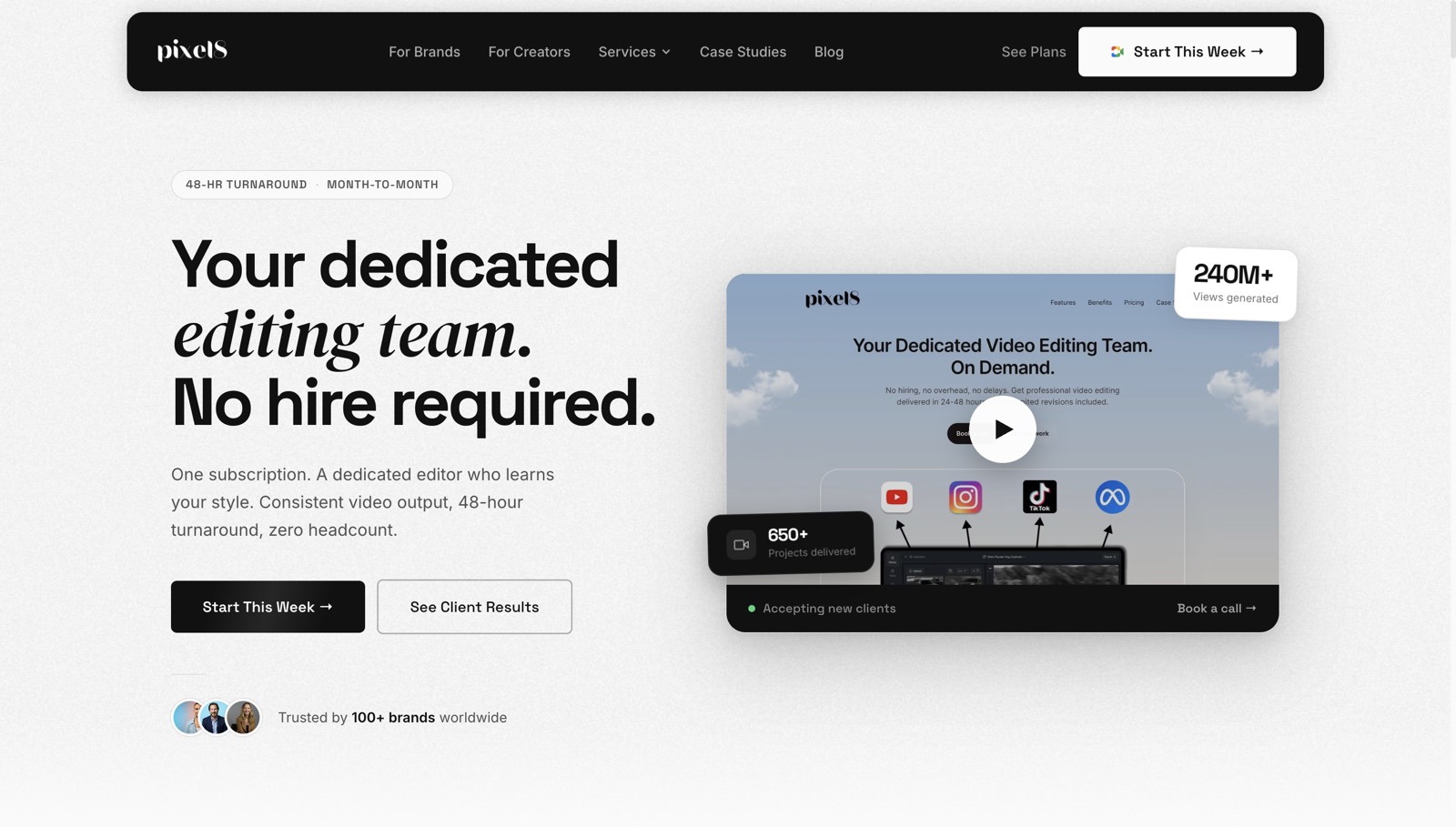
A remote video editing subscription built for teams shipping demos, founder clips, and edited investor updates continuously. You get a dedicated editor who learns your product, a 48-hour turnaround, and a flat $2,000 to $3,200 per month. The fit is a team with footage already piling up. Not the right call if you need one animated launch film built from scratch, which is production work.
Source: pixel8production.com
2. Knowlify

Best for: pre-seed teams with no video budget. Stage: pre-seed to seed. A YC-backed company (S25) that turns docs and ideas into narrated, animated videos, with a self-serve tier you can use yourself in minutes and a studio team that will make them for you instead. That dual model is unusually well matched to accelerator economics: do it yourself while runway is tight, hand it over once it is not. Source: knowlify.com
3. Gisteo

Best for: a first explainer without a boutique price tag. Stage: pre-seed to seed. An explainer video company and AI video production agency, positioned around turning confusion into clarity, and stating it works with Fortune 500 companies and small businesses alike. The draw for early teams is a real animated explainer at a price that does not consume a meaningful slice of a seed round. Source: gisteo.com
4. Sandwich

Best for: the launch film you build a campaign around. Stage: Series A and beyond. The studio most associated with the genre of startup launch video that other startups imitate. If the goal is a single piece with real weight behind a funding announcement or a major launch, this is the tier that delivers it. Priced accordingly, and worth it only once the messaging is settled enough to commit to. Source: sandwich.co
5. Superside

Best for: post-traction teams needing design and video together. Stage: Series A and beyond. Positions itself as your creative team's creative team, scaling an in-house creative function with global talent and AI workflows, with Reddit, Microsoft, Grubhub, and Bolt among the brands shown on its homepage. A subscription rather than project quoting, but pitched above the price point most seed companies can carry. Source: superside.com
6. Vidico

Best for: a growing tech brand ready for full-funnel video. Stage: Series A and beyond. A creative production team for growing tech brands covering explainers, motion graphics, and ad creative, citing more than 920 brands and a 4.9 rating across 100-plus reviews, with Spotify, Square, and Zendesk among its clients. The most established option here, and priced for companies past the runway-anxiety stage. Source: vidico.com
Match the option to your stage
The most useful filter is where you are, not which reel you like best.
Pre-seed and pre-launch. Messaging is still moving weekly. Anything with a four-week production cycle will ship describing a product you no longer sell. Use self-serve tools or a budget explainer partner, spend almost nothing, and accept that this video is disposable.
During the batch and Demo Day. Volume matters more than polish. You need a Demo Day clip, a launch video, investor updates, and founder content, on a schedule set by the calendar rather than by you. This is where a subscription earns its keep, because the work is continuous and unpredictable in shape.
Post-raise, Series A onward. The positioning is settled, budget exists, and one exceptional piece can carry a campaign. This is the point at which a premium production studio stops being an indulgence.
Most teams eventually need two partners: a production shop for the occasional flagship film, and an editing partner for everything else. Our guide to Series A startup video editing covers that decision at the next stage.
What YC startups actually need edited
The list is consistent across batches. The launch video, usually 60 to 90 seconds. Demo Day clips cut to a strict time limit. Investor updates, increasingly video rather than a long email. Founder-led content for social, which is the highest-volume item by a wide margin. Product demos that change every time the product does. Customer call recordings turned into proof.
Almost all of it is editing rather than production. Founders already record constantly on a laptop camera and a screen recorder. The gap is rarely footage; it is someone turning that footage around before it stops being relevant. Our guide to video editing for startup founders goes deeper on that workflow.
The mistake most batch companies make
The pattern repeats every batch. A company raises, feels the pressure to look established, and commissions a polished launch film early. Six weeks later the film arrives, beautifully made, describing a positioning the team abandoned during the batch. The money is gone and the asset is unusable, which is worse than having no video at all, because a stale launch film sitting on a homepage actively misrepresents what you now sell.
The underlying error is treating video as a one-time artefact rather than a running function. Early-stage companies change their story faster than any production cycle can accommodate. That argues for keeping every video cheap and replaceable until the story stops moving, then investing once it does.
There is a second, quieter mistake: founders who record constantly and ship almost none of it. A folder of unedited screen recordings, customer calls, and half-finished talking-head clips is the most common state we see at seed stage. The footage is already valuable, and the only thing standing between it and published content is editing capacity nobody has. That is a much cheaper problem to solve than it looks, and solving it usually produces more pipeline than a single expensive film would have.
A third consideration specific to accelerators is peer comparison. Being in a batch means your launch content is seen next to fifty other companies launching the same week, which tempts teams into competing on production value. Investors and early customers are reading for clarity about what the product does, not for cinematography, and a clear 60-second screen recording routinely outperforms an expensive animation that explains less.
What it costs at each stage
Self-serve tools start free and stay near zero, with the trade-off that you are the editor. Budget explainer partners land in the low four figures for a single animated video. Premium launch studios run well into five figures and occasionally beyond, which is entirely reasonable for a company with a settled story and a real campaign behind it.
Hiring is the option founders underestimate. A video editor costs $55,000 to $75,000 per year before benefits per ZipRecruiter, plus equipment and software. For a company counting months of runway, that is a large permanent commitment for one person's capacity, and rarely the right early hire.
A subscription sits in between: $2,000 to $3,200 per month for ongoing editing with a dedicated editor and a defined turnaround. HubSpot research shows that 21% of marketers say short-form video delivers the highest ROI of any format, which is exactly the output pattern this model suits.
Choosing from the list
There is no single best video editing agency for YC startups, only the one that matches your stage and your runway. If you are pre-seed and the story is still moving, spend almost nothing and keep the video disposable. If you are shipping constantly through a batch, a subscription gives you volume without a hire. And once the positioning is settled and there is budget, the premium studios here will make something worth building a campaign around. Pixel8 Production covers the ongoing editing at $2,000 to $3,200 per month with a dedicated editor and a 48-hour turnaround. Get in touch to see if it fits your stage.
Where to go from here
Frequently asked questions
What is the best video editing agency for YC startups?
It depends on stage. Pre-seed teams with no budget are best served by a self-serve option such as Knowlify or a budget explainer partner like Gisteo. Teams shipping continuously through the batch fit a subscription such as Pixel8 Production. Post-raise companies with settled messaging can justify Sandwich, Superside, or Vidico.
How much should a YC startup spend on video?
At pre-seed, close to nothing, because the messaging will change. During the batch, a flat monthly rate in the $2,000 to $3,200 range buys continuous output without a hire. After a raise, a single flagship film in the five-figure range becomes defensible. The common mistake is spending Series A money at pre-seed on a video that is obsolete within a quarter. A $900 trial is available to test the service before committing to a monthly plan.
Should a startup hire an in-house video editor?
Rarely before Series B. An in-house editor costs $55,000 to $75,000 a year before benefits and equipment, gives you one person's capacity, and leaves you uncovered when they take leave during a launch. Most startups get better coverage from a subscription partner until volume genuinely justifies a full-time role.
What video does a startup need for Demo Day?
A tightly cut clip that respects the time limit, plus a launch video for the site and a set of short clips for founder posts afterwards. Demo Day rewards clarity over production value, so editing that removes everything non-essential matters more than animation or a shoot.
Can a video editing agency work with pre-product startups?
Yes, and editing partners handle this better than production agencies do, because there is no long build to invalidate. When the product is still forming, the useful output is founder talking-head content, early demos, and customer conversations, all of which are editing jobs on footage you already have.
How fast should video turnaround be for a startup?
48 hours on a standard edit is a reasonable benchmark, and it matters more for startups than for enterprises. Accelerator timelines, launch windows, and news cycles do not wait, and a partner taking two weeks per revision turns video into a bottleneck exactly when speed is the advantage you have.
Is a subscription better than hiring an agency per project?
For continuous output, usually yes, on cost predictability and turnaround. For one flagship film with a settled story, a production agency is the better tool. Most startups use a subscription for weekly volume and buy production once or twice a year. Our comparison of video editing agency vs subscription covers the trade-off in full.

Prakhar Mehta
Pixel8 is a done-for-you video editing subscription, giving SaaS companies, agencies, and founders a dedicated editing team with 48-hour turnaround.
Ready to stop doing this yourself?
Get a dedicated video editing team. 48-hour turnaround, unlimited revisions, month-to-month.