Opus Clip vs Video Editing Service: Which?
Opus Clip vs video editing service: an honest look at where AI auto-clipping wins on speed and cost, and where a human editing team wins on quality and polish.
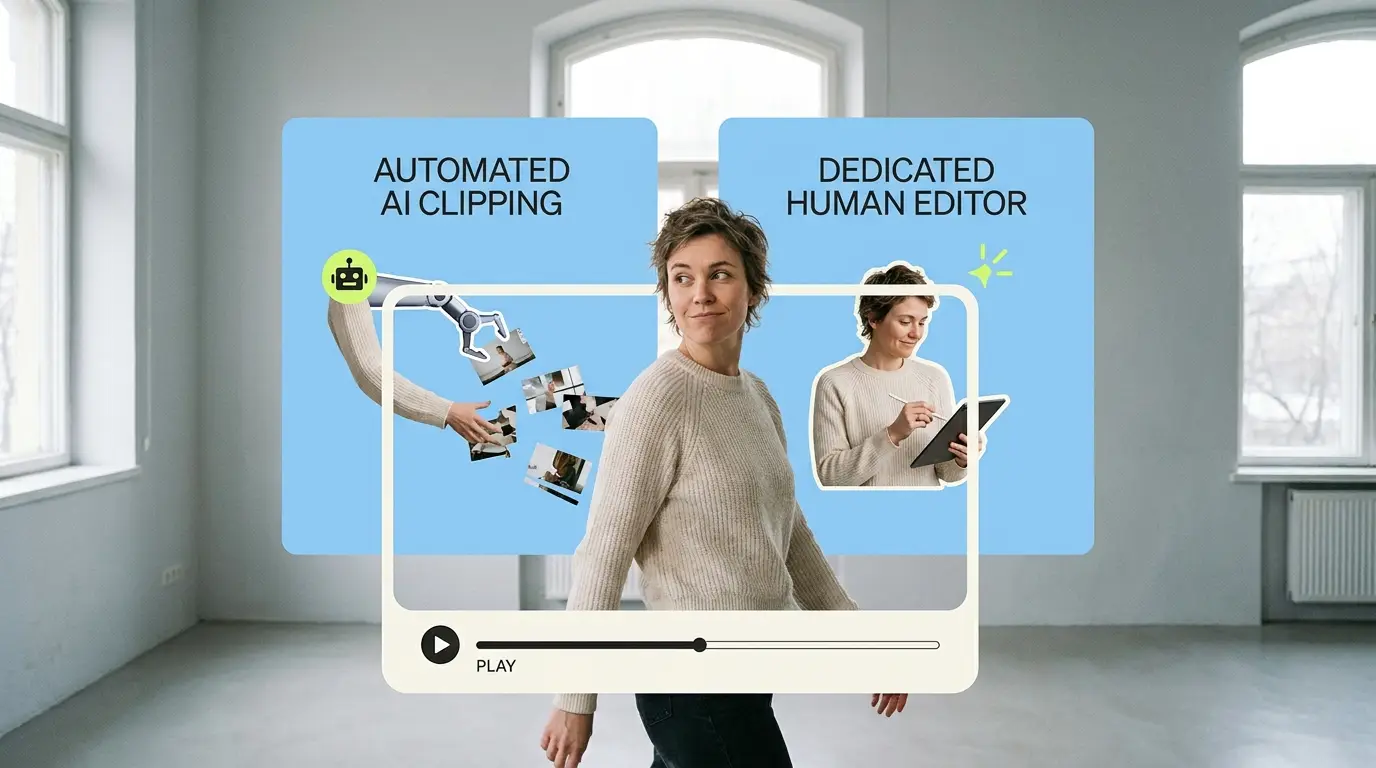
Choosing between Opus Clip vs video editing service is one of the most common decisions facing anyone who produces long-form video and wants more reach from it. Opus Clip is an AI tool that scans a long video, finds the moments it predicts will perform, and cuts them into vertical shorts with auto-reframe and captions. A done-for-you video editing service gives you a human editor who makes those calls by judgment and handles work an AI cannot. This guide compares the two fairly, shows where each one wins, and helps you pick the right fit for how you actually publish.
Both options exist because video demand keeps climbing. According to Wyzowl, 91% of businesses use video as a marketing tool, and 82% say a video convinced them to buy a product or service. That kind of demand means you need a reliable way to keep producing, whether the engine is software or a person.
What Opus Clip actually does
Opus Clip belongs to a category of AI clipping tools that automate the most tedious part of short-form production: finding the good moments inside a long recording. You feed it a podcast, webinar, interview, or talking-head video, and it returns a batch of vertical clips ready for TikTok, Reels, and Shorts.
The core features are consistent across this category:
- Auto-clipping. The AI analyzes speech and pacing to detect segments it predicts will hold attention, then trims them into standalone clips.
- Auto-reframe. It tracks the speaker and reframes a horizontal 16:9 video into a vertical 9:16 format, keeping the face centered.
- Auto-captions. It generates animated, word-by-word captions, which matters because most social video is watched on mute.
- A predicted virality score. Each clip gets a number meant to estimate how well it might perform, so you can prioritize what to post.
Opus Clip runs on a freemium model with paid tiers, so you can test it before committing to a subscription. For a creator sitting on hours of footage and no editor, that is a genuinely useful starting point.
Where Opus Clip wins

Be honest about the strengths, because they are real.
Speed. A long video becomes a dozen draft clips in minutes. No human editor matches that turnaround on raw clip generation. If you record a weekly podcast and need clips live the same day, the AI is hard to beat.
Volume. Because the marginal cost of each additional clip is near zero, you can generate a large batch from a single recording and flood your channels. For a posting strategy built on frequency, that volume is the entire point.
Cost on simple clipping. For straightforward "cut this podcast into shorts" work, a freemium tool with paid tiers is cheaper than any human option. There is no per-video fee and no monthly retainer to clear before you see value.
Lowering the barrier. Opus Clip removes the technical skill required to reframe and caption a clip. Someone with zero editing experience can ship something watchable, and for many creators that is the difference between posting and not posting.
If your only goal is to turn talking-head footage into a steady stream of captioned vertical clips, an AI tool covers a lot of ground. We go deeper on this workflow in our guide to repurposing long-form video into shorts.
Where the limits show up
AI clipping is pattern matching, not judgment. It scores moments against signals like word density and pacing, but it does not understand your business, your brand, or what makes a specific clip land with your audience.
A few limits surface quickly once you scale:
- It guesses at what is compelling. The virality score is a prediction, not a verdict. The AI regularly picks a clip that reads well on paper but falls flat, and it misses the quiet moment that a human would recognize as the real hook.
- Awkward cuts. Auto-clipping can start mid-thought or end before a punchline resolves, because the model does not always grasp the arc of an idea the way a person following the conversation does.
- Reframe misses. Auto-reframe works well for a single static speaker. Add a second person, a product demo, on-screen text, or quick movement, and the crop can cut off the thing that matters.
- Generic output. Every Opus Clip user gets the same template look. The captions, the framing, and the pacing follow house defaults, so your clips can look like everyone else's.
- Clips only. It cuts moments out of existing footage. It does not edit a full episode, build an intro, design lower thirds, color grade, mix audio, or assemble B-roll into a story.
Those last two points are where many serious brands hit a wall. A clip is a snippet of something you already made. A polished video is something an editor builds. HubSpot's video marketing research consistently shows quality and consistency driving results, and that is exactly where automated output tends to plateau.
Where a human editing service wins

A done-for-you video editing service is a different product solving a broader problem. Instead of automating one task, it gives you an editor who handles the full range of video work and makes creative decisions you cannot script.
Judgment on what is actually compelling. A human watches your footage as a viewer would. They catch the offhand line that becomes the hook, cut around a stumble, and build a clip that earns the watch instead of guessing at it from a score.
Brand polish. Custom captions in your fonts and colors, branded intros and outros, consistent lower thirds, clean color, and balanced audio. The result looks like your brand, not a default template that anyone could produce.
Custom edits. Reaction zooms, layered B-roll, motion graphics, sound design, multi-camera cuts, and pacing tuned to the platform. These are the choices that separate a clip people scroll past from one they finish and share.
Full-episode and non-clip work. A service edits the long-form video itself, not only the snippets. It handles YouTube videos, ads, course modules, sales videos, and case studies. Clipping is one deliverable among many, not the whole offering.
For a side-by-side view of how these providers differ, see our breakdown of the best video editing services compared and our overview of done-for-you video editing.
The cost comparison, honestly
This is where the two options separate most clearly, because they are priced for different work.
An AI tool like Opus Clip runs freemium with paid tiers. For pure clip generation, that is the cheapest path, full stop.
Human editing spans a wide range. A hire costs you a salary: in-house video editors run roughly $55,000 to $75,000 per year according to ZipRecruiter, before benefits, software, and management time. Freelancers charge about $75 to $250 per video, which is flexible but variable in quality and availability. Agencies run $500 to $5,000 or more per project. Across the market, done-for-you services land in the $500 to $3,000 range depending on volume and scope.
The honest read: if your work is purely clipping podcasts into shorts, AI is cheaper and that is fine. If you need brand-level quality, full episodes, or custom edits, human pricing buys you something the AI cannot deliver at any price. Our video editing subscription services guide walks through how to weigh these costs against your output.
How to choose

Run your decision through a few honest questions.
What is the actual work? If it is "cut this talking-head footage into captioned vertical clips," AI handles it. If it is "edit our episodes, ads, and clips to brand standard," you need a human service.
How much does brand quality matter? For a personal channel testing volume, template output is fine. For a B2B brand where the video represents the company, generic clips undercut the message.
What is your volume and cadence? High-volume, same-day clipping favors the AI. Steady, polished output across formats favors a service or a hybrid.
Do you have time to direct and fix? AI output still needs review, reordering, and re-prompting. If no one owns that, the "free" clips quietly cost you hours.
Many teams land on a hybrid: use AI to draft clip candidates fast, then hand the keepers and the full-episode work to a human team. If you are weighing the outsourcing route specifically, our guide on how to outsource video editing covers what to look for.
What Pixel8 Production offers
Pixel8 Production is a done-for-you B2B video editing subscription built for teams that need consistent, brand-quality video without hiring or managing an editor.
You get a dedicated editor who learns your brand and style, a 48-hour turnaround on most edits, and unlimited revisions until each video is right. Pricing is $2,000 to $3,200 per month, flat, with no per-video fees and no surprise project quotes.
The fit is simple. Pixel8 covers the work AI clipping cannot: full-episode edits, custom short-form with branded captions and motion, ads, sales videos, and the judgment calls that decide whether a clip actually lands. If you already use a tool like Opus Clip to draft clip candidates, Pixel8 takes the keepers and the long-form work and finishes everything to a standard your brand can stand behind. One predictable monthly cost replaces the salary, the management overhead, and the quality lottery of piecing it together yourself.
Bottom line
Opus Clip and a human video editing service are not really the same product. Opus Clip wins on speed, volume, and cost for straightforward auto-clipping, and it lowers the barrier to posting short-form at all. A done-for-you service wins on judgment, brand polish, custom edits, and the full-episode work an AI does not touch. Pick the AI if your job is clipping podcasts into shorts. Pick a service like Pixel8 Production, at $2,000 to $3,200 per month, when your video carries your brand and quality has to be consistent. For most growing teams, the smart play is using both for what each does best.
Where to go from here
Frequently asked questions
Is Opus Clip good enough to replace a video editor?
For pure auto-clipping of talking-head footage, it does the job well and fast. It does not replace an editor for full-episode work, branded short-form, custom edits, or the judgment of deciding what is actually compelling. Most teams that care about quality use it as a drafting tool, not a replacement.
How accurate is Opus Clip's virality score?
It is a prediction based on signals like pacing and word density, not a guarantee. It can flag a strong clip and just as easily miss a quiet moment that performs well, or rank a clip high that falls flat. Treat it as a rough sorting aid, then apply your own judgment.
What can a human service do that Opus Clip cannot?
A human service edits the long-form video itself, builds branded intros and captions, adds B-roll and motion graphics, color grades, mixes audio, and decides what is genuinely compelling rather than guessing from a score. It handles ads, YouTube videos, and full episodes, not just clips cut from existing footage.
How much does Opus Clip cost versus a video editing service?
Opus Clip runs on a freemium model with paid tiers, which is the cheapest option for simple clipping. Human editing ranges more widely: freelancers charge about $75 to $250 per video, agencies $500 to $5,000 or more per project, and done-for-you services land in the $500 to $3,000 range. Pixel8 Production is a flat $2,000 to $3,200 per month. A $900 trial is available to test the service before committing to a monthly plan.
Can I use both Opus Clip and a video editing service together?
Yes, and many teams do. Use the AI to generate clip candidates quickly, then hand the best ones plus your full-episode work to a human team for polish. This hybrid keeps your speed on volume while protecting quality on the videos that represent your brand.
Does auto-reframe work for every type of video?
It works best for a single static speaker. With multiple people, product demos, on-screen text, or quick movement, the automatic crop can cut off important parts of the frame. Those cases usually need a human editor to reframe correctly.
Which is better for a B2B brand?
For a B2B brand where video represents the company, a human editing service is usually the better core choice because brand polish and judgment matter more than raw volume. AI clipping can still help draft short-form fast, but the finished, on-brand output that builds trust comes from a human team like Pixel8 Production.

Prakhar Mehta
Pixel8 is a done-for-you video editing subscription, giving SaaS companies, agencies, and founders a dedicated editing team with 48-hour turnaround.
Ready to stop doing this yourself?
Get a dedicated video editing team. 48-hour turnaround, unlimited revisions, month-to-month.