Munch vs Done-for-You Video Editing: Compared
Munch vs done-for-you video editing compared: where the AI clipping tool wins on speed and cost, where a human service wins on polish, and how to pick.
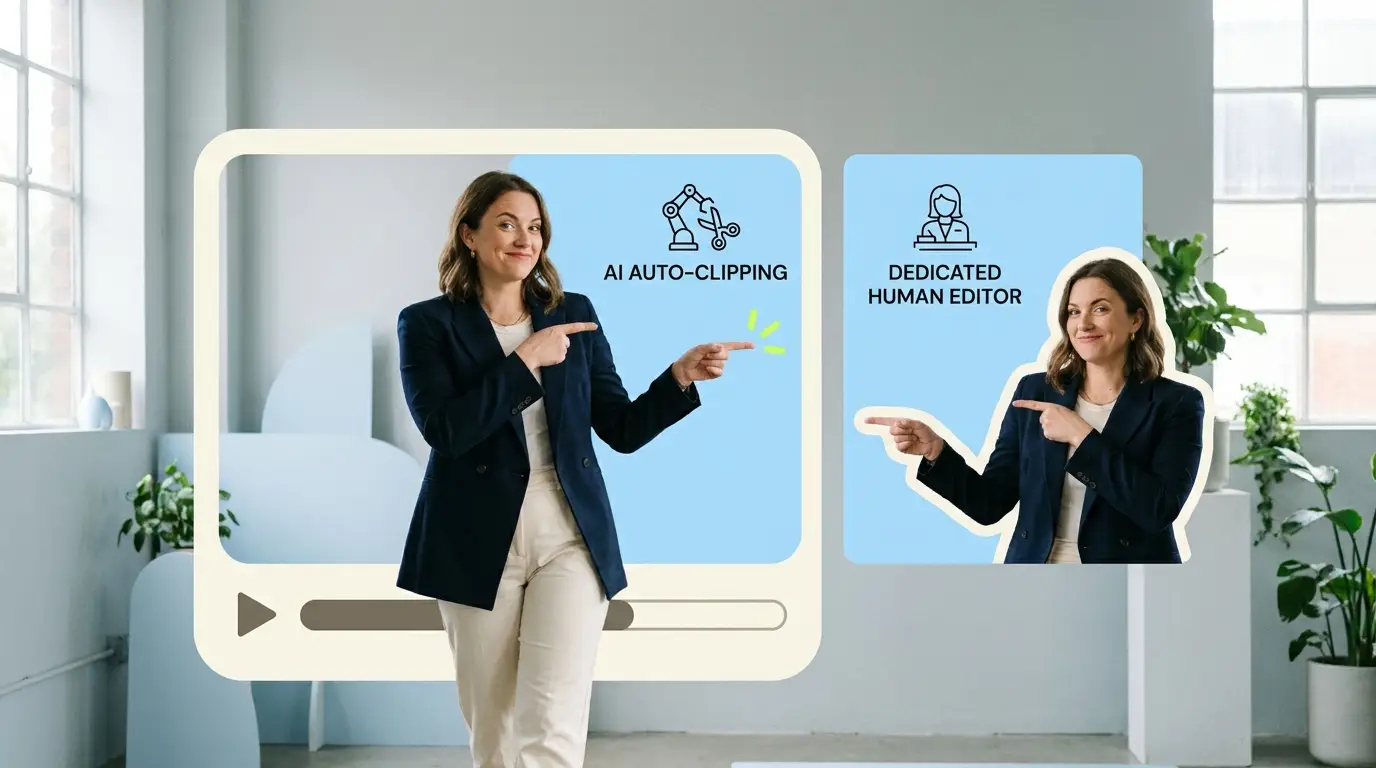
If you make long videos and want more out of them, you have probably hit the same fork in the road that most marketing teams reach. You can run an AI clipping tool, or you can hand the work to a human service. This guide is a practical look at Munch vs done-for-you video editing, so you can see where each one earns its keep. Munch is an AI tool that takes long videos and turns them into short, ranked social clips using analytics and trend signals. A done-for-you service is a team of human editors who cut, polish, and finish your video the way you ask. Both have a place. They just solve different problems, and picking the wrong one wastes time and money.
Video is not optional anymore. Wyzowl reports that 91% of businesses use video as a marketing tool, and 82% of people say a video has convinced them to buy a product or service. That demand is exactly why tools like Munch exist, and also why human editing services stay busy. The question is not whether to invest in video. It is how to produce it without burning your week.
What Munch actually does
Munch is built around one core job: repurposing. You feed it a long asset, like a webinar, a podcast episode, or a recorded talk, and it analyzes the footage to find the moments most likely to perform on social. It then cuts those moments into short vertical clips, adds captions, and ranks the clips by predicted engagement. The analytics angle is the selling point. Instead of you scrubbing through an hour of footage guessing which 45 seconds will land, the tool surfaces candidates for you.
On pricing, Munch runs a freemium model with paid tiers. Plans and limits change, so check current pricing on their side before you commit. The general idea is that you pay for volume and features rather than for a person's time.
Where Munch is strong:
- Speed. A long video becomes a stack of clips in minutes, not days.
- Volume. You can process a lot of footage and produce many clips per source.
- Low cost per clip. Once you are on a plan, each additional clip costs almost nothing.
- Auto-clipping and ranking. The tool decides where to cut and tells you which clips it thinks are best.
- Captions and basic formatting. Standard social-ready output without manual work.
If your bottleneck is "I have hours of recorded content and no time to chop it up," Munch removes that bottleneck fast. This is the same problem we cover in our guide on how to repurpose long-form video into shorts, and AI clipping is a legitimate first step in that workflow.
What a done-for-you service actually does

A done-for-you video editing service is people. You send raw footage and a brief, and a human editor returns a finished video. That includes the things software still struggles with: editorial judgment about what story to tell, pacing that feels intentional, brand-correct graphics, color and audio cleanup, motion design, and revisions based on your taste rather than an algorithm's guess.
The scope is also wider. Munch clips existing long videos. A human service can build a full edit from scratch, assemble footage from multiple takes, fix a bad shot, design lower thirds that match your brand kit, and handle formats Munch was never meant to touch, like case study films, ads, product explainers, and event recaps. If you want to understand the full category, our done-for-you video editing service breakdown goes deeper on what these teams handle.
Where a human service is strong:
- Editorial judgment. A person knows when a clip needs context, when a joke lands, and when a cut feels rushed.
- Brand polish. Consistent fonts, colors, motion, and tone across everything you ship.
- Full edits, not just clips. Start-to-finish projects beyond repurposing.
- Custom work. Anything specific to your campaign, your product, or your audience.
- Revisions to your taste. You give notes, a human acts on them.
The honest cost comparison
Cost is where people make the wrong call, because they compare the wrong numbers. An AI tool's monthly fee looks tiny next to a service invoice. But the two are not buying the same thing.
Here is the broader market for context. Hiring an in-house editor runs about $55,000 to $75,000 per year in salary alone, per ZipRecruiter, before benefits and software. Freelancers charge roughly $75 to $250 per video depending on complexity. Agencies bill anywhere from $500 to $5,000 or more per project. Across the outsourced market generally, you will see pricing from $500 to $3,000 depending on scope and provider.
ZipRecruiter's video editor salary data makes the in-house math clear: a single full-time hire is a major fixed cost, and that person can only edit so fast.
Munch sits far below all of that on a per-clip basis, because you are paying for software, not labor. That is its real advantage. If you need 40 clips a month from existing webinars, an AI tool is almost certainly cheaper than any human option.
But cheap clips are not the same as the right output. If you need a polished ad, a branded case study, or a campaign video that has to be exactly right, the AI fee is irrelevant because the tool cannot do that job. You are then comparing human options to other human options. For a fuller picture of how the paid models stack up, see our video editing subscription services guide.
Where Munch wins

Be clear-eyed about this, because the wins are real.
Munch wins on throughput. If your content engine produces long videos every week and your job is to feed social channels, an AI clipper keeps up in a way no human team can match at the same cost. It wins on speed, turning a recording into publishable shorts in the time it takes to get a coffee. It wins on cost per asset, since the marginal cost of one more clip is close to zero. And it wins as a triage tool, because the ranking feature gives you a starting shortlist instead of a blank timeline.
For a podcast, a webinar program, or a creator pushing daily clips, that combination is hard to beat. The tool is doing exactly what it was designed to do.
Where a human service wins
The flip side is just as real. AI clipping finds moments. It does not have taste. It will happily rank a clip that is technically punchy but says something off-brand, or cut a sentence in a way that changes the meaning. It does not know your campaign goals, your product positioning, or that one client who hates a certain word.
A human service wins anywhere judgment matters. That includes:
- Brand-critical work where every frame represents the company.
- Full productions like ads, explainers, and case studies that need structure, not just clips.
- Complex source material that needs assembly, color, audio repair, and motion graphics.
- Custom requests that no template covers.
- Accountability when a deliverable absolutely has to be right by a deadline.
There is also a quality ceiling. The best repurposed clip an AI makes is still a clip. A skilled editor can take the same footage and make something that feels produced. If your brand competes on looking sharp, that gap shows. When you are deciding whether to bring this in-house, hand it to a service, or run a tool, our walkthrough on how to outsource video editing covers the tradeoffs.
How to choose between them

You do not actually have to pick one forever. The smarter framing is matching the tool to the job.
Choose Munch when your goal is volume repurposing of existing long videos, your brand standards are flexible enough for templated output, speed matters more than polish, and budget is tight. It is a strong fit for social-first teams drowning in recorded content.
Choose a done-for-you service when the output has to be on-brand and finished, when you need full edits and not just clips, when the work is custom, or when the video is tied to revenue and cannot miss. The HubSpot research on what makes video convert, summarized in HubSpot's video marketing statistics, reinforces that quality and relevance drive results, not raw clip count.
Many teams run both. They use an AI clipper to spin daily shorts out of webinars and a human service for the videos that actually carry the brand. That hybrid is often the right answer, and it is why comparing the two as enemies misses the point. They cover different parts of the same pipeline. If you want a wider field of options, our roundup of the best video editing services compared lays out the alternatives side by side.
One more data point worth keeping in mind: with 91% of businesses already using video and 82% of buyers saying a video convinced them to purchase, per Wyzowl's video marketing research, the cost of shipping weak video is not just wasted budget. It is a missed conversion. That raises the bar for anything brand-facing.
What Pixel8 Production offers
Pixel8 Production is a done-for-you B2B video editing subscription. You get a dedicated editor who learns your brand, a 48-hour turnaround on most edits, and unlimited revisions so the work lands the way you want it. Pricing is $2,000 to $3,200 per month, flat, with no per-project surprises.
That model is built for the work an AI clipper cannot do. When you need a finished ad, a polished case study, a product explainer, or a series of campaign videos that all match your brand, you hand it over and get it back ready to publish. The dedicated editor matters here, because they carry context from one project to the next instead of starting cold each time.
Where does that leave Munch? Honestly, the two can coexist. Run an AI clipper for high-volume social repurposing where speed and cost win. Use Pixel8 for the brand-critical, judgment-heavy editing where a human has to be in the loop. Plenty of our clients do exactly that. The subscription covers the videos they cannot afford to get wrong, and a tool handles the firehose of clips that only need to be good enough.
The flat monthly price is the part teams tend to appreciate most. You are not negotiating a quote per video or watching costs climb with revisions. You know your number, you get a dedicated person, and the turnaround is fast enough to keep a real content calendar moving.
Bottom line
Munch vs done-for-you video editing is not really a contest, because they are not after the same prize. Munch is an excellent AI clipper. It wins on speed, volume, and cost per clip, and it is the right call when you need to turn long videos into social shorts fast. A human service wins on editorial judgment, brand polish, full edits, and custom work, and it is the right call when the output has to be exactly right. Pick the tool when you need throughput. Pick a service like Pixel8 Production when you need finished, on-brand video you can stand behind. Most growing teams end up using both, and there is nothing wrong with that.
Where to go from here
Frequently asked questions
Is Munch a replacement for a video editor?
No. Munch repurposes existing long videos into short clips using AI and analytics. It does not do full edits, custom production, or brand-specific work that needs human judgment. It replaces the manual chore of clipping, not an editor.
When is Munch the better choice?
When your main need is high-volume repurposing of long content like webinars and podcasts, your brand standards allow templated output, and you want speed at a low cost per clip. It is built for social-first teams with lots of source footage.
When should I use a done-for-you service instead?
When the output has to be on-brand and fully finished, when you need complete edits rather than clips, when the work is custom, or when the video is tied to revenue and cannot miss the mark. Human judgment is the deciding factor.
How much does Munch cost?
Munch uses a freemium model with paid tiers. Plans and limits change over time, so check their current pricing directly. The key point is that you pay for software and volume rather than for a person's time.
How much does a human video editing service cost?
It varies. An in-house editor runs about $55,000 to $75,000 per year per ZipRecruiter, freelancers charge roughly $75 to $250 per video, and agencies bill $500 to $5,000 or more per project. The broader outsourced market generally falls between $500 and $3,000. Pixel8 Production is $2,000 to $3,200 per month. A $900 trial is available to test the service before committing to a monthly plan.
Can I use both Munch and a human service?
Yes, and many teams do. Use an AI clipper for high-volume social shorts and a human service for brand-critical, custom, and full-edit work. They cover different parts of the same video pipeline.
What does Pixel8 Production include?
A dedicated editor, a 48-hour turnaround on most edits, and unlimited revisions, all for a flat $2,000 to $3,200 per month. It is designed for the polished, brand-correct editing that an AI clipping tool cannot handle.

Prakhar Mehta
Pixel8 is a done-for-you video editing subscription, giving SaaS companies, agencies, and founders a dedicated editing team with 48-hour turnaround.
Ready to stop doing this yourself?
Get a dedicated video editing team. 48-hour turnaround, unlimited revisions, month-to-month.