How Much Does It Cost to Edit a YouTube Video?
How much does it cost to edit a YouTube video? Real prices by approach, from DIY software to freelance, agency, and monthly subscription, plus how to budget.
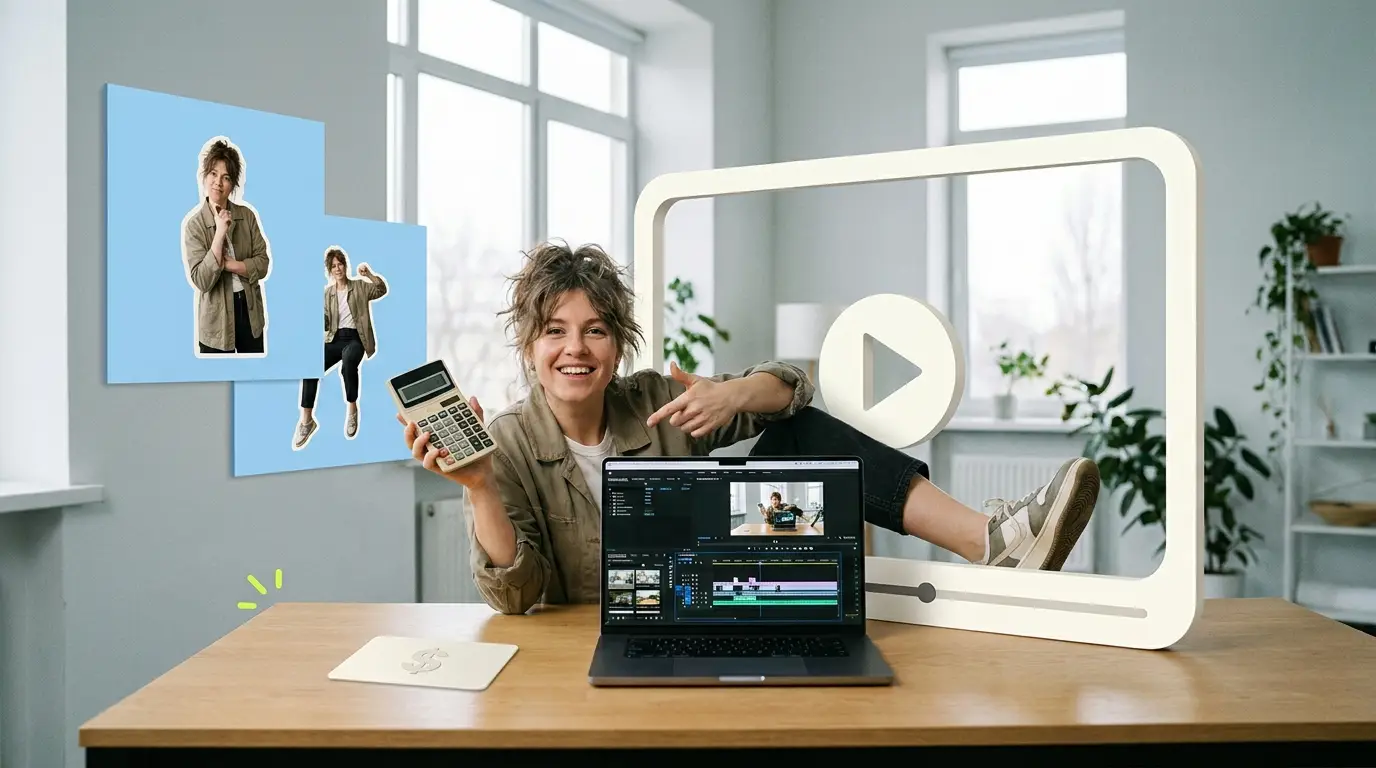
If you are publishing on YouTube regularly, the editing bill adds up fast, and the first question every channel owner asks is simple: how much does it cost to edit a YouTube video? The honest answer is that it depends on who does the work and how complex the video is. A plain talking-head clip costs almost nothing if you cut it yourself. A polished video with b-roll, motion graphics, and a fast turnaround can run several hundred dollars per episode, or a few thousand dollars a month if you outsource the whole pipeline. This guide breaks down every approach so you can budget with real numbers instead of guesses.
Video is no longer optional for businesses that want attention. According to Wyzowl, 91% of businesses use video as a marketing tool, and 82% say a video has convinced them to buy a product or service. That demand is exactly why editing costs matter. The work has to get done one way or another, so the only real decision is how you pay for it.
The four ways to get a YouTube video edited
There are four common paths, and each one has a very different cost structure:
- DIY with software -- you do the cutting yourself.
- Freelance per video -- you hire an editor for each project.
- Agency or production house -- you pay per project or per campaign.
- Monthly subscription editing -- you pay a flat retainer for ongoing output.
The right choice depends on how often you publish, how complex your videos are, and how much of your own time you want to spend in a timeline.
DIY editing: cheap in dollars, expensive in hours

If you edit your own videos, the only hard cost is software. Free tools like DaVinci Resolve, CapCut, and iMovie cover a lot of ground. Paid tools like Adobe Premiere Pro run around $23 per month, and Final Cut Pro is a one-time purchase near $300. Add a few stock asset subscriptions or a music library and you might spend $50 to $100 per month total.
So in pure cash, DIY is the cheapest option by far. The catch is time. A clean ten-minute YouTube video usually takes three to six hours to edit well, and that climbs quickly once you add b-roll, captions, and graphics. If your hourly rate as a business owner or creator is meaningful, those hours are the real cost. For a channel publishing weekly, DIY editing can quietly eat 15 to 25 hours a month. That is the math most people skip when they call DIY "free."
Freelance editors: pay per video
Hiring a freelance editor is the most popular middle ground, and it is where most channels land first. Freelance YouTube editing runs roughly $75 to $500 per video depending on length and complexity:
- Simple edits (talking head, light cleanup, basic cuts): about $75 to $250 per video.
- Complex edits (multi-cam, b-roll, motion graphics, sound design, color): up to $500 or more per video.
Rates vary by editor experience and region. For reference, ZipRecruiter data shows video editor pay spread across a wide band, which is why freelance quotes range so much. A senior editor in a high-cost market charges more than a newer editor building a portfolio.
Freelance works well when your volume is low or unpredictable. The downside shows up when you scale. Finding, vetting, and managing freelancers takes time, quality drifts when you switch editors, and turnaround slows during busy weeks. If you want a deeper breakdown of these tradeoffs, our guide on how to outsource video editing walks through the hiring and handoff process in detail.
Agencies and production houses: per project pricing

Agencies sit at the premium end. A full-service video agency or production house typically charges $500 to $5,000 or more per project, and the high end climbs further for shoots, scripting, and heavy post-production. You are paying for a team rather than one person, which means more capacity and a more produced result.
Agencies make sense for flagship videos, brand campaigns, and launches where production value is the point. They are usually overkill for steady weekly YouTube uploads, where the per-project model gets expensive fast and the formal scoping process slows you down. For a channel that just needs consistent, well-edited episodes every week, agency pricing rarely pencils out.
In-house editor: a salary, not a per-video fee
Some businesses hire a full-time editor. A staff video editor in the United States typically earns $55,000 to $75,000 per year, plus benefits, payroll taxes, software, and hardware. Loaded, that often lands north of $80,000 annually.
An in-house hire makes sense once your volume is high and steady enough to keep one person busy every single day. Below that threshold, you are paying a full salary for partial utilization. There is also key-person risk: when your editor is sick, on vacation, or quits, your pipeline stops. For most channels publishing a handful of videos a month, a salary is more commitment than the output justifies.
Subscription editing: a flat monthly rate

Subscription editing has become the default for businesses that publish consistently. Instead of negotiating per video or carrying a salary, you pay a flat monthly fee for a set amount of ongoing editing. You get predictable output and predictable cost.
This model fits the rhythm of YouTube perfectly because the work is recurring. The general market for video editing subscription pricing ranges widely, from budget services to premium done-for-you retainers. Quality services for serious businesses usually fall in the $500 to $3,000 per month range, with the higher end buying a dedicated editor, faster turnaround, and consistent quality. Our breakdown of video editing cost per month for a business shows how this compares to other models over a full year.
What actually drives the price
Whichever path you choose, the same factors move the number up or down:
- Length. A 3-minute video and a 25-minute video are not in the same price tier. More footage means more cutting, more decisions, more time.
- Complexity. Simple cuts are cheap. Multi-cam, color grading, sound design, and storytelling structure cost more.
- B-roll. Sourcing, syncing, and layering b-roll adds hours. So does shooting or licensing it.
- Motion graphics. Animated titles, lower thirds, charts, and effects are skilled work and priced accordingly.
- Turnaround. Rush jobs and guaranteed fast delivery command a premium. A 48-hour turnaround is worth real money to a channel on a schedule.
- Revisions. Unlimited or generous revision rounds raise the price but protect quality.
When you ask a quote and the number feels high or low, it almost always traces back to one of these six levers.
Per video versus monthly: do the math for your channel
Here is where the decision gets concrete. Imagine a channel publishing one video per week, so about four to five videos per month, with moderate complexity (some b-roll, captions, light graphics).
Freelance per video: at roughly $200 to $350 per moderate video, four to five videos lands you at about $800 to $1,750 per month, before the time you spend managing the relationship and the risk of uneven turnaround.
Agency per project: at $500 plus per video, the same four to five videos easily exceeds $2,000 to $2,500 per month, and that is on the conservative end.
In-house editor: roughly $4,600 to $6,300 per month in base salary, and more once you add benefits and overhead, which only makes sense at much higher volume.
Subscription: a flat monthly fee covers the whole slate with one predictable invoice, a consistent editor, and a set turnaround.
The pattern is clear. At low volume, freelance is cheapest. As you publish more consistently, per-video and per-project costs climb and the management overhead grows, while a flat subscription holds steady. That crossover point, usually around a few videos a month, is exactly why so many channels switch. Our comparison of outsource YouTube video editing cost runs these scenarios side by side.
How to budget without overspending
Start with two honest numbers: how many videos you will actually publish per month, and how complex they need to be. Most channels overestimate complexity and underestimate consistency. A clean, well-paced edit usually outperforms a heavily produced one that ships late.
From there, match the model to your volume. If you publish sporadically, stay freelance and accept the variability. If you publish on a fixed schedule, a done-for-you video editing service with a flat rate removes the guesswork and the per-video haggling. Whatever you choose, build the cost into your content budget as a fixed line item, not an afterthought. Video is a core marketing channel now, and the data backs that up: HubSpot reports that video continues to deliver some of the strongest engagement and conversion of any format. Budgeting for editing is budgeting for results.
What Pixel8 Production offers
Pixel8 Production is a done-for-you B2B video editing subscription built for businesses that publish consistently and do not want to manage editors. You get a dedicated editor who learns your style, a 48-hour turnaround on standard edits, and a flat price of $2,000 to $3,200 per month.
That flat rate covers ongoing YouTube editing, including b-roll, captions, motion graphics, and revisions, without per-video invoices or scoping calls. Compared to stacking freelancers, you get consistency and reliability. Compared to a full-time hire, you avoid the salary, the benefits, and the key-person risk. For a channel publishing several videos a month, the subscription model usually costs less than the alternatives once you count the time you stop spending on management. You send the footage, your editor delivers the cut, and your publishing schedule stays on track.
Bottom line
How much does it cost to edit a YouTube video comes down to volume and complexity, and the best video editing services for YouTube creators are priced accordingly. DIY is cheapest in dollars but expensive in hours. Freelancers run $75 to $500 per video and suit low or irregular output. Agencies charge $500 to $5,000 or more per project for premium work. For channels publishing consistently, a flat subscription is usually the most predictable and cost-effective choice. Pixel8 Production delivers that with a dedicated editor, a 48-hour turnaround, and a flat $2,000 to $3,200 per month. Match the model to how often you actually publish, and the budget takes care of itself.
Where to go from here
Frequently asked questions
How much does it cost to edit a YouTube video on average?
For most channels, a single moderately edited YouTube video costs between $200 and $350 with a freelancer. Simple talking-head edits start around $75, and complex videos with heavy graphics can reach $500 or more. The average depends almost entirely on length and complexity.
Is it cheaper to edit YouTube videos myself?
In pure cash, yes. DIY editing only costs software, roughly $50 to $100 per month including stock assets. The hidden cost is time, often 15 to 25 hours a month for a weekly channel, which is significant if your hours are worth money elsewhere.
How much do freelance YouTube editors charge?
Freelance YouTube editing runs roughly $75 to $500 per video. Simple edits land at $75 to $250, while complex multi-cam videos with b-roll and motion graphics reach the top of that range or beyond. Rates vary by editor experience and location.
What does an agency charge to edit a YouTube video?
Video agencies and production houses typically charge $500 to $5,000 or more per project. That premium buys a full team and high production value, which makes agencies a good fit for flagship videos but usually too expensive for steady weekly uploads.
How much does a subscription video editing service cost?
Quality subscription editing for businesses generally falls in the $500 to $3,000 per month range. Premium done-for-you services that include a dedicated editor and fast turnaround sit at the higher end. Pixel8 Production prices its subscription at $2,000 to $3,200 per month. A $900 trial is available to test the service before committing to a monthly plan.
When does a subscription beat hiring freelancers?
A subscription usually wins once you publish consistently, often around three or more videos per month. At that volume, per-video freelance costs and management overhead climb past a flat monthly rate, and you also gain a consistent editor and a reliable turnaround.
Should I hire an in-house editor instead?
Only if your video volume is high and steady enough to keep one person busy daily. An in-house editor costs $55,000 to $75,000 per year plus benefits and overhead, and you carry the risk of the pipeline stopping when they are unavailable. Below high volume, outsourcing is more efficient.
What makes one editing quote higher than another?
Six factors drive the price: video length, editing complexity, the amount of b-roll, motion graphics, turnaround speed, and the number of revision rounds. A quote that seems high or low almost always traces back to one of these levers.

Prakhar Mehta
Pixel8 is a done-for-you video editing subscription, giving SaaS companies, agencies, and founders a dedicated editing team with 48-hour turnaround.
Ready to stop doing this yourself?
Get a dedicated video editing team. 48-hour turnaround, unlimited revisions, month-to-month.