Best Awesomic Alternatives for Video Editing
Compared the best Awesomic alternatives for video editing, from design-first subscriptions to dedicated-editor services, with pricing, turnaround, and fit.
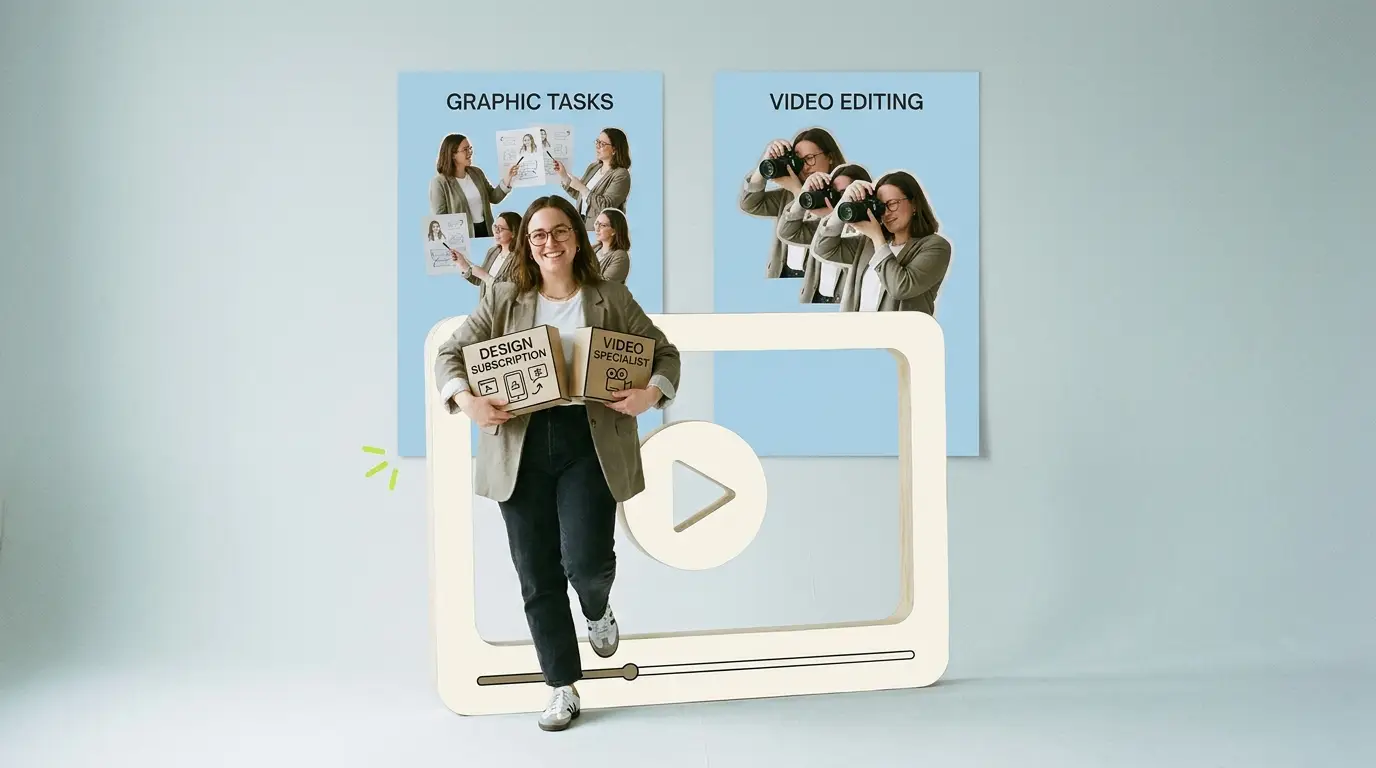
If you have used or shopped around for Awesomic, you already understand the appeal of a subscription model. You submit a task, an app matches you with a designer, and work comes back without the friction of hiring. So why look for Awesomic alternatives at all? Because Awesomic is a design subscription. It is built for brand assets, web design, and graphics, not for the ongoing, format-specific demands of real video editing. If your output is shifting toward video, the best Awesomic alternatives are services that treat video as the main product, not an add-on.
This guide walks through what to look for when you move from a design-first subscription to a video-capable one, the trade-offs between task-based and dedicated-editor models, and the services worth comparing.
Why a design subscription struggles with video
Task-based design subscriptions like Awesomic are excellent at what they do. You queue a request, a designer picks it up, and you get a logo, a landing page, or a social graphic. The model works because design tasks are often discrete and self-contained.
Video does not behave that way. A single edited video can involve raw footage review, cutting, color, captions, motion graphics, sound design, and several revision passes against a moving brief. That is not one task. It is a production process. When you push that process through a design-first queue, a few things tend to break.
First, the person who picks up your task may be a strong graphic designer without deep video chops. Second, the turnaround estimates that work for a static graphic do not map cleanly onto a three-minute edit with revisions. Third, the tooling and file handling for video, large media uploads, timeline feedback, version control, are different from what a design app is optimized for.
None of this is a knock on Awesomic. It is a sign that you have outgrown a single-category subscription and need a service built around your actual deliverable. If you want a broader market view first, our comparison of the best video editing services is a useful starting point.
What to look for in an Awesomic alternative

Before comparing specific services, get clear on the criteria that actually matter for video.
Video as the core product, not a side feature
Some subscriptions advertise video alongside design. That can work for simple cut-downs, but read carefully. A service where video is one menu item among twenty will rarely match a service where video editors are the entire team. If your volume is real, you want specialists. Our breakdown of a design subscription with video editing explains where the hybrid model fits and where it falls short.
Task-based versus dedicated editor
This is the biggest structural choice. In a task-based model, any available person handles your next request. In a dedicated-editor model, the same editor (or small team) works with you over time.
For video, continuity matters more than it does for one-off graphics. A dedicated editor learns your brand voice, your pacing preferences, your caption style, and your founder's on-camera habits. By the third or fourth project, the back-and-forth shrinks because they already know what you want. A task-based model resets that context every time.
Turnaround you can actually plan around
Ask what turnaround means in practice. Is it the time to a first draft, or to a finished, revised video? A 48-hour turnaround on a first cut is a planning tool you can build a content calendar around. A vague "a few days" is not.
Revisions and how they are counted
Video almost always needs revisions. Watch for services that cap revisions or count each round as a new task. Unlimited revisions within a clear scope removes the anxiety of asking for one more tweak.
Predictable pricing
Per-project pricing makes budgeting hard when output is steady. A flat monthly fee is easier to forecast. For context, freelance editors typically charge $75 to $250 per video, agencies run $500 to $5,000 or more per project, and full subscription services usually land somewhere in the $500 to $3,000 range depending on scope and dedication of the editor.
The case for video, in numbers
It helps to remember why this even matters. Video is no longer optional for B2B and brand marketing. According to Wyzowl, 91% of businesses use video as a marketing tool, and 82% of people say a video has convinced them to buy a product or service. The demand for consistent, well-edited video is not a trend that is going to fade.
That demand also shows up in hiring data. HubSpot's marketing research consistently ranks video among the highest-performing content formats, which is why teams keep increasing output. The problem is that increasing output exposes whatever bottleneck you have, and a design-first subscription is often that bottleneck.
Comparing the main alternative models

Here are the realistic paths once you decide a design subscription is not the right home for your video work.
Other task-based design subscriptions
You could move to a different design subscription that also offers video. This keeps the familiar workflow you liked about Awesomic. The downside is the same one you started with: video is rarely the priority, and editor expertise varies. This path makes sense only if your video needs are light and infrequent.
Hiring in-house
Bringing on a full-time editor gives you maximum control and availability. It also carries the highest fixed cost. A staff video editor in the United States earns roughly $55,000 to $75,000 per year according to ZipRecruiter, before benefits, software, and equipment. For most teams producing a handful of videos a month, that is more capacity than they need and more cost than they want.
Freelancers and marketplaces
Freelance editors offer flexibility and a range of price points, usually $75 to $250 per video. The trade-off is management overhead. You source, vet, brief, and chase each editor, and your best freelancer may be booked the week you need them most. Our guide on how to outsource video editing covers how to make this model work if you go that route.
Agencies
Agencies bring polish and capacity but at project rates of $500 to $5,000 or more, often with longer timelines and minimums that do not suit a steady drip of social and brand content.
Video-specialist subscriptions
This is the model most directly built to replace a design subscription for video output. You pay a flat monthly fee, you get a dedicated editor, and you submit work continuously. It combines the predictability of a subscription with the depth of a specialist. Our video editing subscription services guide goes deeper on how to evaluate them.
Task-based versus dedicated: a closer look
It is worth sitting with this distinction because it is where most buyers leaving Awesomic make their decision.
A task-based model is efficient for the provider and fine for commodity work. When the deliverable is interchangeable and self-contained, it does not matter much who picks it up. But video is rarely interchangeable. The fifth video for a brand should feel like it belongs with the first four. That consistency comes from a person who has built up context, not from a queue that hands your project to whoever is free.
A dedicated editor also changes the feedback loop. Instead of writing exhaustive briefs every time to a stranger, you build shorthand. You can say "same energy as the last one but tighter intro" and be understood. That saves hours over a month and produces more cohesive output. For teams shipping video weekly, the dedicated model usually wins on both quality and total time spent.
What Pixel8 Production offers

Pixel8 Production is a done-for-you B2B video editing subscription built specifically for the gap that design subscriptions leave open. Instead of routing your video through a general design queue, you get a dedicated editor who learns your brand and handles your ongoing video work.
The pricing is a flat $2,000 to $3,200 per month. That covers a dedicated editor, a 48-hour turnaround on edits, and unlimited revisions within scope. You are not counting tasks or watching a meter. You submit footage, your editor turns it around, and you request changes until it is right.
This is the practical answer for a team that liked the subscription model of Awesomic but needs video to be the main event rather than a side capability. You keep the low-friction, predictable-cost experience and add genuine video specialization. If you want the full picture of how the done-for-you approach works, see our overview of a done-for-you video editing service.
Compared to hiring in-house at $55,000 to $75,000 a year, the subscription costs less and carries no overhead. Compared to freelancers, you skip the sourcing and management. Compared to agencies, you get continuity and predictable monthly pricing instead of per-project quotes.
How to choose the right fit
Match the model to your real volume and cadence. If you produce video rarely and lightly, a freelancer or a design subscription with a video option may be enough. If you produce a steady stream of branded video and want it to stay consistent, a video-specialist subscription with a dedicated editor is the closest replacement for the subscription convenience you valued in Awesomic, without the limitation of a design-first queue.
Be honest about how much briefing and management you can absorb. The hidden cost of cheaper options is your own time. A dedicated editor who already knows your brand removes most of that cost, which is often where the real savings show up.
Bottom line
Awesomic is a strong design subscription, but it is a design subscription. If your work is moving toward video, the best Awesomic alternatives are services where video is the core product, not a feature. The key decisions are task-based versus dedicated editor, project pricing versus a flat monthly fee, and a vague turnaround versus one you can plan around.
For teams that want the predictability of a subscription with the depth of a specialist, a done-for-you video editing service with a dedicated editor, a 48-hour turnaround, and unlimited revisions is the most direct upgrade. Pixel8 Production delivers exactly that at $2,000 to $3,200 per month, so video can finally keep pace with everything else you ship.
Where to go from here
Frequently asked questions
Is Awesomic a video editing service?
No. Awesomic is a task-based design subscription that matches you with designers through an app. It is built for graphics, branding, and web design. If you need consistent, specialized video editing, a video-focused service is a better fit.
What is the best Awesomic alternative for video?
It depends on your volume. For steady video output, a video-specialist subscription with a dedicated editor, like Pixel8 Production, is the closest match to the subscription convenience of Awesomic while actually focusing on video. For occasional needs, a freelancer may be enough.
How much does a video editing subscription cost?
Full video editing subscriptions generally range from $500 to $3,000 per month depending on scope and whether you get a dedicated editor. Pixel8 Production is priced at $2,000 to $3,200 per month and includes a dedicated editor, 48-hour turnaround, and unlimited revisions. A $900 trial is available to test the service before committing to a monthly plan.
Task-based or dedicated editor: which is better for video?
For video, a dedicated editor is usually better. They build context about your brand, pacing, and style over time, which shortens feedback loops and keeps output consistent. Task-based models reset that context with every request, which suits one-off graphics more than ongoing video.
Why not just hire an in-house video editor?
A full-time editor offers control but costs roughly $55,000 to $75,000 per year before benefits and software. For teams producing only a handful of videos a month, that is more capacity and cost than needed. A subscription gives similar continuity at a lower, predictable price.
What about using freelancers instead?
Freelancers are flexible and range from $75 to $250 per video, but they add management overhead. You source, brief, and chase each project, and availability is not guaranteed. A subscription with a dedicated editor removes that overhead while keeping costs predictable.
How fast should video turnaround be?
Look for a turnaround you can actually plan a content calendar around. A 48-hour turnaround on edits, as Pixel8 Production offers, lets you schedule output reliably. Be wary of vague estimates like "a few days," and confirm whether the quoted time is for a first draft or a finished, revised video.

Prakhar Mehta
Pixel8 is a done-for-you video editing subscription, giving SaaS companies, agencies, and founders a dedicated editing team with 48-hour turnaround.
Ready to stop doing this yourself?
Get a dedicated video editing team. 48-hour turnaround, unlimited revisions, month-to-month.