Vidico vs Video Editing Subscription: Compared
Vidico vs video editing subscription compared: how a project-based production agency stacks up against done-for-you monthly editing on cost, speed, and volume.
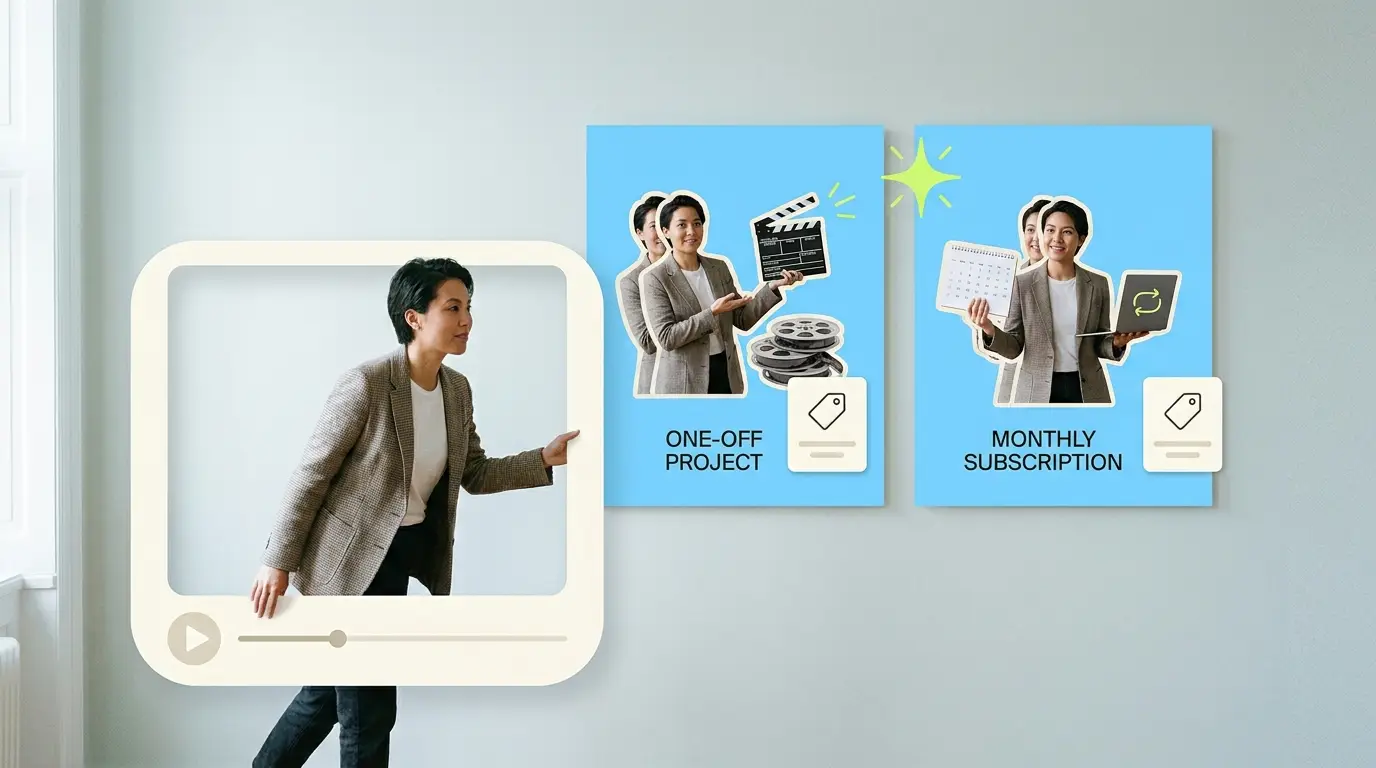
If you run marketing at a tech or SaaS company, the choice of Vidico vs video editing subscription comes up the moment you decide video matters. Vidico is a well-known video production agency that builds polished, produced videos for tech and SaaS brands, usually on a project basis. A video editing subscription is a different model entirely: a flat monthly fee for an ongoing editor who turns your raw footage into finished clips. Both produce video. They solve different problems. This piece compares the two fairly so you can match the model to what you actually need.
The short version: Vidico and agencies like it are built for high-production one-off pieces such as a brand film or a launch hero video. A subscription is built for steady volume at a predictable cost. Picking wrong means you either overpay for output you do not need, or you starve a content engine that needed feeding every week.
Two different models, not two versions of the same thing
A production agency like Vidico is project-based. You brief them, they scope the project, and they handle the full chain: concept, script, storyboard, shoot, animation, edit, and delivery. The output is a produced asset built from scratch, often with a crew, motion graphics, and a creative director steering the look. That is real value when the video is a centerpiece.
A video editing subscription works the other way around. You already have footage, whether that is screen recordings, webinar clips, podcast captures, talking-head selfies, or event B-roll. The subscription gives you a dedicated editor who cuts that raw material into finished, on-brand videos for a flat monthly rate. No shoot, no crew, no project scoping every time. You send files, you get edits back.
That distinction drives everything else: cost, turnaround, and the kind of volume each model can sustain. If you want a deeper breakdown of how the editing-subscription model works in practice, our video editing subscription services guide walks through the mechanics.
Cost structure: project fees vs a flat monthly rate

This is where the two models diverge most sharply.
Production agencies price per project. Vidico does not publish fixed prices, and you should expect project-based quotes rather than a menu. Industry-wide, produced video from an agency commonly runs $1,000 to $5,000+ per video, often higher once you add a full crew, animation, or multiple deliverables. A single polished brand piece can run into the thousands and well beyond. That is not a criticism. Produced video is expensive to make because it involves people, gear, and time. You are paying for craft.
A video editing subscription is a flat monthly fee. At Pixel8 Production, that is $2,000 to $3,200 per month for a dedicated editor, with no per-video charge and no scoping back-and-forth. The broader subscription market sits somewhere in the $500 to $3,000 range per month depending on volume, turnaround, and how senior the editor is.
Here is the practical math. One produced agency video might cost as much as a full month, sometimes several months, of a subscription. If you need one flagship video a year, the agency project is the right spend. If you need eight to fifteen edited videos a month, the subscription gets you a far lower cost per asset. We break the numbers down further in our video editing subscription pricing explainer.
It helps to compare both against the in-house and freelance options:
- In-house editor: roughly $55,000 to $75,000 per year in salary alone (per ZipRecruiter), before benefits, software, and gear.
- Freelance editor: about $75 to $250 per video, which is flexible but unpredictable as volume grows.
- Agency or production project: $500 to $5,000+ per project, often higher for produced work.
- Video editing subscription: a flat $2,000 to $3,200 per month at Pixel8 for unlimited revisions and steady output.
Turnaround: project timelines vs a 48-hour clock
Produced video takes time, and it should. A real production cycle includes pre-production, scheduling a shoot, the shoot itself, and then post. From kickoff to final delivery, an agency project often runs several weeks. For a one-off hero video, that timeline is fine because the asset is meant to last.
A subscription runs on a different clock. Because there is no shoot to schedule and a dedicated editor already knows your brand, turnaround is measured in days. Pixel8 delivers most edits within 48 hours, with unlimited revisions until the cut is right. For teams shipping content weekly, that speed is the whole point. You cannot run a steady social or sales-enablement calendar on a multi-week production cycle.
So the honest framing is not "faster vs slower." It is "built for one polished thing" vs "built to keep a content pipeline moving." For more on how done-for-you editing keeps that pipeline full, see our done-for-you video editing service overview.
Volume fit: where each model breaks down

Volume is the clearest deciding factor.
Production agencies are not designed for high frequency. Commissioning a produced video every week would be slow and financially painful. The model assumes a handful of important pieces per year, each given real attention.
Subscriptions are built for the opposite. The model assumes a steady stream of footage flowing in and finished edits flowing out. That fits the reality of modern B2B marketing, where one webinar becomes a dozen clips, one podcast episode becomes ten short cuts, and a product demo gets re-edited for three different audiences. The demand is constant, and a flat monthly model absorbs it without a new quote each time.
The data backs the volume case. Wyzowl reports that 91% of businesses use video as a marketing tool, and 82% say a video has convinced them to buy a product or service. Wyzowl's video marketing statistics show video is now a baseline expectation, not a nice-to-have. Sustaining that presence takes volume, and volume favors the subscription model. HubSpot's research points the same direction, with marketers consistently citing video as one of their highest-return formats; you can review the figures in HubSpot's video marketing data.
When a produced one-off is worth it
A subscription is not always the answer. There are cases where paying an agency like Vidico for a single produced video is the smarter call:
- A brand film or company manifesto video meant to anchor your homepage for years.
- A major product launch where the hero video needs a crew, custom animation, and high production polish.
- A funding announcement or category-defining moment where the video itself signals scale.
- Anything that requires an actual shoot with talent, locations, and directed footage you do not already have.
In these situations you are not buying volume. You are buying a single asset that has to be excellent and will be seen by a lot of people. The agency project model exists precisely for this, and trying to force it out of a subscription editor who works from your existing footage would miss the point.
When ongoing subscription editing is the better engine

For most ongoing B2B content needs, the subscription is the better engine. Consider it when:
- You have raw footage piling up and no one to cut it.
- You need consistent output every week or month, not a single piece.
- You want predictable spend you can put in a budget line without surprises.
- You care about turnaround speed more than full cinematic production.
- Your video is functional: demos, social clips, testimonials, webinar repurposing, sales enablement.
This is the bulk of what B2B teams actually need day to day. The flagship film is one project a year. The forty social cuts, the demo refreshes, and the webinar repurposing happen every month, and those are what a subscription handles cleanly. If you are weighing several providers, our roundup of the best video editing services compared lays out the trade-offs across models.
A realistic hybrid
The two models are not mutually exclusive, and the smartest teams often use both. You hire a production agency for the one or two produced pieces a year that demand a shoot and a crew. You keep a video editing subscription running for everything else, the steady weekly output that keeps your channels alive between big launches.
That hybrid gives you peak production where it counts and predictable volume everywhere else, without paying agency project rates for routine edits or asking a subscription editor to run a film shoot. Most B2B marketing calendars are mostly volume with a few spikes, and matching each spend to the right model keeps the budget honest.
What Pixel8 Production offers
Pixel8 Production is a done-for-you B2B video editing subscription built for teams that need steady, professional output without the overhead of hiring or the unpredictability of project quotes. Here is what is included:
- A flat rate of $2,000 to $3,200 per month, with no per-video fees and no surprise charges.
- A dedicated editor who learns your brand, your style, and your templates, so quality stays consistent.
- A 48-hour turnaround on most edits, so your content calendar keeps moving.
- Unlimited revisions, so every cut lands the way you want it without metering your feedback.
We work from the footage you already have: webinars, podcasts, demos, talking heads, event clips, and screen recordings. We turn that raw material into finished, on-brand videos ready to publish. We do not run shoots or produce cinematic brand films, and we say so plainly, because if you need a produced hero piece, an agency like Vidico is the right fit. For ongoing volume at a predictable cost, the subscription model is hard to beat. You can read more about how this works for B2B teams in our corporate video production subscription breakdown.
Bottom line
Vidico vs video editing subscription is not a contest between a good option and a bad one. It is a question of fit. If you need a produced flagship video that demands a shoot, a crew, and real cinematic polish, a production agency earns its project fee. If you need steady, predictable, on-brand video output every week without the cost or unpredictability of project quotes, a done-for-you subscription is the better engine. Most B2B teams need a little of the first and a lot of the second. Match the model to the job, and budget for both where it makes sense. For ongoing volume at $2,000 to $3,200 per month with a dedicated editor and 48-hour turnaround, the subscription model does the heavy lifting that keeps your content calendar alive.
Where to go from here
Frequently asked questions
Is Vidico better than a video editing subscription?
Neither is strictly better. Vidico is a production agency built for high-end, produced one-off videos that often require a shoot and a crew. A video editing subscription is built for steady, ongoing editing of footage you already have. The right choice depends on whether you need a single polished asset or consistent monthly volume.
How much does a video production agency like Vidico cost?
Vidico does not publish fixed prices and works on project-based quotes. Industry-wide, produced agency video commonly runs $1,000 to $5,000+ per video, often higher once you add a full crew, animation, or multiple deliverables. A single flagship piece can run well into the thousands.
How much does a video editing subscription cost?
At Pixel8 Production, a video editing subscription is a flat $2,000 to $3,200 per month for a dedicated editor, 48-hour turnaround, and unlimited revisions. The broader market sits in the $500 to $3,000 per month range depending on volume and turnaround. A $900 trial is available to test the service before committing to a monthly plan.
Which model is cheaper for ongoing video content?
For ongoing content, a subscription is far cheaper per asset. One produced agency video can cost as much as a full month or more of subscription editing. If you need eight to fifteen edited videos a month, the flat monthly rate gives you a much lower cost per video than commissioning each one separately.
Can a subscription replace a production agency entirely?
Not for everything. A subscription editor works from existing footage and does not run shoots or produce cinematic brand films. For a launch hero video or a brand film that needs a crew, an agency is the right call. For weekly demos, social clips, and webinar repurposing, a subscription is the better engine.
What about hiring an in-house editor instead?
An in-house editor costs roughly $55,000 to $75,000 per year in salary alone, per ZipRecruiter, before benefits, software, and equipment. You can compare current ranges at <a href="https://www.ziprecruiter.com/Salaries/Video-Editor-Salary" target="_blank" rel="nofollow noopener noreferrer">ZipRecruiter's video editor salary data</a>. A subscription often costs less per year and removes hiring, management, and downtime risk.
How fast can I get edits back from a subscription?
With Pixel8, most edits are delivered within 48 hours, and revisions are unlimited until the cut is right. That speed is the core advantage over a project-based agency, where a single produced video can take several weeks from kickoff to delivery.

Prakhar Mehta
Pixel8 is a done-for-you video editing subscription, giving SaaS companies, agencies, and founders a dedicated editing team with 48-hour turnaround.
Ready to stop doing this yourself?
Get a dedicated video editing team. 48-hour turnaround, unlimited revisions, month-to-month.