Video Editing Service for Startups: Top 5 Agencies (2026)
The 5 best video editing agencies for startups, ranked by best fit, with real pricing and the founder-time trade-off that decides which model actually works.
A video editing service for startups is a partner that turns raw footage, screen recordings, and founder clips into finished video without pulling anyone off product. That framing matters, because the real constraint at a startup is rarely money in the abstract; it is founder time, and every model below trades money against founder hours differently. This guide ranks five options by best fit, with honest pricing and the trade-off each one makes.
Most startup video agencies fall into one shape: a subscription that gives you a dedicated editor for a flat monthly fee. That is not an accident. Startups produce video continuously and unpredictably, and per-project quoting fits that pattern badly. The differences that matter are volume ceilings, whether design is included, and how much strategy comes attached.
A note on method: every company below was verified against its own live website, and the descriptions reflect each one's public positioning. Pixel8 Production is our own service, and we have said so plainly rather than quietly placing ourselves first.
The 5 best video editing services for startups
1. Pixel8 Production
Best for: B2B and SaaS startups shipping video weekly.
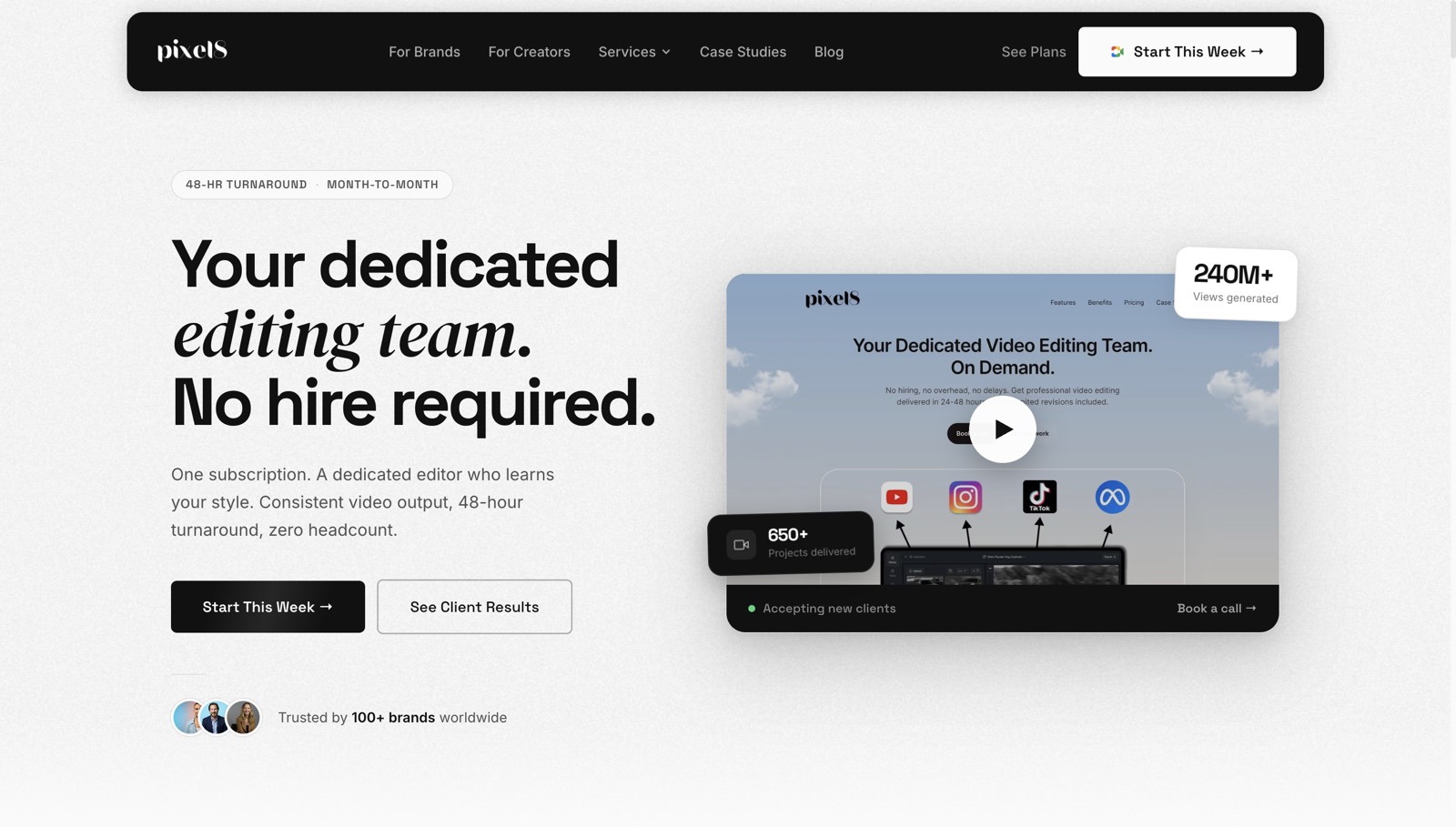
A remote, done-for-you video editing subscription with a dedicated editor who learns your product, a 48-hour turnaround, and a flat $2,000 to $3,200 per month. Built for teams treating video as an ongoing channel: demos, social clips, edited webinars, founder content. The trade-off it removes is founder time, since you hand over raw footage and get finished video back. Not the right fit if you need a one-off animated explainer built from scratch.
Source: pixel8production.com
2. Vidpros

Best for: high volume across creators, agencies, and startups. Positions itself as video editing services on demand, with the headline promise to hire a video editor today, and reports more than 50,000 videos delivered for businesses, creators, and agencies. A one to two day turnaround and a broad remit make it a strong fit when the priority is throughput rather than a narrow B2B specialism. Source: vidpros.com
3. BeCreatives

Best for: the earliest teams watching every dollar. An unlimited video editing service pitched around a dedicated editor from a low daily rate, framed as creating video content without the hassle of managing it. The budget positioning is the point: for a pre-seed team that needs steady editing but cannot commit to a four-figure monthly spend, the entry price is the lowest on this list. Source: becreatives.co
4. Irisbits

Best for: startups that need design alongside video. An on-demand creative service offering unlimited video editing and graphic design under one monthly subscription, aimed at content creators and businesses, and citing more than 500 clients served. The fit is a small team that would otherwise juggle a separate editor and designer and would rather buy both capacities in a single subscription. Source: irisbits.co
5. Komet Media

Best for: founder-led content built for authority and pipeline. Describes itself as a B2B video growth partner that turns expertise into business conversations, working with B2B SaaS, funded tech startups, VC and PE firms, and founders to run a full video content system from strategy and scripting through editing and distribution. The heaviest strategy layer here, which suits a founder trying to build category authority rather than just clear a backlog. Source: kometmedia.com
The real trade-off: money versus founder time
Every option for startup video sits somewhere on a line between two costs, and naming them is the fastest way to choose.
Doing it yourself costs the most founder time and the least money. A founder editing their own clips in a browser tool spends nothing and burns the one resource the company cannot replace. It works at the very start and stops working the moment video volume grows.
A freelancer costs less founder time but adds coordination overhead and reliability risk. You still brief, review, chase, and re-hire when they get busy. Quality drifts when you cycle through several, which startups always end up doing.
A subscription costs the most money of the recurring options and the least founder time, because a dedicated editor learns your brand once and then just delivers. For a team where founder hours are the binding constraint, this is usually the rational trade even though it looks like the priciest line item.
The mistake is comparing only the invoice. A $2,500 monthly subscription that saves a founder ten hours a week is cheaper than a free tool that costs those same hours, once you price founder time honestly. Our guide to video editing for startup founders works through that maths.
What startups actually need edited
The mix is consistent. Product demos and feature walkthroughs that sit on the site and in sales. Short-form clips cut from longer recordings for LinkedIn and YouTube. Founder-led content, which is the highest-volume item and the one most likely to be neglected. Edited webinars and customer calls turned into proof. Occasionally an ad set when a campaign spins up.
Almost none of it is production from scratch; nearly all of it is editing footage that already exists. That is the single most useful thing to internalise before you shortlist anyone, because it rules out the expensive production agencies that dominate search results and points you toward an editing partner instead. HubSpot research shows that 21% of marketers say short-form video delivers the highest ROI of any format, and short clips are exactly the format that demands steady throughput rather than occasional projects. Our guide to types of videos B2B SaaS companies need maps the full set, and it is worth mapping your own mix before you buy, because the right partner depends on which formats dominate your output.
Signs you have outgrown doing it yourself
Most startups start with a founder or an early marketer editing clips in a browser tool, and that is the correct first move. The problem is that the exit signal is easy to miss, so the DIY phase quietly outlasts its usefulness and starts costing more than it saves.
The clearest sign is a backlog. If there is a folder of recordings that never becomes published video, the constraint is no longer talent or tools; it is time, and no amount of willpower fixes a time constraint. A second sign is drift: the videos that do ship look inconsistent because whoever had a spare hour cut them, so the brand reads as slightly different every time. A third is opportunity cost you can name, such as a founder spending a full evening on a clip in the same week they should have been closing a round or shipping a feature.
When two of those three are true, the maths has already tipped toward outsourcing, and usually toward a subscription rather than a per-project arrangement, because the output is continuous. The trap is waiting until the backlog becomes a crisis before switching, by which point weeks of content have gone stale. Our guide comparing a video editing agency versus a subscription covers which model fits once you have made the call to hand it off.
How much does a startup video editing service cost?
Budget unlimited-editing services start around a low daily rate, which annualises well below a hire but comes with volume limits and a queue. Mid-market subscriptions with a dedicated editor run $2,000 to $3,200 per month. Freelancers vary widely by seniority and reliability.
Hiring in-house is the option founders underestimate. A video editor costs $55,000 to $75,000 per year before benefits per ZipRecruiter, plus equipment and software, and that buys one person's capacity with no cover during a launch week. For most startups a subscription delivers the same dedicated-editor benefit without the fixed commitment, and scales down again when priorities shift.
Choosing from the list
There is no single best video editing service for startups, only the one that matches your constraint. If the binding limit is founder time, a dedicated-editor subscription pays for itself. If it is budget at the very earliest stage, a low-cost unlimited service keeps video moving cheaply. And if you need strategy and distribution wrapped around the editing, a growth partner does more than cut clips. Pixel8 Production covers the ongoing editing for $2,000 to $3,200 per month with a dedicated editor and a 48-hour turnaround. Get in touch to see if it fits your stage.
Where to go from here
Frequently asked questions
What is the best video editing service for startups?
It depends on the constraint. For B2B and SaaS teams shipping weekly, a dedicated-editor subscription such as Pixel8 Production fits best. For sheer volume across mixed content, Vidpros. For the lowest entry price, BeCreatives. For editing plus design in one subscription, Irisbits. For founder-led content with strategy attached, Komet Media.
How much should a startup spend on video editing?
Enough to stop it eating founder time, and no more. Budget unlimited services start at a low daily rate; dedicated-editor subscriptions run $2,000 to $3,200 per month. The right number is whatever costs less than the founder hours it saves, which for most teams past the earliest stage points to a subscription over DIY. A $900 trial is available to test the service before committing to a monthly plan.
Should a startup hire an in-house video editor?
Rarely early on. An in-house editor costs $55,000 to $75,000 a year before benefits and equipment, gives you one person's capacity, and sits idle between campaigns. A subscription delivers a dedicated editor without the fixed cost and flexes with your volume, which suits the uneven output of an early-stage company far better.
Is a video editing subscription worth it for a startup?
For continuous output, usually yes. The value is not just finished video; it is the founder time reclaimed and the consistency of one editor who learns your brand. For a genuine one-off, a subscription is the wrong shape and a freelancer or a project studio fits better.
Can a startup video editing service handle founder content?
Yes, and it is the ideal use case. Founder clips are high-volume, low-production, and time-sensitive, which is exactly what a dedicated-editor subscription is built for. Handing off the editing is usually the only way founder content actually ships on a schedule rather than piling up unedited.
How fast should a startup video editing service turn work around?
48 hours on a standard edit is a reasonable benchmark and enough to support a launch calendar and a social cadence. Budget services often run slower because of a shared queue, which is the trade for the lower price. Ask about turnaround on a normal edit and what happens during a volume spike.
What is the difference between a video editing service and a production agency for startups?
An editing service finishes footage you already have; a production agency builds video from nothing, with a script, a shoot, or animation. Startups need editing constantly and production occasionally, so the everyday partner is usually an editing subscription, with a production agency bought only for the rare flagship piece.

Prakhar Mehta
Pixel8 is a done-for-you video editing subscription, giving SaaS companies, agencies, and founders a dedicated editing team with 48-hour turnaround.
Ready to stop doing this yourself?
Get a dedicated video editing team. 48-hour turnaround, unlimited revisions, month-to-month.