Podcast Video Editing Service: Pricing Guide
A podcast video editing service handles full-episode edits, audiograms, clips, and captions. See what it costs and which pricing model fits your show best.
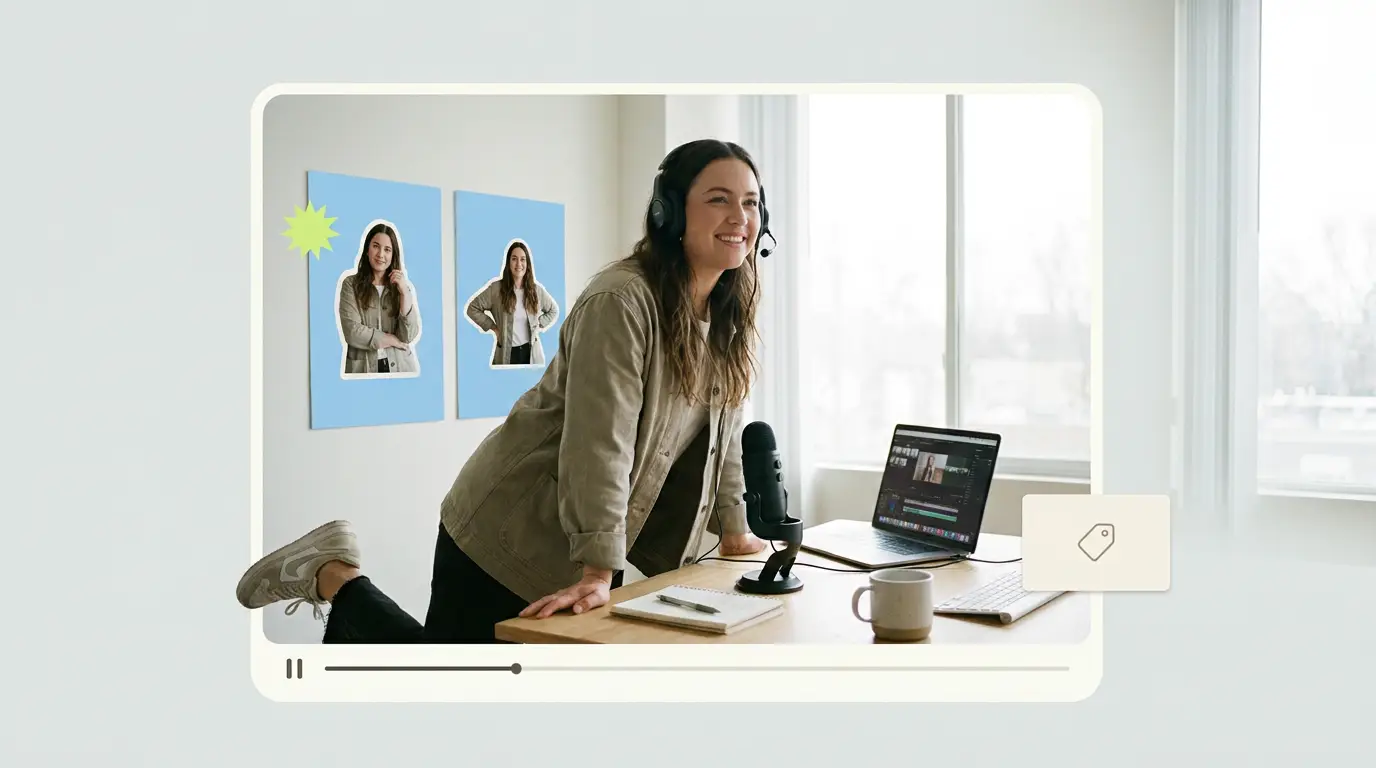
If you publish a podcast on a weekly cadence, a podcast video editing service is the difference between a show that ships on time and one that stalls in a backlog of half-finished files. The question most teams ask is simple: what does it actually cost, and which pricing model makes sense for the volume you produce? This guide breaks down what a podcast video editing service includes, how the major pricing models compare, what pushes the price up or down, and why a subscription editor tends to win for steady weekly output.
Video is not optional for a serious podcast anymore. According to Wyzowl, 91% of businesses use video as a marketing tool, and 82% say a video convinced them to buy a product or service. A podcast that lives only as audio leaves most of that demand on the table.
What a podcast video editing service actually does
The phrase covers more than trimming a long recording. A full-service podcast video editing service typically delivers four distinct outputs from a single recording session, and the price you pay reflects how many of these you need.
The first is the full-episode edit. This is the polished long-form video: cleaned audio, multi-camera switching if you record with more than one angle, color correction, intro and outro graphics, lower-third name tags, and the removal of dead air, cross-talk, and verbal stumbles. A one-hour raw recording usually becomes a 40 to 55 minute finished episode.
The second output is audiograms. These are short, visually animated clips built around a waveform or a static frame, designed for platforms where audio alone needs a visual hook. They are cheap to produce but effective for promoting an episode on social feeds.
The third, and often the most valuable, is short clips for social. A single episode can yield five to fifteen vertical clips sized for Reels, Shorts, and TikTok. Good clip editing means choosing the right 30 to 60 second moments, reframing horizontal footage to vertical, adding hooks, and pacing the cut so it holds attention. This is where most of the audience growth happens, and it is also where editing effort concentrates. If you want a deeper look at this discipline, see our guide to a short-form video editing service.
The fourth is captions. Burned-in captions on clips and accurate subtitle files for full episodes. Captions are not a nice-to-have; most social video is watched without sound, so a clip without captions loses most of its reach.
A service that handles all four from one upload is doing the work of a small production team. For a fuller breakdown of how this works specifically for B2B shows, our video podcast editing service for B2B guide covers the workflow end to end.
The three pricing models
There are three common ways to pay for podcast video editing, and each suits a different production rhythm.
Per-episode freelance
A freelance editor charges by the deliverable. Typical rates run $75 to $250 per video, where a "video" might be a single clip, an audiogram, or a full episode. Full-episode edits sit at the top of that range, and a bundle of clips is priced per clip. For a weekly show that needs one full episode plus ten clips, you are stacking deliverable fees every single week, and the total adds up faster than most people expect.
Freelance is a sensible starting point for a low-volume show or a one-off project. The risk is consistency: a single freelancer takes holidays, gets booked by other clients, and has a turnaround that flexes with their workload. When your publishing calendar is fixed, that variability becomes a real problem.
Agency per-project

A production agency prices by the project or the package. Rates range from $500 to $5,000 or more per project depending on scope, number of cameras, animation complexity, and the volume of clips. Agencies bring polish and capacity, and they suit launches, branded series, and high-production-value flagship shows.
The trade-off is cost and friction. Per-project pricing means every new episode is a new quote, a new scope conversation, and often a new round of onboarding. For a weekly cadence, the per-project model becomes expensive and slow. Our comparison of the best video editing services walks through where agencies fit and where they do not.
Subscription

A subscription editing service charges a flat monthly fee for an agreed scope of output, usually with a dedicated editor and no per-deliverable billing. This is the model built for volume. Instead of paying per clip, you pay one predictable price and submit as much as your plan allows. For a weekly show producing one episode and a batch of clips every week, the per-deliverable cost under a subscription drops well below freelance or agency rates.
Pixel8 uses this model. Our video editing subscription guide explains the mechanics, but the short version is that a flat monthly fee with unlimited revisions removes the per-project math entirely.
What drives the price
Whatever model you choose, the same factors push the price up or down. Understanding them helps you scope a brief that does not pay for work you do not need.
Volume of deliverables. This is the biggest lever. One full episode is cheap. One full episode plus fifteen captioned vertical clips is a different order of work. Be honest about how many clips you will actually publish.
Turnaround speed. Rush work costs more. A 48-hour turnaround is fast for full-service editing, and services that guarantee it price that reliability in. Slower turnaround is cheaper but can break a publishing schedule.
Revisions. Per-project and freelance arrangements often cap revisions and charge for extra rounds. Unlimited revisions remove that friction but are usually only offered under a subscription.
Complexity. Multi-camera switching, motion graphics, animated audiograms, and custom branded templates all add hours. A single-camera talking-head edit is far cheaper than a three-camera show with full motion design.
Raw footage quality. Clean audio and well-lit footage edit faster than messy recordings. Poor source material increases editing time and therefore cost, regardless of who does the work.
For context on the labor behind these numbers, ZipRecruiter data shows video editor salaries vary widely by region and experience, which is part of why freelance and agency quotes range so much.
Comparing the real cost for a weekly show
Run the numbers for a show that publishes one full episode and ten clips per week, which is a common B2B podcast setup.
Under freelance per-episode pricing, a full edit might run $200 and each clip $75. That is $200 plus $750 in clips, or roughly $950 per week. Across a month, you are looking at close to $3,800, and that assumes your freelancer has the capacity to take every batch on schedule.
Under agency per-project pricing, a weekly package at the lower end might be $1,000 to $1,500 per week once clips and captions are included, which lands between $4,000 and $6,000 per month for a steady cadence.
Under a subscription like Pixel8, the price is $2,000 to $3,200 per month flat, covering the full episode, the clips, the captions, and the audiograms, with a dedicated editor and unlimited revisions. The general market for video editing spans $500 to $3,000, and a weekly podcast at real volume sits at the upper, busier end of that range, which is exactly where a flat subscription beats per-deliverable billing.
The pattern is consistent: as soon as weekly volume is real, the per-deliverable models cross the cost of a subscription, and you also inherit their scheduling risk. Data from HubSpot reinforces why that volume matters; consistent short-form output is one of the strongest drivers of reach for brands publishing video.
Why subscription wins for weekly output
The case for a subscription comes down to three things: predictability, throughput, and revisions.
Predictability matters because a weekly show is a recurring obligation, not a series of one-off projects. A flat monthly fee means your editing line item never moves, and you never stop to get a quote before you can ship. That removes the single biggest source of delay in most podcast workflows.
Throughput matters because a dedicated editor who works on your show every week learns your format, your branding, and your preferences. The tenth episode is faster and better than the first because the editor is not starting cold each time. A rotating cast of freelancers never builds that muscle memory.
Revisions matter because the first cut is rarely the final cut. Unlimited revisions mean you can ask for the changes that make a clip actually land without watching a counter tick up. Under per-project billing, every revision is a negotiation.
If you want to understand the broader category, our done-for-you video editing service guide explains how the managed model removes operational overhead beyond just editing.
What Pixel8 Production offers
Pixel8 is a done-for-you B2B video editing subscription built for teams that publish on a schedule. The price is $2,000 to $3,200 per month, flat, with no per-project fees.
Every plan includes a dedicated editor who learns your show and owns your output, a 48-hour turnaround on standard deliverables, and unlimited revisions so the final cut is genuinely final. You upload a raw recording and receive the full-episode edit, the vertical clips for social, audiograms, and captions, all under one monthly fee.
The model is built for B2B SaaS companies, agencies, founders, and professional-services firms that treat their podcast as a content engine rather than a hobby. There is no per-clip math, no new quote for each episode, and no scheduling gap when your usual freelancer is unavailable. The price covers the volume a weekly show actually generates, which is where per-deliverable pricing stops making sense.
Podcast editing is one slice of a broader rate card. For how these figures compare across every pricing model, see our guide to video editing rates.
Bottom line
A podcast video editing service can cost anywhere from a few hundred dollars for a one-off freelance edit to several thousand for a full agency production. The right choice depends on volume. If you publish occasionally, freelance works. If you run a flagship branded series, an agency makes sense. But if you ship a video podcast every week and need full episodes, clips, audiograms, and captions on a reliable schedule, a subscription at a flat $2,000 to $3,200 per month is the model that holds its cost as your output grows. Predictable price, a dedicated editor, a 48-hour turnaround, and unlimited revisions are what keep a weekly show shipping on time.
Where to go from here
Frequently asked questions
How much does a podcast video editing service cost?
It depends on the model. Freelance editors charge $75 to $250 per video, agencies charge $500 to $5,000 or more per project, and subscription services like Pixel8 charge a flat $2,000 to $3,200 per month. The general market for video editing spans $500 to $3,000, with weekly podcasts sitting at the busier end. A $900 trial is available to test the service before committing to a monthly plan.
What is included in a podcast video editing service?
A full-service offering includes the polished full-episode edit, short vertical clips for social platforms, audiograms, and captions. Some services bundle all four from a single upload, while freelancers often price each deliverable separately.
Is a subscription cheaper than hiring a freelancer?
For a weekly show, usually yes. Once you add up per-clip and per-episode fees across a month, freelance costs often exceed a flat subscription, and you also take on the scheduling risk of a single person's availability. For a low-volume or one-off show, freelance can be cheaper.
Should I hire an in-house editor instead?
An in-house editor costs $55,000 to $75,000 per year in salary alone, plus software, benefits, and management overhead. That makes sense at very high volume, but for most podcasts a subscription delivers the same output for a fraction of the annual cost.
What turnaround time should I expect?
It varies by provider. A 48-hour turnaround on standard deliverables is fast for full-service editing. Freelance turnaround flexes with the editor's workload, and agency turnaround depends on the project queue, so confirm the commitment before you sign.
How many short clips can one episode produce?
A single one-hour episode typically yields five to fifteen vertical clips, depending on how much usable content the conversation contains. The number of clips you actually publish is one of the biggest drivers of total editing cost.
What drives the price up the most?
Volume of deliverables is the single largest factor, followed by turnaround speed, editing complexity such as multi-camera and motion graphics, the number of revision rounds, and the quality of your raw footage. Cleaner source material edits faster and costs less.

Prakhar Mehta
Pixel8 is a done-for-you video editing subscription, giving SaaS companies, agencies, and founders a dedicated editing team with 48-hour turnaround.
Ready to stop doing this yourself?
Get a dedicated video editing team. 48-hour turnaround, unlimited revisions, month-to-month.