Video Editing for Construction Companies
Video editing for construction companies turns raw site footage into polished timelapses, project showcases, and recruiting videos that win more bids.
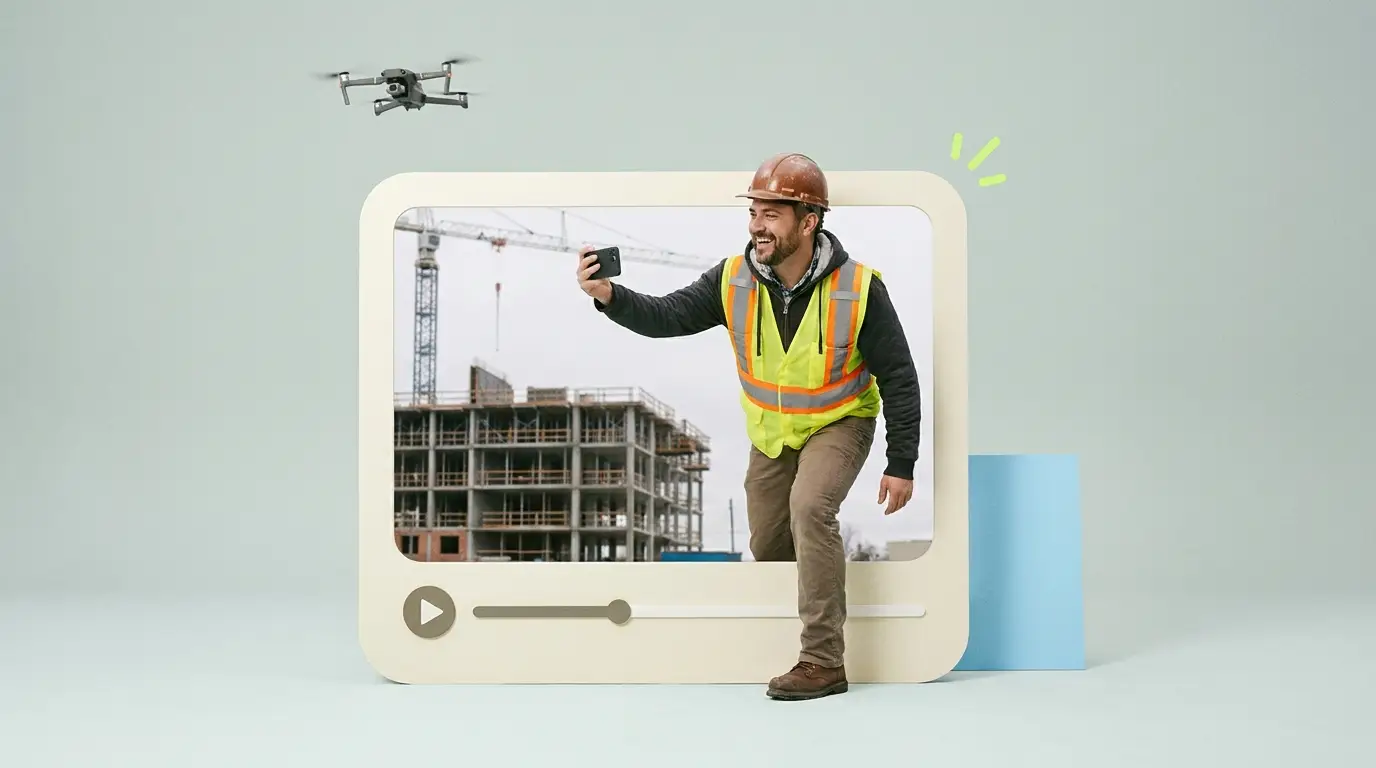
Video editing for construction companies is the difference between a phone full of raw site clips and a finished video that wins the next bid. Most contractors already capture footage. Crews film concrete pours, drone operators fly over a topped-out steel frame, and a superintendent records a quick progress update for the owner. The problem is never a shortage of footage. The problem is that nobody on the crew has the time, software, or skill to turn 200 gigabytes of shaky clips into something a developer, a recruit, or a city council actually wants to watch.
This guide covers how construction and contracting firms use edited video to win work and attract talent, what to look for when you hand that editing off, and how the cost of doing it yourself compares to a done-for-you service.
Why construction firms are filming everything now
Walk any active jobsite and you will see phones, GoPros, and drones. The reason is simple. Video is now how decisions get made. According to Wyzowl's video marketing research, 91% of businesses use video as a marketing tool, and 82% of people say a video convinced them to buy a product or service. For a construction firm, that "purchase" is a signed contract or a senior estimator who chooses your bid over three others.
The catch is that raw footage does none of this. A 14-minute unedited drone flyover puts a client to sleep. A pile of vertical clips shot by different crew members on different days does not tell a story. Editing is what converts captured reality into a tool that sells. The footage is the raw material. The edit is the product.
The five videos every contractor actually uses

Not every construction video serves the same goal. Before you film or hire an editor, it helps to know which of these you need.
1. Project timelapses
A timelapse compresses months of work into 60 to 90 seconds. A fixed camera shoots a frame every few minutes, and editing stitches thousands of stills into a smooth sequence that shows a foundation become a finished building. Timelapses are the single most requested construction video because owners love watching their investment rise. They also double as proof of schedule for disputes. Good editing here means color-matching footage across seasons, smoothing out camera bumps, and cutting dead time like weather delays.
2. Site progress updates
These are short, regular videos sent to owners, lenders, and project stakeholders. Instead of a 40-page written report, the project manager walks the site narrating what changed. Editing trims the dead air, adds captions and date stamps, branded title cards, and overlays callouts on specific scopes. A clean monthly progress reel keeps clients calm and reduces the "what is happening with my money" phone calls.
3. Completed-project showcases
This is your portfolio piece and your best bidding tool. It combines drone footage, interior walkthroughs, before-and-after comparisons, and sometimes a short client testimonial into a two to three minute story. When you bid the next job, this video proves you can deliver. It is the construction equivalent of a finished home tour, and it is what you embed on your website and send with proposals.
4. Safety and training videos
Edited safety content standardizes onboarding and protects you in an audit. A polished toolbox-talk series or site-specific orientation video means every new hire gets the same message. Editing adds chapter markers, on-screen text for key OSHA points, and clean audio so the message lands.
5. Recruiting videos
The trades are short on people, and a recruiting video shows what your competitors only claim. Footage of real crews, real equipment, and real culture tells an apprentice why your firm is the place to build a career. This is where editing earns its keep, cutting authentic moments into something that feels human instead of corporate.
How a done-for-you service fits a jobsite workflow
The reason most contractors never produce these videos is that the editing step dies on the vine. Footage gets dumped on a drive and forgotten. A done-for-you editing service fixes the bottleneck without adding work for the crew.
The workflow is straightforward. Your team keeps doing what it already does: capturing footage on phones, drones, and fixed cameras. You upload the raw files to a shared drive. A dedicated editor turns that footage around, usually within a couple of days, and sends back a finished video. You review, request changes, and publish. The crew never touches editing software, never learns a timeline, and never loses a billable hour to color grading.
This is the model Pixel8 uses, and it is the same approach we describe in our done-for-you video editing service overview. The point is to remove editing from the list of things your team has to figure out. If you want the broader case for outsourcing this function rather than hiring, our guide to a video editing service for businesses walks through it for any industry, construction included.
What to look for in a construction video editor

Construction footage is not like editing a podcast or a talking-head video. The material is heavier, messier, and more technical. Here is what actually matters when you evaluate a service.
They can handle drone and timelapse footage
This is the first filter. Drone footage comes in high resolution and large file sizes, often with log color profiles that look flat and gray until graded. Timelapse work means processing thousands of sequential stills, removing flicker, and stabilizing a camera that sat outside in the wind for three months. Plenty of editors can cut an interview. Far fewer know how to make a topped-out building look cinematic from 400 feet up. Ask for construction or architectural samples specifically. Per HubSpot's marketing research, the production quality buyers expect keeps climbing, so a flat, ungraded drone shot now reads as amateur.
Turnaround that matches your pace
A jobsite moves fast. If your editor takes three weeks, your progress update is stale before it ships and your timelapse milestone is buried under newer footage. Look for a defined turnaround. Pixel8 commits to 48-hour turnaround on standard edits, which means a Friday upload comes back Monday or Tuesday, in time to send to the owner before the next draw meeting.
Brand consistency across every video
If your timelapse, your safety video, and your showcase all use different fonts, colors, and intros, you look like three different companies. A good service builds a brand kit once, with your logo, color palette, lower-third style, and title cards, then applies it to every video. This is where a video editing subscription services guide is worth reading, because the subscription model is what keeps that consistency going month after month with the same editor who already knows your brand.
Revisions without a meter running
Construction stakeholders have opinions. The owner wants the logo bigger, the partner wants a different shot of the lobby, legal wants a disclaimer added. If every revision triggers a new invoice, you will stop asking for changes and settle for worse video. Unlimited revisions, which Pixel8 includes, means you keep refining until the video is right.
Cost: DIY versus hiring versus a service
This is where most contractors get stuck, so let us put real numbers on it.
Doing it yourself
The hidden cost of DIY is your team's time, which is the most expensive resource on any job. A project manager earning a six-figure salary spending six hours fighting with editing software is not a free video. It is a very expensive one, and the output usually looks it. Add the cost of editing software subscriptions and a computer powerful enough to handle 4K drone footage, and "free" gets pricey fast.
Hiring an in-house editor
A full-time video editor in the United States earns roughly $55,000 to $75,000 per year, based on ZipRecruiter salary data, before benefits, payroll taxes, software, and equipment. For most contractors that is hard to justify, because video work comes in bursts. You have heavy editing needs when a project wraps and almost none in the slow weeks between. You end up paying a full salary for part-time demand.
Freelancers and agencies
Freelance editors typically charge $75 to $250 per video, which works for one-off projects but gets unpredictable when you need a steady stream of content and a freelancer who disappears mid-project. Agencies run $500 to $5,000 or more per project, which buys high production value but rarely fits a contractor who needs monthly volume rather than one polished hero film. Market rates for ongoing editing help generally land between $500 and $3,000 depending on volume and model. If you want to see how the options stack up side by side, we compared them in our roundup of the best video editing services compared.
The subscription model
A done-for-you subscription sits between the freelancer and the agency. Pixel8 runs $2,000 to $3,200 per month for a dedicated editor, 48-hour turnaround, and unlimited revisions. For a firm producing regular progress updates, the occasional showcase, and a recruiting reel, that flat monthly cost is predictable and usually cheaper than the loaded cost of an in-house hire, with no idle salary in the slow weeks. For shorter social clips specifically, the same logic applies to a short-form video editing service for the vertical content you post to attract crews and clients.
What Pixel8 Production offers

Pixel8 is a done-for-you B2B video editing subscription built for businesses that capture footage but do not want to manage editing in-house. For construction and contracting firms, that means you keep filming your jobsites and we handle the rest.
You get a dedicated editor who learns your brand and your project style, so your timelapses and showcases stay consistent. Standard edits come back within a 48-hour turnaround, fast enough to keep progress videos current with the work on site. Revisions are unlimited, so you can satisfy the owner, the partner, and legal without watching a meter. Pricing is a flat $2,000 to $3,200 per month, with no per-video surprises and no idle salary in the weeks when filming slows down.
We handle drone footage, multi-month timelapses, site progress reels, completed-project showcases, safety content, and recruiting videos. You upload raw files, we send back polished video, and your crew never opens an editing timeline.
Bottom line
Your crews are already filming. The footage sitting on a drive does nothing until someone edits it into a timelapse that wows an owner, a showcase that wins the next bid, or a recruiting reel that brings in the apprentices you cannot find. Video editing for construction companies is what closes that gap, and a done-for-you subscription closes it without pulling a single person off the job. If you are weighing the cost of a full-time hire against a flat monthly service, the math usually favors the service, especially when video work comes in bursts. Keep filming, hand off the editing, and let the finished video do the selling.
Where to go from here
Frequently asked questions
What is video editing for construction companies?
It is the process of turning raw jobsite footage, including drone flights, fixed-camera timelapses, and phone clips, into finished videos like progress updates, completed-project showcases, safety content, and recruiting reels. The editing adds color grading, stabilization, branded graphics, captions, and a clear story so the footage actually helps you win bids and hire crews.
How much does it cost to edit construction videos?
It depends on the model. Freelancers charge $75 to $250 per video, agencies run $500 to $5,000 or more per project, and a full-time in-house editor costs $55,000 to $75,000 a year before benefits. A done-for-you subscription like Pixel8 is $2,000 to $3,200 per month for a dedicated editor with unlimited revisions, which is usually the most predictable option for firms producing regular video. A $900 trial is available to test the service before committing to a monthly plan.
Can an editing service handle drone and timelapse footage?
A good one can, but not all can, so ask before you commit. Drone footage often arrives in flat log color profiles that need grading, and timelapse work means processing thousands of sequential frames and removing flicker. Always request construction or architectural samples to confirm the editor has done this kind of work before.
How fast can I get my videos back?
Turnaround varies by provider. Some freelancers and agencies take two to three weeks. Pixel8 commits to a 48-hour turnaround on standard edits, which keeps progress videos current with what is happening on the jobsite rather than weeks behind.
Do I need to learn editing software or hire someone?
No. With a done-for-you service, your crew keeps capturing footage on the equipment they already use, then uploads the raw files. The editor handles everything else. Nobody on your team touches a timeline, learns software, or loses billable hours to color grading.
Will my videos look consistent across projects?
They will if you use a dedicated editor who builds a brand kit for your firm. That kit holds your logo, colors, fonts, and title-card style and gets applied to every video, so your timelapse, safety video, and showcase all look like they came from the same company. The subscription model keeps the same editor on your account month after month, which is what protects that consistency.
Is outsourcing better than hiring an in-house editor?
For most contractors, yes, because video demand is uneven. Editing needs spike when a project wraps and go quiet in between, so a full salary sits idle during slow stretches. Outsourcing gives you editing capacity only when you need it, at a predictable monthly cost, without the overhead of a permanent hire.

Prakhar Mehta
Pixel8 is a done-for-you video editing subscription, giving SaaS companies, agencies, and founders a dedicated editing team with 48-hour turnaround.
Ready to stop doing this yourself?
Get a dedicated video editing team. 48-hour turnaround, unlimited revisions, month-to-month.