Video Editing Studio: What It Costs and When You Need One
What a video editing studio actually is, what building or hiring one costs, and the three signs you need a studio rather than a single editor or a subscription.
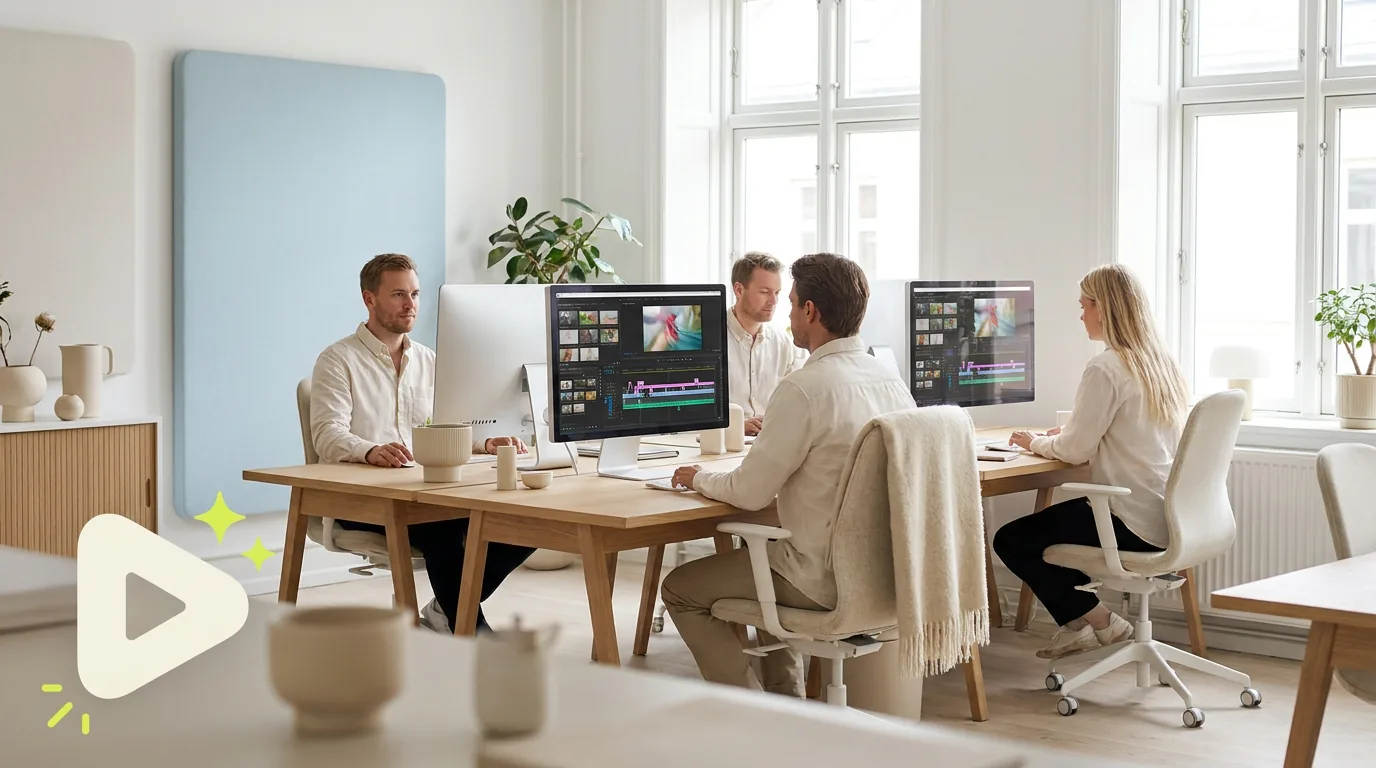
A video editing studio is a team and a set of systems built to finish video at volume, which is a different thing from one talented editor with a fast computer. The distinction matters because most companies searching for a studio do not actually need one. They need reliable output, and a studio is only one of three ways to get it.
This guide sets out what a studio genuinely provides beyond an individual editor, what building one internally costs against hiring an external one, and the specific signals that tell you which of the three models fits.
What a video editing studio actually is
Strip away the word and a studio is four things an individual editor is not.
Redundancy. More than one person can finish your work. When an editor is ill, on holiday, or leaves, the output does not stop. This is the single biggest practical difference and the one people notice only when it fails.
Specialisation. A studio has someone who is genuinely good at motion graphics, someone who is good at sound, and someone who is good at colour. One generalist editor is competent at all three and excellent at maybe one.
Capacity that flexes. Launch week needs three times the normal output. A studio can staff up internally. An individual cannot, no matter how willing.
Process rather than memory. Brand standards live in a documented system, not in one person's head. That is what makes output consistent across editors and across months.
What a studio is not is a physical room. The word carries a legacy meaning of a facility with suites and edit bays, and that meaning is largely obsolete for post-production. The work is software. Most studios operating today are distributed, which is why our guide to remote video editing covers the workflow most of them actually run.
The three models, and what each really costs

Build a studio in-house. You are hiring at least two editors to get redundancy, and realistically a motion designer as well. A video editor in the US costs $55,000 to $75,000 a year according to ZipRecruiter, before benefits, software licences, hardware, and the management time to run them. A minimal internal studio therefore starts around $130,000 to $180,000 annually in salary alone. It makes sense above a certain volume and almost never below it.
Hire an external studio per project. Traditional post houses quote by the job, commonly $500 to $5,000 or more per project depending on length and complexity. The quality ceiling is high and the model is built for campaigns. It suits a flagship piece and suits a weekly cadence badly, because every video restarts the briefing and quoting cycle.
Use a subscription with a dedicated team. A flat monthly fee, typically $2,000 to $3,200 per month, that buys studio-style redundancy and specialisation without the fixed cost of employing it. The trade is that you are not the only client, so genuinely bespoke creative direction is thinner than a dedicated post house would provide.
The comparison people get wrong is judging these on price per video. At two videos a month, per-project work is cheapest. At twenty, it is by far the most expensive, and the in-house option starts looking rational only past the point where you can keep two editors genuinely busy. Our video editing agency cost guide works through the crossover points in detail.
Three signs you actually need studio capacity
Most teams asking this question need an editor, not a studio. These three signals indicate otherwise.
You have missed a deadline because one person was unavailable. Not "we were busy". Specifically: the work stopped because the individual who does it could not do it. That is a redundancy problem and only a team solves it.
Your formats have genuinely diverged. You are producing long-form YouTube, vertical social cutdowns, motion-graphics-heavy explainers, and event recaps. One editor doing all four does none of them at the level a specialist would.
Volume is unpredictable rather than merely high. Steady high volume suits a dedicated editor perfectly well. It is the spikes, launches, conferences, campaign bursts, that break individual arrangements, because you cannot ask one person to triple their output for a fortnight.
If none of those three apply, a single dedicated editor will serve you better and cost less. Our comparison of a dedicated editor against an in-house hire covers that decision.
What to look for when hiring a studio

Ask who specifically does your work. Studios vary enormously here. Some assign a named editor who stays with your account. Others route each job to whoever is free. The second is cheaper and produces visibly less consistent output. This is the question that predicts your experience more than any other.
Ask what happens during a spike. A studio's value is capacity that flexes, so test it. If the answer is vague, you are buying an individual editor with a company name attached.
Ask to see work in your format. A showreel of cinematic brand films tells you nothing about whether they can cut a fifteen-minute product walkthrough that holds attention.
Check the revision model. Fixed revision rounds push you toward accepting work that is close enough. Unlimited revisions matter most in the first month while the style is still being calibrated.
Understand the turnaround commitment. Ask what a normal edit takes and what a rush costs. Studios built for campaigns often quote in weeks, which quietly rules out timely content.
One structural note worth weighing: Wistia found a consistent pattern in its data, that the shorter the video, the higher the engagement rate. That has pushed most B2B output toward high volumes of short pieces rather than a few long ones, and high-volume short-form is precisely the workload that breaks per-project studio pricing.
Where a studio is the wrong answer
Being direct about it, because the word carries prestige that distorts decisions.
If you publish under four videos a month, a studio is overcapacity you will pay for and not use. The redundancy you are buying only pays for itself when the pipeline is busy enough that a gap would actually hurt.
If your output is a single consistent format, you need one good specialist rather than a bench. A team of five who each touch your work occasionally will produce less consistent results than one editor who does all of it and knows exactly how you like your cuts paced.
If your budget is genuinely constrained, an external studio's per-project rate will consume it faster than any subscription, and the per-project model gives you the least predictable spend of the three. Finance teams tend to dislike it for exactly that reason.
And if what you actually need is creative direction and concepting rather than execution, a post-production studio is the wrong supplier entirely. Most are built to finish work rather than originate it, and briefing a finishing house to invent your creative usually produces expensive disappointment on both sides.
There is also a timing question worth asking before you commit to anything. Studio capacity is a fixed arrangement, and video volume for most B2B teams is seasonal, heavier around launches, conferences and end-of-quarter pushes. If your annual output is genuinely lumpy rather than steady, a model that flexes month to month will serve you better than one sized for your busiest fortnight.
What Pixel8 Production offers

Pixel8 Production gives you studio-style capacity on a subscription rather than a payroll.
You get a dedicated editor who learns your brand, with a wider team behind them for motion graphics, thumbnails, and volume spikes. That combination is what most companies are actually looking for when they search for a studio: redundancy and specialisation, without employing five people to get it.
Turnaround is 48 hours on a standard edit. Revisions are unlimited. Pricing is flat, $2,000 to $3,200 per month depending on volume, with a $900 trial if you want to test the working relationship before committing. There are no per-project quotes, which is the part that makes weekly output affordable rather than punishing.
Bottom line
A video editing studio buys three things an individual cannot: redundancy, specialisation, and capacity that flexes. If you have felt the absence of any of those, the extra cost is justified. If you have not, you are likely paying for a bench you will never use, and a single dedicated editor will give you more consistent work for less money. Decide on the failure you are trying to prevent rather than on the size of the supplier.
Where to go from here
Frequently asked questions
What is a video editing studio?
A team and a documented process built to finish video at volume, rather than a single editor. The defining features are redundancy when someone is unavailable, specialists for motion graphics and sound, and capacity that flexes during busy periods. It rarely means a physical facility any more, since post-production is software.
How much does a video editing studio cost?
Building one internally starts around $130,000 to $180,000 a year in salaries for a minimal two-editor team, before software and management. External studios quote per project, commonly $500 to $5,000 or more. Subscription services with a dedicated team run $2,000 to $3,200 per month, and a $900 trial is available to test the service first.
Do I need a studio or just a video editor?
An editor, in most cases. You need studio capacity when work has stopped because one person was unavailable, when your formats have genuinely diverged across long-form, short-form, and motion graphics, or when your volume spikes unpredictably. If none of those apply, one dedicated editor produces more consistent work for less.
Is a video editing studio the same as a production company?
No. A production company films, which means crew, direction, and location. An editing studio finishes footage that already exists. Some companies do both, but the skills, staffing, and cost structures are different, and most teams need editing constantly and filming occasionally.
Should the studio be local to me?
Only if you also need filming. Editing is entirely digital, so restricting yourself to studios within driving distance shrinks your options and raises the price without improving the output.
How do I judge quality before committing?
Ask for work in your specific format rather than a general showreel, ask who personally handles your account, and use a paid trial if one exists. A trial reveals the working relationship, communication, and revision handling, which is what you are actually buying.
What turnaround should a studio offer?
48 hours on a standard edit is a reasonable benchmark for ongoing content. Studios built around campaign work often quote in weeks, which is fine for a flagship film and unworkable for a weekly cadence. Ask specifically about turnaround during a volume spike.
Can a studio maintain a consistent look across editors?
Only with a documented brand system: caption styles, colour treatment, fonts, intro and outro conventions. Ask to see it. If consistency lives in one person's memory rather than a document, it disappears the moment that person is unavailable.

Prakhar Mehta
Pixel8 is a done-for-you video editing subscription, giving SaaS companies, agencies, and founders a dedicated editing team with 48-hour turnaround.
Ready to stop doing this yourself?
Get a dedicated video editing team. 48-hour turnaround, unlimited revisions, month-to-month.