Affordable Sandwich Video Alternatives
Affordable Sandwich Video alternatives for brands that love premium quality but cannot justify a five-figure one-off. Studios, freelancers, and subscriptions.
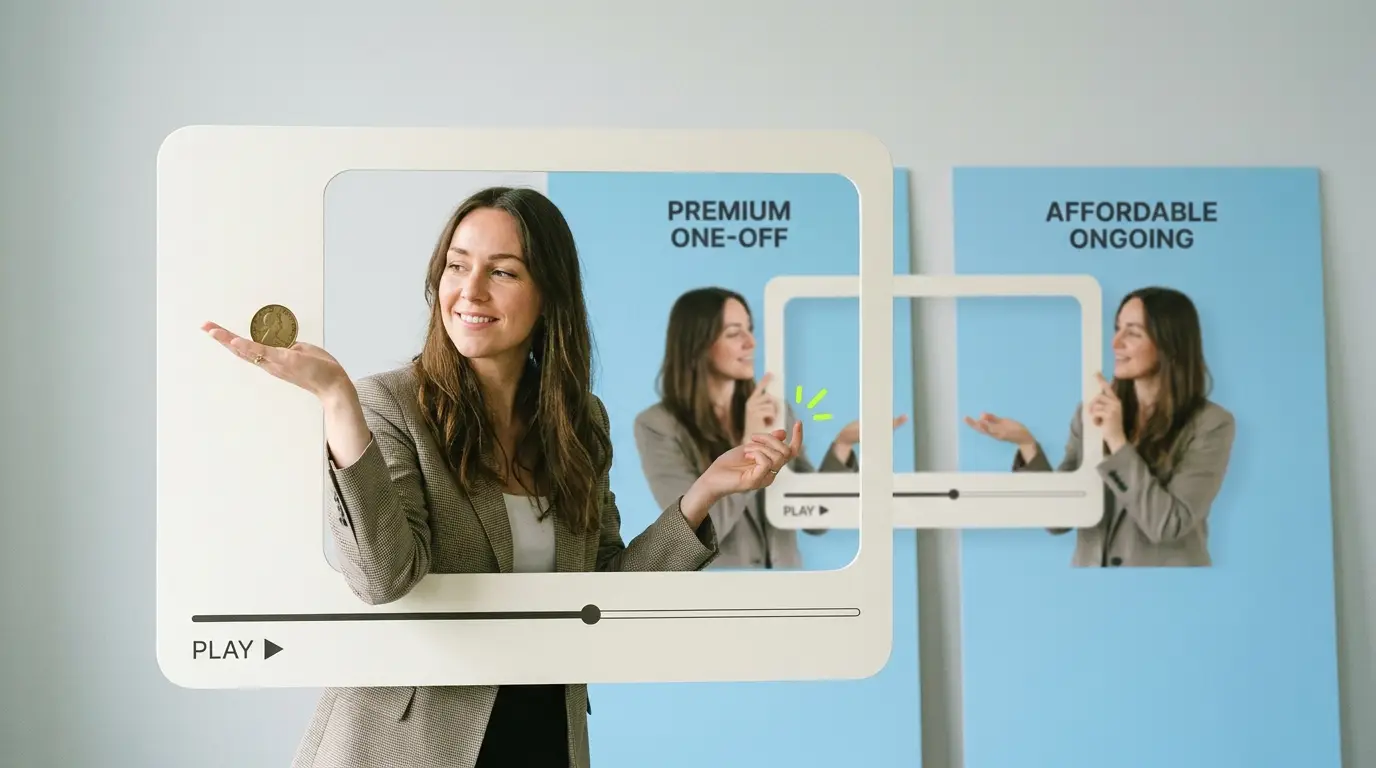
If you have watched a slick product launch film and felt the quality jump off the screen, there is a good chance Sandwich made it. That is exactly why so many founders start looking for Sandwich Video alternatives the moment they see the budget a premium one-off production requires. The work is excellent. The problem is rarely the quality. The problem is that a single high-end launch or brand film can run into five figures or more, and most growing companies need a steady stream of video, not one beautiful piece they cannot afford to repeat.
This guide treats Sandwich fairly as what it is: a premium video production studio with a strong reputation for polished launch and brand films. We are not here to knock it. We are here to help you decide when that premium one-off is genuinely worth the money and when an affordable, ongoing model serves you better. Along the way we will cover other studios, freelancers, and a done-for-you editing subscription built for companies that need consistent output without the agency price tag.
Why people look for Sandwich Video alternatives
Sandwich earned its name on production value. The scripts are tight, the comedy lands, and the films feel expensive in the way that makes a product look credible. For a Series B launch or a category-defining brand moment, that polish can pay for itself.
The trouble shows up the week after the launch. You still need explainer clips for sales, short cuts for social, customer testimonial edits, webinar highlights, and product update videos. A premium studio is built to make a small number of high-stakes pieces beautifully. It is not built to be your everyday video engine, and paying premium one-off rates for routine output is how budgets blow up fast.
Video demand is not slowing down. According to Wyzowl, 91% of businesses use video as a marketing tool, and 82% say a video convinced them to buy a product or service. When video is doing that much work in the funnel, you need it in volume. The question becomes how to get that volume affordably without throwing away the quality bar that made you admire Sandwich in the first place.
The four ways to get video made

When you strip it down, you have four practical options. Each one fits a different budget and a different cadence.
- A premium production studio like Sandwich for high-stakes, one-off films.
- A mid-tier or local production agency for project work.
- Freelance editors and videographers hired per project.
- A done-for-you editing subscription for steady, ongoing output.
Most companies end up using more than one of these. The mistake is using the most expensive option for work that a cheaper model handles just as well. Let us walk through each so you can match the tool to the job.
Option one: keep using a premium studio for the big moments
There are times when a premium one-off is the right call. A funding announcement, a flagship product launch, a rebrand, or a high-budget paid ad campaign all justify spending heavily on a single piece, because the upside of getting it right is large and the piece will be seen by a lot of people.
If that is your situation, do not cheap out. Pay for the studio, get the polished film, and run it hard. Premium one-off productions can run into five figures or more, but for a moment that defines how the market sees you, that can be money well spent.
The error is treating every video like that moment. Most of your video calendar is made of smaller, repeatable pieces that do not need a full studio. For those, you want a model that prices for volume.
Option two: mid-tier and local production agencies

A step down from the premium studios, you have plenty of capable production agencies. These shops can shoot and edit solid work for a wider range of budgets, with agency projects typically landing anywhere from $500 to $5,000 or more depending on scope.
Agencies make sense when you need real production: a crew, a shoot, lighting, and direction. The catch is that the per-project model still creates friction. Every video means a new scope, a new quote, and a new round of back-and-forth. If you are producing video weekly, that overhead adds up in both time and money. For a deeper breakdown of how agency, freelance, and subscription models stack up, our guide on the best video editing services compared lays out the tradeoffs side by side.
Option three: freelance editors and videographers
Freelancers are the most affordable way to get individual videos made. Rates vary widely, but you can expect roughly $75 to $250 per video for editing work, depending on complexity and the editor's experience. If you have raw footage and just need someone to cut it, a good freelancer is hard to beat on price.
The honest downside is consistency and management. A great freelancer is a real asset. But you are responsible for finding them, briefing them, reviewing the work, and chasing revisions. When they get busy with another client or go on vacation, your pipeline stalls. For context on what the role pays full time, ZipRecruiter data on video editor salaries shows a wide range, which tells you the talent pool is uneven. You can find a bargain or you can overpay for someone who misses your style.
Freelance works best when your volume is low and predictable, or when you have someone in-house to manage the relationship. Once your needs grow past a few videos a month, the management load starts to feel like a part-time job.
Option four: a done-for-you editing subscription

This is the model most companies overlook, and it is often the best fit for the exact person searching for Sandwich Video alternatives. Instead of paying per project or hiring per video, you pay a flat monthly fee for ongoing editing with a dedicated editor who learns your brand.
The math is where it gets interesting. Hiring an in-house editor costs roughly $55,000 to $75,000 per year before benefits, equipment, and software. A subscription gives you comparable consistency at a fraction of the commitment, and you can pause or scale as your needs change. If you want the full cost comparison, our breakdown of video editing subscription pricing walks through the numbers against hiring and agencies.
A subscription is not the right tool for a full cinematic shoot. It is the right tool for the ongoing river of content that sits between your big launch moments: the social cuts, the explainers, the testimonials, the repurposed webinar clips. That is most of your video calendar, and it is the part premium studios were never designed to handle affordably.
What Pixel8 Production offers
Pixel8 is a done-for-you B2B video editing subscription built for exactly this gap. You get a dedicated editor who learns your brand, a 48-hour turnaround on most requests, and unlimited revisions until the work is right. Pricing is flat at $2,000 to $3,200 per month, with no per-project quotes and no surprise invoices.
Here is how that plays out in practice. You send raw footage, screen recordings, interview takes, or even a rough idea, and your editor turns it into finished video. Because the editor sticks with you month after month, they stop needing detailed briefs. They already know your fonts, your pacing, your lower-third style, and the kind of hook your audience responds to. That continuity is the thing freelancers and agencies struggle to deliver and the thing that makes ongoing output feel effortless.
The model fits the way modern marketing actually consumes video. HubSpot research on video marketing trends shows just how central short, frequent video has become across the funnel. You cannot feed that machine with one launch film a quarter. You feed it with steady, reliable editing, which is exactly what a subscription is built to provide. If you want to understand the format end to end, our done-for-you video editing service overview explains how the workflow runs day to day, and our corporate video production subscription guide covers how it fits a B2B content program.
How to choose between premium one-off and affordable ongoing
The decision is less about which option is better and more about which job you are trying to do. A simple way to think about it:
- Choose a premium studio when the stakes are high, the audience is large, and the piece is a one-time event you want to be perfect. A major launch or rebrand fits here.
- Choose an agency or freelancer when you have an occasional project that needs a real shoot or a specific specialist skill.
- Choose a subscription when you need consistent volume, fast turnaround, and a predictable budget. This is where most ongoing content lives.
Many smart teams run a hybrid. They book a premium studio once or twice a year for the marquee film, then hand everything else to a subscription that keeps the calendar full at a flat rate. That gives you the cinematic peaks without paying premium rates for the everyday work.
If you are weighing the broader category before committing, our video editing subscription services guide compares the major providers and explains what to look for in turnaround, revisions, and editor quality.
What you actually trade off
It is worth being clear about the tradeoffs, because every affordable option gives something up.
A subscription is not going to send a crew to your office to shoot a glossy brand film. It edits the footage you provide or works with the material you already have. If your need is a full production with sets, actors, and a director, a studio is the honest answer.
Freelancers give you the lowest per-video price but the highest management burden. Agencies give you production muscle but per-project friction and slower turnarounds. Premium studios give you the highest polish but the highest cost and the slowest cadence.
The reason a subscription wins for so many companies is that the work most teams need most often, the steady stream of editing, is precisely what it optimizes for. You are not paying premium one-off rates for routine cuts, and you are not managing a roster of freelancers either.
Bottom line
Sandwich makes outstanding video, and for the right moment a premium one-off is worth every dollar. But most of your video calendar is not that moment. It is the steady stream of clips, cuts, and explainers that keep your brand visible week after week, and paying premium one-off rates for that work is how budgets break.
The most affordable Sandwich Video alternative for ongoing output is a done-for-you editing subscription. You keep the quality bar high, you get a dedicated editor who learns your brand, and you pay a flat, predictable rate instead of a five-figure invoice. Book the studio for the launch film if you need it. For everything else, a subscription at $2,000 to $3,200 per month keeps the content flowing without the sticker shock.
Where to go from here
Frequently asked questions
What is Sandwich Video known for?
Sandwich is a premium video production studio with a strong reputation for polished launch and brand films, often built around sharp writing and high production value. Brands hire it for high-stakes, one-time pieces where quality matters more than cost.
Why are Sandwich Video alternatives worth considering?
Because a premium one-off production can run into five figures or more, and most companies need ongoing video rather than a single film. Alternatives like agencies, freelancers, and editing subscriptions deliver steady output at a fraction of that per-piece cost.
How much do affordable video options cost?
It depends on the model. Freelance editing runs roughly $75 to $250 per video, agency projects land around $500 to $5,000 or more, and the general market for video work spans about $500 to $3,000. A done-for-you editing subscription like Pixel8 is a flat $2,000 to $3,200 per month. A $900 trial is available to test the service before committing to a monthly plan.
Is a subscription cheaper than hiring an in-house editor?
Usually, yes. An in-house editor costs about $55,000 to $75,000 per year before benefits, equipment, and software. A subscription gives you comparable consistency at $2,000 to $3,200 per month, and you can pause or scale without the overhead of a full-time hire.
When should I still use a premium studio?
Use a premium studio for high-stakes, one-time moments such as a flagship launch, a rebrand, or a major paid campaign where a large audience will see the piece. For those, the polish can pay for itself. For everything else, an affordable ongoing model is usually the smarter spend.
What does Pixel8 actually do?
Pixel8 is a done-for-you B2B video editing subscription. You get a dedicated editor who learns your brand, a 48-hour turnaround on most requests, and unlimited revisions, all for a flat $2,000 to $3,200 per month. It handles the ongoing editing work that premium studios are not built to do affordably.
Can I combine a studio and a subscription?
Yes, and many teams do. They book a premium studio once or twice a year for the marquee film, then route all the routine content, the social cuts, explainers, and testimonials, through a subscription. That hybrid gives you cinematic peaks without paying premium rates for everyday output.

Prakhar Mehta
Pixel8 is a done-for-you video editing subscription, giving SaaS companies, agencies, and founders a dedicated editing team with 48-hour turnaround.
Ready to stop doing this yourself?
Get a dedicated video editing team. 48-hour turnaround, unlimited revisions, month-to-month.