Podcast Video Editing Service: A Guide
A podcast video editing service turns raw episodes into polished videos and short clips for YouTube and social. Learn what to look for, turnaround, and cost.
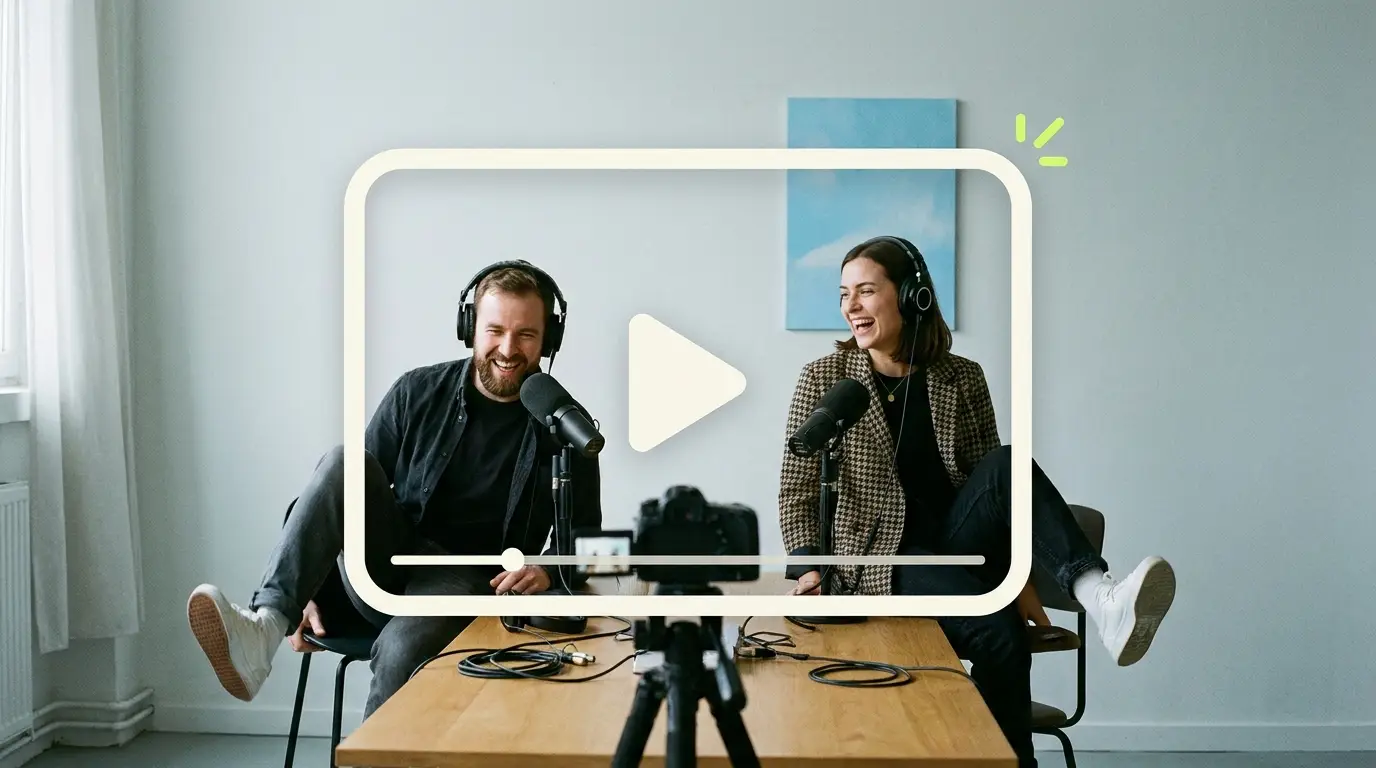
A podcast video editing service takes the long, multicam recording you finished on Friday and hands you back a clean full episode plus a stack of short clips ready for YouTube, Instagram, TikTok, and LinkedIn. The right podcast video editing service does this every single week, on a schedule, with consistent branding, captions, and color, so your show looks the same in episode 40 as it did in episode 4. That consistency is what separates a podcast that grows from one that quietly stalls.
Video podcasting has stopped being optional. People want to watch interviews, not just hear them, and the platforms reward it. According to Wyzowl research, 91% of businesses use video as a marketing tool and 82% say a video has convinced them to buy a product or service. A weekly video podcast is one of the most efficient ways to produce that volume of video, because one recording session can feed an entire month of content if it gets edited well.
This guide covers what a podcast video editing service actually does, what to look for when you hire one, realistic turnaround for weekly shows, how one episode becomes many clips, and how the cost compares to editing it yourself or hiring a freelancer.
What a podcast video editing service actually does
The job is bigger than trimming dead air. A full-service editor handles several distinct layers on every episode.
Multicam editing. Most video podcasts record two to four angles: a wide shot, a camera on each host or guest, and sometimes a screen capture. The editor syncs all of that audio and video, then cuts between angles so the conversation feels alive instead of static. Good multicam cutting is invisible. You notice it only when it is missing and you are staring at the same locked-off shot for nine minutes.
Audio cleanup. Room echo, uneven levels between a loud host and a soft guest, plosives, background hum. The audio gets leveled, de-noised, and balanced so it is comfortable on both earbuds and laptop speakers.
Color and branding. Matching the look across cameras, applying your lower thirds, intro animation, outro card, and the same fonts and colors every week. This is the part that builds recognition.
Captions. Burned-in or platform captions, accurate and properly timed. A large share of social video gets watched on mute, so captions are not a nice extra, they are how most people consume the clip.
Clipping and repurposing. Pulling the strongest two to five minute moments out of the full episode and reformatting them vertically for shorts and reels. This is where a single recording multiplies into a content calendar.
If you want a deeper breakdown of how this works specifically for business shows, our piece on video podcast editing for B2B goes further into workflow and brand standards.
What to look for when hiring

Not every editor or service is built for the grind of a weekly show. Here is what actually matters.
They can handle multicam without hand-holding. Ask to see a sample episode with more than two angles. Syncing and cutting multicam is a skill, and plenty of cheap editors quietly avoid it.
Consistent turnaround you can plan around. A weekly show lives and dies by schedule. You need a service that delivers on the same cadence every week, not one that is fast in month one and slow by month three.
A repurposing system, not one-off clips. The value of video podcasting is volume. Look for a service that treats clips as a standard part of the deliverable, not an upsell you have to chase. Our guide to short-form video editing explains what good clip output looks like.
Brand consistency baked in. Your intro, lower thirds, captions style, and colors should be templated so they are identical every episode without you re-explaining them.
Revisions handled calmly. You will have notes. A service that caps revisions or charges per round creates friction exactly where you do not want it.
One point of contact. Passing your footage through a rotating cast of anonymous editors usually means inconsistent output. A dedicated editor who learns your show is worth a lot.
A done-for-you video editing service model usually checks more of these boxes than a marketplace where you re-brief a new person every time.
Turnaround for a weekly show
For a weekly video podcast, the realistic target is a full episode plus clips delivered within two to three days of you handing over the raw footage. That window lets you stay on a fixed publish day without scrambling.
Why does turnaround matter so much? Because podcasting compounds only if it is consistent. Listeners and the algorithms both reward shows that show up on the same day every week. If your editing turnaround is unpredictable, your publish schedule becomes unpredictable, and the audience habit never forms.
At Pixel8 we work on a 48-hour turnaround for standard deliverables, which means a Monday recording can be live by Wednesday with clips queued for the rest of the week. That speed is only useful if it is reliable, which is the real test of any service. A fast editor who misses every third week is worse than a slightly slower one who never does.
For shows recording multiple episodes in one session, batch delivery works well: record three or four episodes in a day, then receive them on a staggered schedule so your feed stays evenly spaced.
One episode, many clips

This is the part that changes the economics of podcasting. A single 45 minute episode is not one piece of content. Handled correctly, it is one full video plus eight to fifteen short clips, plus audiograms, plus quote graphics.
Here is how a strong repurposing workflow breaks down one recording:
- One full episode for YouTube and your podcast feed, fully edited with multicam and branding.
- Six to twelve vertical clips of the best moments, captioned and formatted for Shorts, Reels, and TikTok.
- Two to four audiograms for LinkedIn and X, where animated waveform video outperforms static posts.
- A handful of quote cards pulled from the strongest lines.
That is a month of social content from one afternoon of recording. The volume play is exactly why so many businesses lean on video, and the data backs it up. HubSpot's research consistently shows short-form video delivering the highest return on investment of any content format, which is precisely what clips from your podcast are.
The trick is treating clip selection as a craft. The clips that perform are self-contained, open with a hook in the first two seconds, and make sense to someone who has never heard of your show. We cover the full method in our guide on how to repurpose long-form video into shorts.
Cost: service vs DIY vs freelance
This is usually the deciding question, so let us be concrete about the options.
Doing it yourself. The software is cheap or free. The cost is your time. Editing one multicam episode with clips properly is easily six to ten hours of work, every week. If your time is worth anything to the business, DIY is the most expensive option on this list, it just hides the cost inside your calendar instead of your bank statement.
Hiring a freelancer. Freelance video editors typically charge $75 to $250 per video depending on complexity and clip count. That is reasonable for occasional work. The risks are availability, consistency, and the eternal problem of the freelancer who vanishes mid-season. You also re-brief and re-explain your brand standards more often than you would like.
Hiring in-house. A full-time video editor in the United States runs roughly $55,000 to $75,000 per year according to ZipRecruiter salary data, before benefits, software, and management overhead. That only makes sense once your volume is high enough to keep one person fully busy.
Hiring an agency or subscription service. Project-based agencies range from $500 to $5,000 or more per project, while general market editing services sit anywhere from $500 to $3,000 depending on scope. A monthly subscription model gives you predictable cost and predictable output, which is what a weekly show actually needs.
If you want to see how the main service types stack up side by side, we put together a comparison of the best video editing services.
What Pixel8 Production offers

Pixel8 Production is a done-for-you B2B video editing subscription built for exactly this kind of recurring work. The price is a flat $2,000 to $3,200 per month, and for that you get a dedicated editor who learns your show, a 48-hour turnaround on standard deliverables, and unlimited revisions so you are never paying per round of notes.
For a podcast, that means you hand over the raw multicam footage and get back the full edited episode plus the clip package, branded consistently, on the same cadence every week. The dedicated editor matters here: because the same person handles your show week after week, your intro, lower thirds, caption style, and color treatment stay identical without you re-explaining anything.
The subscription model fits weekly shows better than per-project pricing because the cost is fixed and the output is predictable. You are not negotiating a quote every episode or worrying that a busy month will blow your budget. You record, you send, you publish.
Bottom line
A podcast video editing service is the difference between a show you intend to publish weekly and one you actually do. The core value is consistency at volume: polished full episodes, a steady stream of clips, identical branding, and a turnaround you can build a schedule around. Weigh the options honestly. DIY hides its cost in your hours, freelancers trade consistency for flexibility, and in-house only pays off at high volume. For most weekly shows, a subscription service like Pixel8 at $2,000 to $3,200 per month gives you the predictable output and fixed cost that a growing podcast needs.
Where to go from here
Frequently asked questions
What is a podcast video editing service?
It is a service that takes your raw recorded podcast episodes, often multicam, and edits them into a finished full video plus short clips. The work includes syncing camera angles, cleaning audio, adding captions and branding, color matching, and formatting clips for YouTube and social platforms.
How long does it take to edit a weekly podcast episode?
A realistic target is two to three days from when you hand over the footage. Pixel8 works on a 48-hour turnaround for standard deliverables, so a Monday recording can publish by Wednesday with clips ready for the rest of the week.
How many clips can you get from one episode?
A single 45 minute episode typically yields six to twelve vertical clips, plus a few audiograms and quote cards, in addition to the full edited video. That is roughly a month of social content from one recording session.
Is a podcast video editing service worth it over doing it yourself?
If you value your time, usually yes. Editing one multicam episode with clips is six to ten hours of weekly work. A service removes that load and keeps your output consistent, which is what builds an audience over time.
How much does podcast video editing cost?
Freelancers charge roughly $75 to $250 per video. In-house editors cost about $55,000 to $75,000 per year. Project agencies run $500 to $5,000 or more, and general market services range from $500 to $3,000. Pixel8's subscription is a flat $2,000 to $3,200 per month. A $900 trial is available to test the service before committing to a monthly plan.
Can a service match my existing branding?
Yes. A good service templates your intro, outro, lower thirds, caption style, fonts, and colors so every episode looks identical. A dedicated editor who handles your show each week keeps that consistency without repeated briefing.
Do I need to record in multicam to use a service?
No, but it helps. A service can edit a single-camera show too. Multicam simply gives the editor more to work with, which makes the final episode more dynamic and produces stronger clips.
What is the difference between a freelancer and a subscription service?
A freelancer is usually billed per video and works on their own availability. A subscription service gives you a fixed monthly cost, a dedicated editor, a guaranteed turnaround, and a standing repurposing system, which suits the recurring nature of a weekly show.

Prakhar Mehta
Pixel8 is a done-for-you video editing subscription, giving SaaS companies, agencies, and founders a dedicated editing team with 48-hour turnaround.
Ready to stop doing this yourself?
Get a dedicated video editing team. 48-hour turnaround, unlimited revisions, month-to-month.