Best Pictory Alternatives for Businesses
Compare the best Pictory alternatives for businesses, from other AI video tools to done-for-you human editing, and learn where each option fits best for you.
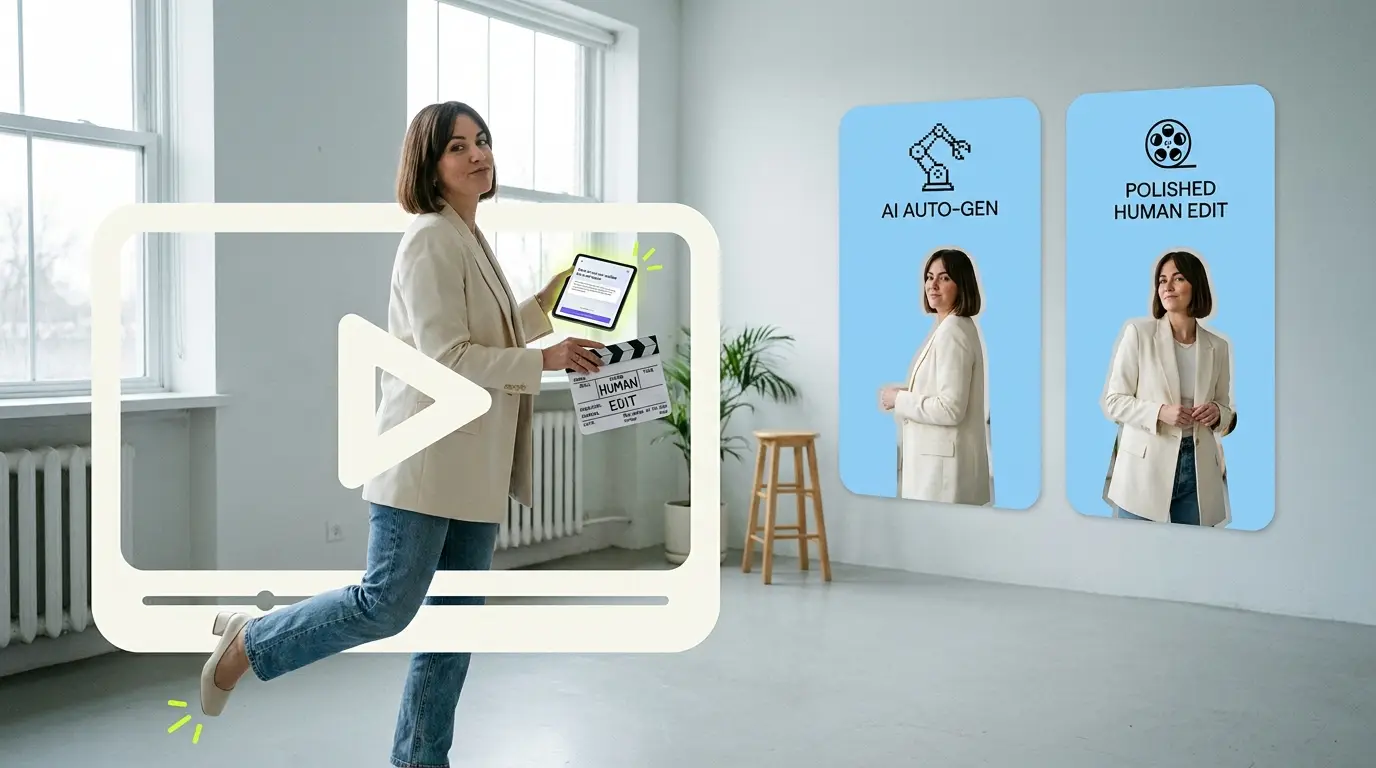
If you have used Pictory to turn blog posts, scripts, or long recordings into short videos, you already know both its appeal and its ceiling. That is exactly why so many teams start searching for Pictory alternatives once their content needs grow past simple automation. Pictory is an AI text-to-video and repurposing tool: you feed it a script or a long video, and it generates a short, captioned clip with stock footage and auto-edits. For quick social posts that works well. For brand-defining work, the output can feel generic. This guide covers the best Pictory alternatives for businesses, from other AI tools to human done-for-you editing, and where each one actually fits.
Video is not optional anymore. According to Wyzowl's video marketing research, 91% of businesses use video as a marketing tool, and 82% of people say a video convinced them to buy a product or service. The question is no longer whether to make video. It is how to produce enough of it at a quality your brand can stand behind.
What Pictory actually does well
Pictory sits in a clear category: automated text-to-video and long-form repurposing. Its strengths are speed and volume. Paste a blog article and it summarizes the text, picks stock clips, adds auto-captions, and exports a short video in minutes. Drop in a webinar recording and it can pull highlight segments without you scrubbing a timeline.
That is genuinely useful for certain jobs. Internal updates, rough social drafts, captioned snippets from a podcast, or a high-volume content calendar where nobody expects cinema-grade polish. Pictory runs on a freemium model with paid monthly tiers, so the entry cost is low and you can test it without a real commitment.
The limits show up when the work has to represent your brand. AI auto-editing makes safe, average choices. It cannot judge which 12 seconds of your founder's talk are the emotional hook. It defaults to library stock that hundreds of other brands also use. Custom motion graphics, on-brand color grading, sound design, and pacing that matches your specific audience are mostly out of reach. For businesses that have moved past the experiment stage, that gap is the reason to look at alternatives.
When AI auto-video is fine and when it falls short
Before comparing tools, it helps to be honest about where automation belongs. AI text-to-video is a good fit when:
- You need volume more than polish, such as daily social clips.
- The content is informational, not emotional or persuasive.
- Captions and a clean cut matter more than original footage.
- You are repurposing existing long-form into rough drafts a human can later refine.
AI auto-video falls short when:
- The video carries your brand identity, like a homepage hero or a paid ad.
- Storytelling, timing, and emotion drive the result.
- You need original footage, custom graphics, or precise brand styling.
- A client or executive will judge the work against agency standards.
Knowing which bucket a project falls into tells you whether a Pictory alternative should be another AI tool or a human editing service. Many businesses end up needing both, and that is a reasonable strategy rather than a failure.
AI-based Pictory alternatives
If automation is working for you and you just want a better or cheaper engine, several AI tools compete in the same space.
Repurposing-focused tools specialize in slicing long videos into short clips. They are strong if your main job is turning webinars, podcasts, or interviews into social cuts. The auto-detection of highlights is often better than a general text-to-video tool, but you still get AI-chosen moments rather than human judgment. If repurposing is your core need, our guide on how to repurpose long-form video into shorts walks through where these tools help and where they do not.
Text-to-video generators focus on script-to-screen, similar to Pictory's core function. Some add AI avatars or voiceover, which can be useful for explainer content or training videos where a presenter on camera is not practical. The tradeoff is the same uncanny, templated feel that pushes teams to look elsewhere for brand work.
Editing software with AI features such as timeline editors that now include auto-captioning and scene detection give you more manual control than Pictory. The catch is that you, or someone on your team, still has to do the editing. You trade automation for control, which only pays off if you have the time and skill in-house.
The honest takeaway: swapping one AI tool for another solves cost and speed problems, not quality and brand problems. If your output keeps looking generic, a different algorithm will not fix it.
The human done-for-you alternative
The other category of Pictory alternative is not software at all. It is a managed service where real editors handle your video. Instead of you steering an algorithm, a person who understands pacing, story, and your brand does the work.
This is the right move when AI output stops being good enough and hiring is not the answer yet. There are a few ways businesses buy human editing, and each has a different cost and control profile.
Hiring an in-house editor
A full-time editor gives you the most control and the deepest brand knowledge over time. It is also the biggest fixed commitment. According to ZipRecruiter salary data, an in-house video editor typically costs $55,000 to $75,000 per year, before benefits, software, and equipment. That math only works when you have a steady, full-time volume of editing to keep one person busy.
Hiring freelancers

Freelancers are flexible and project-based. Rates commonly run $75 to $250 per video depending on length and complexity. The strength is on-demand scaling. The weakness is consistency: managing multiple freelancers, re-explaining your brand each time, and chasing revisions can eat the time you hoped to save. Our walkthrough on how to outsource video editing covers how to manage that without losing your weekends.
Working with an agency

Traditional agencies deliver high production value and full-service planning. They also price accordingly, often $500 to $5,000 or more per project. For a one-off launch campaign that can be worth it. For ongoing weekly content, project-based agency pricing gets expensive fast and is hard to budget.
Subscription editing services

A newer model sits between freelancers and agencies: a flat monthly subscription for done-for-you editing. You get a dedicated editor, predictable pricing, and steady output without the overhead of a hire. This is where managed services like Pixel8 fit. We break down the full category in our video editing subscription services guide and compare providers directly in our roundup of the best video editing services compared.
AI tool vs managed service: how to choose
The decision usually comes down to three questions.
How much does brand quality matter for this content? If a project will define how customers see you, a human editor is worth the cost. If it is filler volume, AI is fine.
How much time can your team spend? AI tools still need someone to prompt, review, and fix output. A done-for-you service removes that work entirely. Be honest about whether your team actually has the hours, because hidden time cost is the most common reason AI tools disappoint.
What is your volume and budget? Across the market, professional editing runs roughly $500 to $3,000 depending on the model and scope. AI tools sit below that on price but also below it on output quality for brand work. The cheapest option is rarely the most cost-effective once you count revisions and redos.
A practical pattern many B2B teams use: keep an AI tool like Pictory for quick internal or experimental clips, and route anything customer-facing to a human editing service. You get speed where speed is enough and quality where quality counts.
What Pixel8 Production offers
Pixel8 is a done-for-you B2B video editing subscription built for businesses that have outgrown AI auto-editors but do not want to hire or manage freelancers. For $2,000 to $3,200 per month, you get a dedicated editor who learns your brand, a 48-hour turnaround on most edits, and unlimited revisions so the final cut actually matches what you pictured.
The difference from a tool like Pictory is the human judgment. Instead of an algorithm picking safe stock clips, a real editor decides which moments land, how the pacing should feel, and how the piece fits your brand. Instead of you reviewing and fixing AI output, the work arrives ready to publish. Compared to a full-time hire at $55,000 to $75,000 per year, the subscription scales with your needs and carries no overhead. Compared to per-project agency pricing of $500 to $5,000 or more, the flat monthly fee is predictable and easy to budget.
It is not the right fit for every job. If you only need rough, high-volume social drafts and brand polish does not matter, an AI tool will serve you better and cost less. Pixel8 is for the work that represents your company. You can see how the model works in detail in our overview of our done-for-you video editing service.
Bottom line
Pictory is a capable AI tool for fast, high-volume video, and for that job it is hard to beat on price. The trouble starts when your video needs to represent your brand, because automation makes average choices that polished work cannot afford. The best Pictory alternatives depend on what you actually need. If you want cheaper or faster automation, another AI tool will do. If you want output that looks like a person who understands your brand made it, a human done-for-you service is the answer. For businesses producing ongoing, customer-facing video, a subscription like Pixel8 at $2,000 to $3,200 per month gives you a dedicated editor, fast turnaround, and unlimited revisions without the cost of a hire or the unpredictability of per-project pricing. Match the tool to the job, and you stop overpaying for quality you do not need and underdelivering on the work that matters most. For more on how video drives results, HubSpot's marketing data is a useful reference.
Where to go from here
Frequently asked questions
What is Pictory used for?
Pictory is an AI text-to-video and repurposing tool. It turns scripts, blog posts, and long videos into short, captioned clips automatically, using stock footage and auto-editing. It is best for quick, high-volume social content rather than polished brand work.
Why do businesses look for Pictory alternatives?
Most businesses hit Pictory's quality and customization limits. The AI makes safe, generic choices, relies on stock footage, and cannot match the storytelling or brand styling that customer-facing video needs. Teams that have moved past experimenting usually want either a better AI engine or human editing.
Are other AI video tools better than Pictory?
Other AI tools can be cheaper, faster, or better at specific tasks like repurposing long videos into clips. But switching from one AI tool to another solves cost and speed, not the underlying quality and brand limits. If your output keeps looking generic, a different algorithm will not fix the core problem.
When should I use AI video tools instead of a human editor?
Use AI when you need volume over polish, the content is informational rather than emotional, and no executive or client will judge it against agency standards. Use a human editor when the video carries your brand, depends on storytelling, or needs original footage and custom graphics.
How much does professional video editing cost?
It varies by model. Freelancers commonly charge $75 to $250 per video, agencies $500 to $5,000 or more per project, and an in-house editor costs $55,000 to $75,000 per year. Subscription services sit in between, with the broad professional market running roughly $500 to $3,000.
How is a subscription editing service different from Pictory?
Pictory is software that automates editing, so you still prompt, review, and fix the output. A subscription service like Pixel8 gives you a real, dedicated editor who does the work to a brand-ready standard, with a 48-hour turnaround and unlimited revisions, for $2,000 to $3,200 per month.
Can I use Pictory and a managed service together?
Yes, and many teams do. Keep Pictory for fast internal or experimental clips where polish does not matter, and route anything customer-facing to a human editing service. That way you get speed where speed is enough and quality where it counts.

Prakhar Mehta
Pixel8 is a done-for-you video editing subscription, giving SaaS companies, agencies, and founders a dedicated editing team with 48-hour turnaround.
Ready to stop doing this yourself?
Get a dedicated video editing team. 48-hour turnaround, unlimited revisions, month-to-month.