Interactive Product Demo Video: A Practical Guide
A guide to interactive product demo videos: how they work, how they compare to standard demos, what they cost, and how to produce one that lets buyers explore.
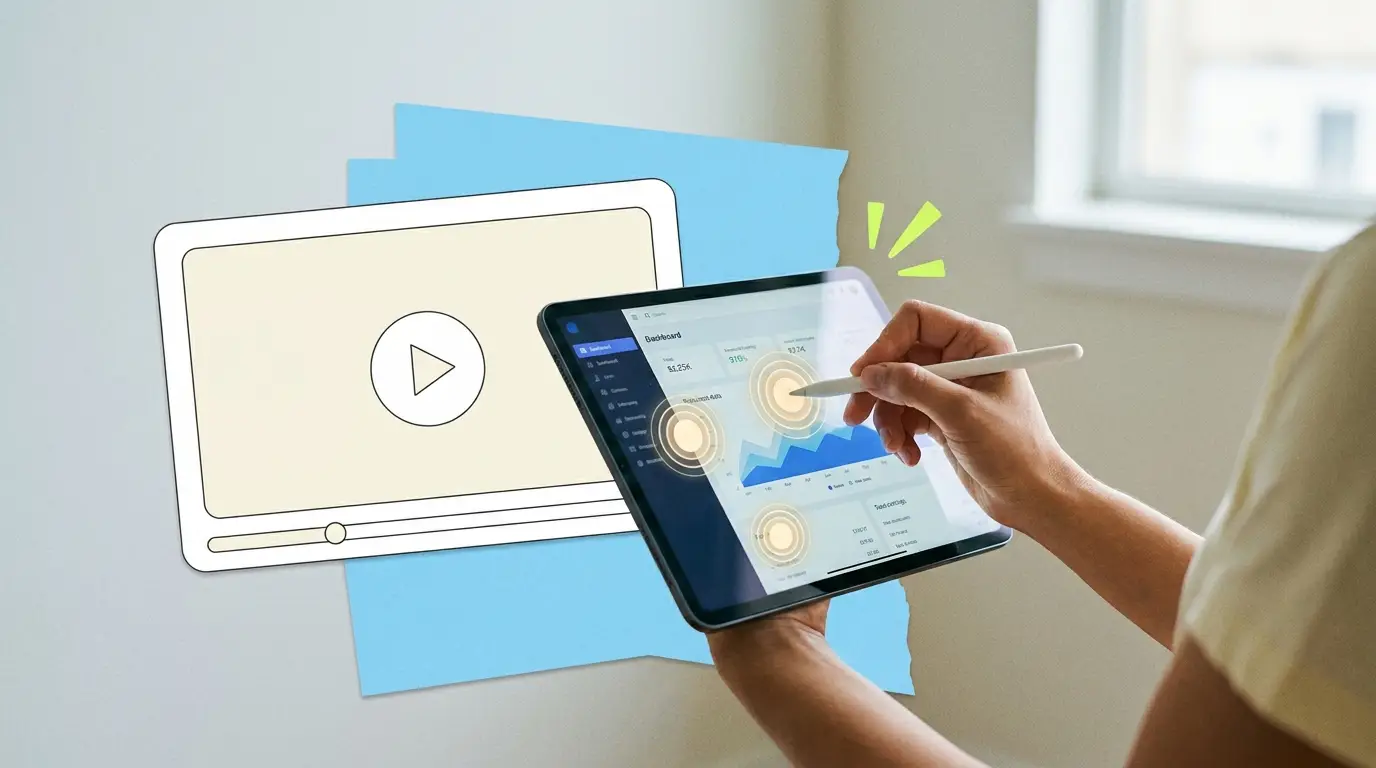
An interactive product demo video lets a prospect do more than watch: it lets them explore the product at their own pace, clicking through features and choosing what to see. As buyers increasingly want to self-serve their research, interactive demos have become a powerful middle ground between a passive video and a full free trial. This guide covers what an interactive product demo video is, how it compares to a standard demo, what production involves, what it costs, and how to decide whether it fits your product.
What interactive product demo video involves
An interactive product demo video combines video and product walkthroughs with clickable, choose-your-path interactivity, letting a prospect explore the features and use cases most relevant to them rather than watching a fixed sequence. It sits between a linear demo video and a hands-on trial, offering guided exploration without requiring signup.
The defining trait is self-directed engagement. Because the prospect chooses what to explore, an interactive demo can serve many buyer types from one asset and keeps engaged prospects on the page longer. It also captures useful signal about what a prospect cares about, which sales teams can act on.
The production blends several disciplines: clean product capture or screen recording, video segments, and the interactive layer that ties them together, often built on a dedicated interactive-demo platform. The video craft, clear capture, narration, and editing, still underpins the experience, because a confusing or low-quality demo fails interactively just as it would linearly. According to Wyzowl, 91% of businesses use video as a marketing tool.
What interactive product demo video includes

Guided interactive walkthroughs let a prospect click through a structured tour at their own pace, the most common format, balancing guidance with self-direction.
Choose-your-path demos let prospects pick the use case or feature set relevant to them, serving multiple buyer types from a single asset.
Embedded video segments carry narration and explanation within the interactive experience, where the video craft of clear capture and editing still matters. Our saas product demo video best practices guide covers producing strong product footage.
Standard demo versions usually accompany the interactive one, since a linear demo still serves homepages, ads, and sales follow-up. Our product demo video production guide covers these.
Short social cutdowns drive traffic to the interactive demo from feeds and campaigns. Our short form video editing service overview covers producing these.
Analytics and follow-up turn the engagement signal from an interactive demo into sales action, a key advantage of the format.
How much it costs
Interactive demos involve two cost layers: the production of the video and product content, and often a subscription to an interactive-demo platform that hosts the experience. Production of the underlying demo content is comparable to a standard demo, while the platform adds a recurring software cost depending on the vendor and scale.
For the video and content side, a dedicated subscription is the most economical way to produce and maintain the demo assets, along with the standard demos, explainers, and social content that support them. Done-for-you services run $2,000 to $3,200 per month for a steady flow of content at a flat fee. Our video editing agency vs subscription guide weighs the production models.
Hiring an in-house editor is an option for teams with constant volume, but an in-house video editor costs $55,000 to $75,000 per year before benefits per ZipRecruiter, plus equipment and software. For most companies a service delivers the same quality without the overhead of a full-time hire.
What to look for

Decide whether interactivity fits your product. Interactive demos suit products complex enough that different buyers care about different things, where self-directed exploration adds real value. For a simple product, a clear linear demo may serve better.
Confirm strong underlying video craft. Interactivity does not rescue confusing content; the capture, narration, and editing still have to be clear and high quality. Review the demo content itself, not just the interactive wrapper.
Plan for the standard demo too. An interactive demo rarely replaces a linear demo entirely, since homepages, ads, and sales follow-up still need one. A partner who can produce both efficiently is ideal. Our done for you video editing service overview covers ongoing production.
Why interactive demos fit how buyers research now
Buyers increasingly want to research on their own terms before talking to sales, and an interactive demo meets that preference directly: it lets a prospect explore the product, follow their own questions, and reach genuine understanding without a signup or a call. For products where different buyers care about different capabilities, that self-directed exploration converts better than forcing everyone through the same linear pitch.
The format also produces something a linear video cannot: signal. Because prospects choose what to explore, an interactive demo reveals what each one cares about, which sales teams can use to follow up with relevance. That combination of self-serve engagement and actionable signal is why interactive demos have grown quickly among software companies.
The caveat is that interactivity is not a substitute for quality. The underlying product capture, narration, and editing still determine whether the demo is clear and persuasive, and a poorly produced demo fails interactively just as it would as a video. The format adds exploration on top of strong content; it does not replace the need for it. Wistia reports that 57% of teams spend more time creating videos than promoting them.
The bottom line on interactive product demos

An interactive product demo video lets prospects explore your product on their own terms, fitting how buyers increasingly prefer to research and producing useful signal about what they care about. It works best for products complex enough that self-directed exploration adds value, and it usually complements rather than replaces a standard linear demo. The underlying video craft still determines whether it succeeds, so produce the demo content well, on a platform if interactivity fits, and keep both the interactive and standard versions current as the product evolves.
When an interactive demo is worth the added complexity
An interactive demo adds real value, but it also adds cost and complexity, so the honest question for any company is whether its product and buyers actually warrant it. The format pays off when buyers are diverse enough that they care about genuinely different things, when the product is rich enough that self-directed exploration reveals more than a linear pitch could, and when the sales motion benefits from the engagement signal interactive demos produce. For a focused product with one clear use case, a strong linear demo often delivers the same result with far less overhead.
Where interactive demos do fit, the underlying content discipline matters more, not less. Because a prospect can wander, every path has to be clear, every segment has to stand on its own, and the product capture has to be clean throughout, since there is no fixed narrative to carry a confusing moment. A poorly produced interactive demo compounds its weaknesses, giving prospects more ways to get lost, which is why the video craft beneath the interactivity is what determines whether the format helps or hurts.
The engagement signal is the part teams most often underuse. An interactive demo reveals which features each prospect explored and where they spent time, which is exactly the kind of intent data a sales team can act on. Capturing that signal and routing it to reps turns the demo from a passive marketing asset into an active part of the sales motion, which is a large part of what justifies the added complexity in the first place.
For a company weighing an interactive demo, the practical takeaway is to adopt it for the right reasons. Use it when product complexity and buyer diversity genuinely reward exploration, invest in clear underlying content so the freedom helps rather than confuses, and put the engagement signal to work. Approached this way, an interactive demo earns its added complexity; adopted as a trend, it rarely does.
Where to go from here
Frequently asked questions
What is an interactive product demo video?
An interactive product demo video combines video and product walkthroughs with clickable, choose-your-path interactivity, letting a prospect explore the features most relevant to them at their own pace. It sits between a linear demo and a hands-on trial.
How is an interactive demo different from a standard demo?
A standard demo plays a fixed sequence the viewer watches passively. An interactive demo lets the prospect choose what to explore, serving multiple buyer types from one asset and capturing signal about what each cares about.
How much does an interactive product demo cost?
There are two layers: producing the video and product content, comparable to a standard demo, and often a subscription to an interactive-demo platform. A dedicated video subscription for the content side runs $2,000 to $3,200 per month. A $900 trial is available to test the service before committing to a monthly plan.
Do I still need a standard demo if I have an interactive one?
Usually yes. Homepages, ads, and sales follow-up still call for a linear demo, so most companies produce both. The interactive demo adds self-directed exploration; it rarely replaces the standard version entirely.
What products suit interactive demos best?
Products complex enough that different buyers care about different features, where self-directed exploration adds real value. For a simple product with one clear use case, a strong linear demo often serves just as well.
Does interactivity make up for weak demo content?
No. The underlying product capture, narration, and editing still determine whether the demo is clear and persuasive. Interactivity adds exploration on top of strong content; it cannot rescue a confusing or low-quality demo.
What is the main advantage of an interactive demo?
It lets prospects research on their own terms without a signup, converts better for complex products by letting buyers follow their own questions, and reveals what each prospect cares about, giving sales teams signal to follow up with relevance.
Do interactive demos replace live sales demos?
Rarely entirely. Interactive demos let prospects self-serve their research and reveal what they care about, but complex or high-value deals still benefit from a live, tailored walkthrough. Most teams use interactive demos to qualify and engage prospects earlier, then bring sales in for the deals that warrant it.
What does an interactive demo cost to run?
There are two layers: producing the video and product content, comparable to a standard demo, and usually a subscription to an interactive-demo platform that hosts the experience. The content side fits well within a dedicated video subscription, while the platform adds a recurring software cost.
How do I know if my product suits an interactive demo?
Interactive demos pay off when buyers are diverse enough to care about different things and the product is rich enough that exploration reveals more than a linear pitch. For a focused product with one clear use case, a strong linear demo often delivers the same result with less overhead.
What is the single biggest advantage of an interactive demo?
It lets prospects research entirely on their own terms, without a signup or a call, which fits how buyers increasingly prefer to evaluate software. For complex products it converts better than a fixed pitch because each buyer follows their own questions, and it produces something a linear video cannot: a record of what each prospect explored. That engagement signal turns the demo from a passive marketing asset into an active part of the sales motion, giving reps real intent data to follow up on.

Prakhar Mehta
Pixel8 is a done-for-you video editing subscription, giving SaaS companies, agencies, and founders a dedicated editing team with 48-hour turnaround.
Ready to stop doing this yourself?
Get a dedicated video editing team. 48-hour turnaround, unlimited revisions, month-to-month.