YouTube Ad Video Editing for B2B and SaaS Brands
YouTube ad video editing for B2B and SaaS teams: how paid-media editing differs from organic, what it costs, and why a subscription editor fits ad iteration.
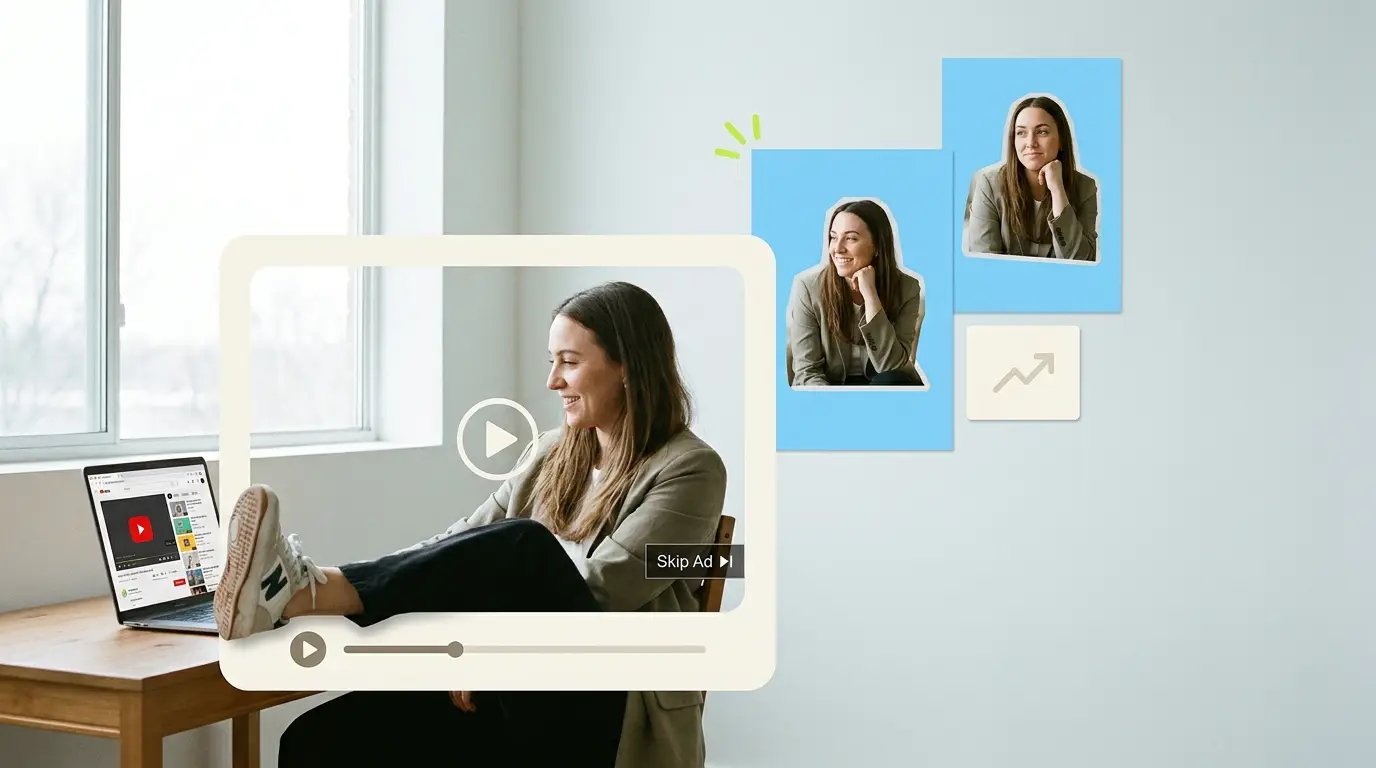
YouTube ad video editing is its own discipline, and if you are running paid media for a B2B or SaaS brand, treating it like organic editing will quietly drain your budget. An ad has about five seconds to earn attention before the skip button takes over, so the editing job changes. You are not building a polished hero film that lives on a channel for years. You are building a fast, testable unit of creative that has to hook, prove, and convert before the viewer is gone. This guide breaks down how YouTube ad video editing differs from organic content, why paid-media teams need high editing volume to iterate, what the work costs, and why a subscription editor fits recurring ad-creative needs better than one-off projects.
Video already does the heavy lifting in marketing. According to Wyzowl, 91% of businesses use video as a marketing tool, and 82% of people say a video convinced them to buy a product or service. For paid teams, the question is not whether to run video ads. It is how to produce enough variations, fast enough, to find the ones that actually perform.
Why ad editing is a different job from organic
Organic YouTube content and paid YouTube ads share a timeline editor and not much else. The goals, the constraints, and the editing decisions diverge almost immediately.
Organic video assumes the viewer chose to watch. They clicked your thumbnail, they have some intent, and they will give you twenty or thirty seconds of patience before they judge the value. Editing for organic leans on pacing, retention curves, and storytelling that rewards a viewer who stays. You can open with context. You can build.
Paid ads assume the opposite. The viewer did not choose you. They wanted to watch something else, and your ad is the toll booth. That single fact reshapes every editing decision, from the first frame to the call to action. If your organic strategy and your ad strategy are blurred together, it is worth separating them deliberately, the way we lay out in our guide to B2B SaaS YouTube channel strategy.
The first five seconds carry the whole ad
On skippable in-stream placements, the viewer can skip after five seconds. Those five seconds are the entire negotiation. A good ad editor front-loads the hook: the problem statement, the pattern interrupt, the bold claim, or the visual that makes someone pause. There is no slow logo intro, no "hi, welcome back," no throat-clearing.
For B2B and SaaS specifically, the hook usually names the pain. "Your sales team is losing deals to slow follow-up" lands harder in second two than a brand sizzle reel ever will. The edit has to deliver that line with a visual that reinforces it, captions that make it readable on mute, and momentum that makes skipping feel like missing something.
Multiple cut-downs from one shoot

Organic editing produces one finished video. Ad editing produces a family of them. From a single shoot or a single set of source assets, a paid-media team typically needs a 6-second bumper, a 15-second version, a 30-second version, and sometimes a longer 60-second or 90-second cut for top-of-funnel awareness. Each length is not just a trim. Each one needs its own pacing, its own hook placement, and its own CTA timing.
This is where editing volume becomes the real constraint. One concept can spawn eight to twelve deliverables before a single dollar of media spend goes out the door. If your editor can only turn around one or two cuts a week, your testing velocity collapses.
A/B variations are the actual product

The point of ad editing is not the ad. It is the variation. Paid teams do not know in advance which hook, which thumbnail frame, which CTA, or which opening line will win. They find out by testing. That means the editor is producing controlled variants: the same script with three different opening hooks, the same footage with two different music beds, the same offer with a soft CTA versus a hard CTA.
Each variant isolates one variable so the data means something. This is closer to a manufacturing process than a creative one, and it rewards editors who can move quickly and consistently across a high volume of near-identical assets. For more on the formats that tend to convert in B2B, see our breakdown of B2B video content types that convert.
Captions and sound-off design

A large share of YouTube ad impressions are watched on mute, at least at first. The edit has to communicate the full message with the sound off. That means burned-in captions, on-screen text that carries the hook, and visual storytelling that does not depend on a voiceover the viewer never hears. Captions are not an accessibility afterthought in ad editing. They are a core conversion element, and sloppy caption timing or styling reads as low-budget instantly.
CTAs that are placed, not tacked on
In organic content, the call to action often lives at the end. In ads, the CTA placement is a tested variable. Some ads put the offer up front for high-intent retargeting audiences. Others build value first and ask at the end for cold prospects. The editor needs to produce both and let the data decide. A subscription model suits this because the same context that drives your YouTube for B2B lead generation efforts carries straight into how the editor frames each CTA across variants.
Why paid-media teams need high editing volume
Here is the uncomfortable math of paid creative. Most ad variations do not work. You might test ten hooks to find one that beats your control. You might run twenty creative concepts in a quarter and have three that you actually scale spend behind. The winners pay for everything, but only if you produce enough shots on goal to find them.
This creates a structural demand for editing volume that one-off project pricing punishes. Every test costs you a project fee. Every iteration is a new invoice. Teams that price editing per project end up rationing their tests, which is the worst possible response, because rationing tests means you find fewer winners and your cost per acquisition stays high.
Ad fatigue makes this worse. A winning ad does not win forever. After enough impressions, performance decays as your audience tires of the same creative. The fix is a steady supply of fresh variations to rotate in. That is a recurring, never-ending content treadmill, and it is exactly the kind of work that breaks a per-project budget. The teams that win at paid YouTube treat ad editing as an ongoing utility, not a series of discrete jobs. Our guide to B2B video content types that convert goes deeper on which concepts to keep feeding into rotation.
The data backs the volume bet. HubSpot research has long shown that video consistently ranks among the highest-performing content formats for marketers, which is precisely why competition for attention in the feed keeps rising and why fresh, well-edited variations matter.
What YouTube ad video editing costs
Editing cost depends on how you staff it. There are four common paths, and the right one depends on your volume.
An in-house editor gives you control and availability, but it is the highest fixed cost. According to ZipRecruiter salary data, a video editor in the United States typically earns between $55,000 and $75,000 per year, before benefits, software, equipment, and the overhead of managing an employee. For a single editor, that is a real commitment, and a single editor still has a ceiling on how many variations they can produce in a week.
Freelancers are flexible and useful for overflow, but per-video pricing adds up fast when you need volume. Expect $75 to $250 per video depending on complexity, which sounds reasonable until you remember that a single ad concept can require ten cut-downs and variants. Freelancers also come with the friction of availability, onboarding, and inconsistent quality across people.
Agencies handle complex productions well, but they price per project, commonly $500 to $5,000 or more per project, and that structure is hostile to iteration. You do not want to negotiate a statement of work every time you want to test a new hook.
The general market for editing services runs from roughly $500 to $3,000 per month for subscription-style options, depending on volume and turnaround. This is where a subscription editor fits the paid-media use case almost perfectly, because the cost is fixed and the output is built for iteration. If you want a side-by-side view, we compare the models in best video editing services compared.
Why a subscription editor fits recurring ad needs
Ad creative is recurring by nature, so the editing arrangement should be recurring too. A subscription model aligns the way you pay with the way the work actually happens. You are not buying a deliverable. You are buying ongoing capacity.
The practical wins are concrete. A dedicated editor learns your brand, your product, your typical hook structures, and your CTA preferences, so each new batch of variants gets faster and more on-brand. A fixed monthly cost means you can test aggressively without watching an invoice climb with every iteration. Unlimited revisions matter because ad editing is iterative by definition, and you should be able to nudge a caption, swap a hook, or retime a CTA without a change-order conversation.
Fast turnaround is the other half of the equation. Paid media moves on a weekly cadence, sometimes daily. When a variant is winning, you want more like it now, not in two weeks. A subscription built around quick turnaround keeps your testing loop tight. This is the same logic behind a done-for-you video editing service, and it applies just as well to short-form video editing service needs across YouTube Shorts and other vertical placements.
What Pixel8 Production offers
Pixel8 Production is a done-for-you B2B video editing subscription built for teams that need consistent, high-volume creative output without the overhead of hiring or the friction of per-project billing.
The structure is simple. You pay $2,000 to $3,200 per month, with no per-project fees. You get a dedicated editor who learns your brand and your ad style, a 48-hour turnaround on most requests, and unlimited revisions so iteration never costs extra. That model is purpose-built for paid-media work, where the volume of cut-downs, hooks, and A/B variations would make per-project pricing punishing.
Our ICP is B2B SaaS companies, agencies, founders, and professional-services firms, the exact teams running ongoing YouTube and paid-social campaigns that demand a steady flow of fresh, testable creative. Instead of choosing between an expensive in-house hire and unpredictable freelancers, you get a predictable monthly partner who can keep your ad-creative pipeline full.
Bottom line
YouTube ad video editing is not a slower cousin of organic editing. It is a high-volume, iterative discipline where the first five seconds decide everything, where one concept spawns a dozen variations, and where the winners only show up if you produce enough tests to find them. Per-project pricing fights that reality at every turn. A subscription editor with fast turnaround, unlimited revisions, and a fixed monthly cost fits the recurring nature of paid creative far better. If you are running paid YouTube for a B2B or SaaS brand, the smartest move is to stop rationing your tests and start treating editing as the always-on capacity it needs to be.
Where to go from here
Frequently asked questions
How is YouTube ad video editing different from organic editing?
Ad editing front-loads the hook into the first five seconds because viewers can skip, while organic editing can build more slowly for an audience that chose to watch. Ad editing also produces many cut-downs and A/B variations from one concept, designs for sound-off viewing with captions, and treats CTA placement as a tested variable rather than a fixed ending.
Why do paid-media teams need such high editing volume?
Most ad variations do not perform, so you need many shots on goal to find the few winners that justify your spend. Ad fatigue also forces you to refresh creative constantly, since a winning ad decays as your audience sees it repeatedly. That makes editing a recurring, high-volume need rather than a one-time project.
How many versions of one ad do I actually need?
A single concept usually needs multiple lengths, such as 6-second, 15-second, 30-second, and sometimes 60-second cuts, each with its own pacing and CTA timing. On top of that, you test variations of the hook, captions, music, and CTA. One concept can easily produce eight to twelve deliverables before any media spend goes out.
What does YouTube ad video editing cost?
Costs vary by staffing model. An in-house editor runs about $55,000 to $75,000 per year per ZipRecruiter, freelancers charge $75 to $250 per video, and agencies bill $500 to $5,000 or more per project. Subscription editing services generally run $500 to $3,000 per month depending on volume and turnaround.
Why is a subscription editor better for ad creative?
Ad creative is recurring, so a fixed monthly cost lets you test aggressively without an invoice climbing per iteration. A dedicated editor learns your brand and gets faster over time, and unlimited revisions mean you can refine hooks and CTAs without change-order friction. It aligns how you pay with how the work actually happens.
How important are captions for YouTube ads?
Very important, because a large share of ad impressions start on mute. Burned-in captions and on-screen text carry the hook and message when the sound is off, and clean caption timing signals production quality. Captions in ads are a core conversion element, not an accessibility afterthought.
How fast should ad edits turn around?
Paid media moves on a weekly or even daily cadence, so slow turnaround kills your testing loop. When a variant is winning, you want more like it quickly while the momentum lasts. A 48-hour turnaround keeps your iteration cycle tight enough to react to live performance data.

Prakhar Mehta
Pixel8 is a done-for-you video editing subscription, giving SaaS companies, agencies, and founders a dedicated editing team with 48-hour turnaround.
Ready to stop doing this yourself?
Get a dedicated video editing team. 48-hour turnaround, unlimited revisions, month-to-month.