Video Editing Market Size: We Analysed 2,417 Keywords (2026 Study)
Original study of the video editing market size: only 2.5% of US video search demand is someone hiring an editor. Data from 2,417 keywords and 318 articles.

The video editing market is far smaller than the video category that contains it. We analysed 2,417 keywords and 318 of our own published articles, and found that only 2.5% of US video search demand comes from someone trying to hire an editor. The remaining 97.5% is people looking for software or people looking to film something, which are different businesses with different buyers.
This is a study of our own data, published in full including the parts that make our previous strategy look wrong. We are a video editing agency, so we had a commercial reason to hope the number was larger. It is not.
Key findings
- Buyer-intent demand is 2.5% of the category. 368 keywords, 58,020 US searches a month, against 1.9 million a month for software and DIY tools.
- Ranking on page one is close to meaningless at this scale. Across 109 of our pages that rank on page one for at least one query, the median page earns 3 impressions in 90 days.
- Keyword format predicts performance better than topic. Comparison pages earn a median of 152 impressions. Industry pages earn 6, and we built 49 of them.
- Question-shaped queries produced 643 impressions and zero clicks. Not a low click-through rate. Zero.
Method
Keyword volumes come from DataForSEO's Google Ads endpoint, US only, pulled on 6 August 2026 across four datasets: seed expansion from our own terms, related-keyword expansion, and a full crawl of a direct competitor's ranking keywords. Total cost of the pull was under a dollar, which is worth stating because the finding did not require an expensive tool.
We then classified each keyword by what the searcher plainly wants: software, filming, or hiring an editing service. 1,558 of the 2,417 keywords fell cleanly into one of the three. The remaining 859 were ambiguous, brand-specific or unrelated, and we left them out rather than forcing them into a bucket. All percentages below are shares of the 2,312,060 monthly searches represented by the classified set.
Performance data comes from Google Search Console for pixel8production.com, covering 11 May to 9 August 2026. Search Console's query dimension omits anonymised queries, so query-level figures describe 8,134 of our 20,329 total impressions. Site-level totals use the unfiltered numbers.
Finding 1: the market is 2.5% of what it appears to be
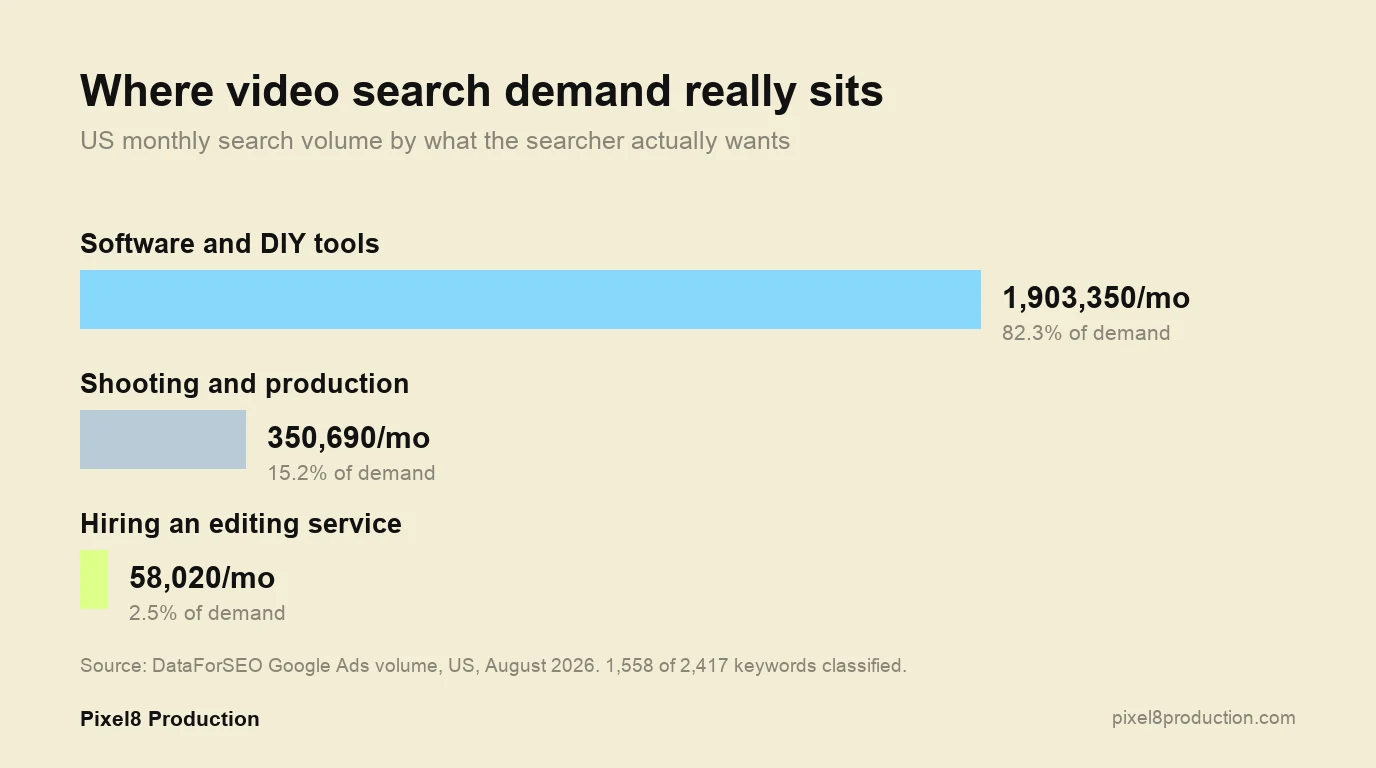
| What the searcher wants | Keywords | US searches/mo | Share |
|---|---|---|---|
| Software and DIY tools | 1,017 | 1,903,350 | 82.3% |
| Shooting and production | 173 | 350,690 | 15.2% |
| Hiring an editing service | 368 | 58,020 | 2.5% |
The video industry's headline numbers describe the first row. Someone searching "video editing programs" or "canva video editor" is not a customer for an editing service, and a competitor ranking for those terms is harvesting traffic that will never convert into a retainer. When we crawled one competitor's keyword profile, their two largest terms were "video editing programs" at 301,000 searches a month and "canva video editor" at 40,500. That looks like dominance and functions as noise.
Even inside the 2.5%, the segment is not cleanly addressable. The single largest term is "video production service" and its plural, at 6,600 searches a month, and both imply filming. We do not film. The genuinely servable head terms are "video editing service" and its plural at 2,400 a month, and "hire a video editor" at 1,600.
So the realistic ceiling for a specialist editing business, in US search, is roughly 58,000 monthly searches, of which the head terms account for a few thousand. Ranking first for everything would still be a modest number of visitors before click-through and conversion.
Finding 2: page-one rankings that earn nothing
We published 318 articles. Here is what they produce.
| Metric | 90 days |
|---|---|
| Clicks | 117 |
| Impressions | 20,329 |
| Click-through rate | 0.58% |
| Average position | 11.9 |
| Pages with at least one impression | 293 |
The natural diagnosis is that the writing or the rankings are bad. Neither holds up.
109 pages rank on page one for at least one query. 97 of them, or 89%, earn under 50 impressions in the full 90 days. The median page-one page earns 3 impressions. At the query level it is starker: of 253 queries where we rank in the top ten, the median earns 2 impressions in 90 days, and 71% earn five or fewer.
We have pages sitting at position 2.0 with a single impression. That is not a ranking problem, and no amount of rewriting fixes it. Those pages were built on keywords whose volume nobody checked, and they rank first for questions almost nobody asks.
This is the mechanism behind the headline number. A corpus can be well written, correctly optimised, and genuinely ranking, and still produce almost nothing, because the demand underneath it was never measured.
Finding 3: format predicts performance better than topic
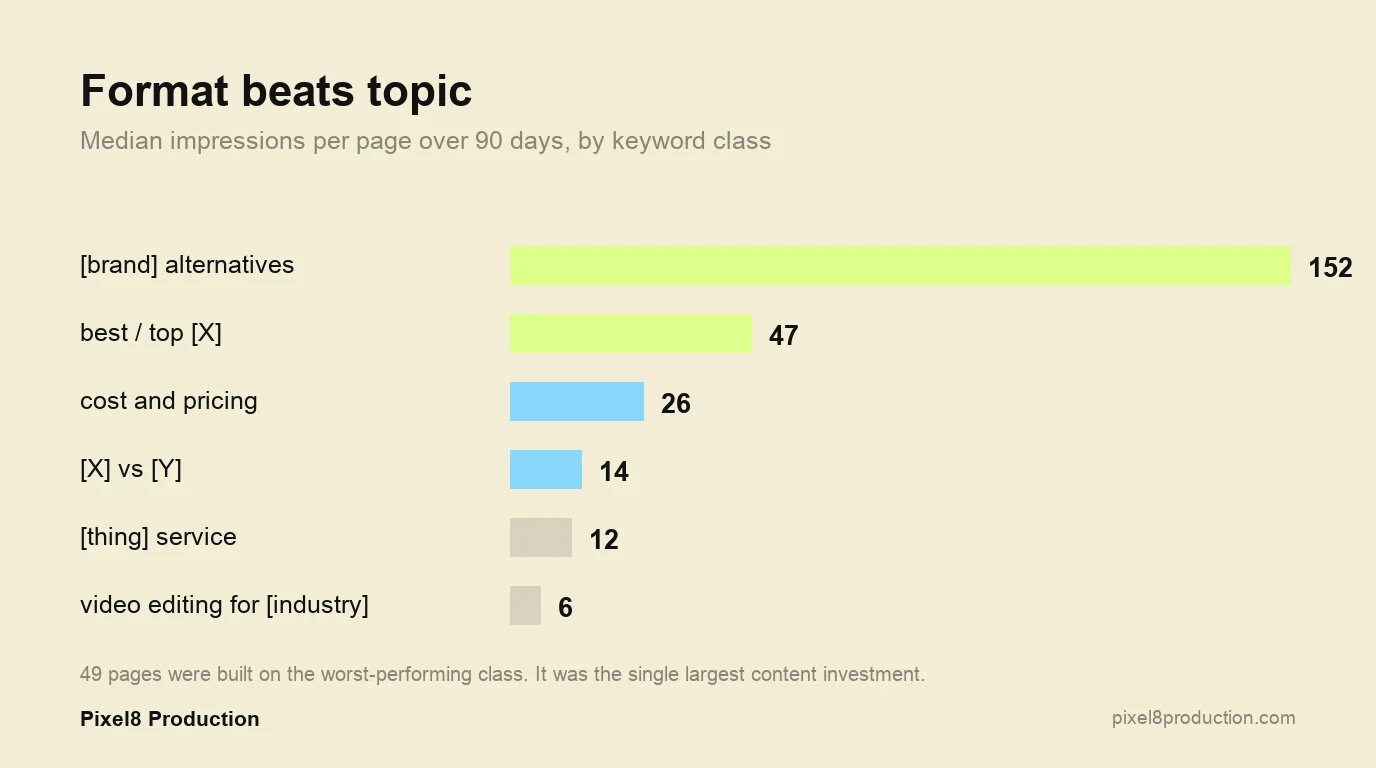
Grouping our pages by the shape of the keyword rather than its subject produced the clearest predictor in the dataset.
| Keyword class | Pages | Median impressions (90d) |
|---|---|---|
[brand] alternatives |
10 | 152 |
best or top [X] |
10 | 47 |
| Cost and pricing | 12 | 26 |
[X] vs [Y] |
32 | 14 |
[thing] service |
65 | 12 |
video editing for [industry] |
49 | 6 |
A comparison page outperforms an industry page by roughly 25 to 1. The uncomfortable part is the page count: our single largest content investment, 49 industry pages, went into the worst-performing class in the set. They were easy to produce and templated well, which is exactly why there were so many of them, and templated production is a good way to manufacture pages nobody searches for.
The pattern is not mysterious. Someone typing "descript alternatives" is comparing purchases. Someone typing "video editing for dentists" is usually a dentist idly wondering, if they exist at all.
Finding 4: the clicks that never existed
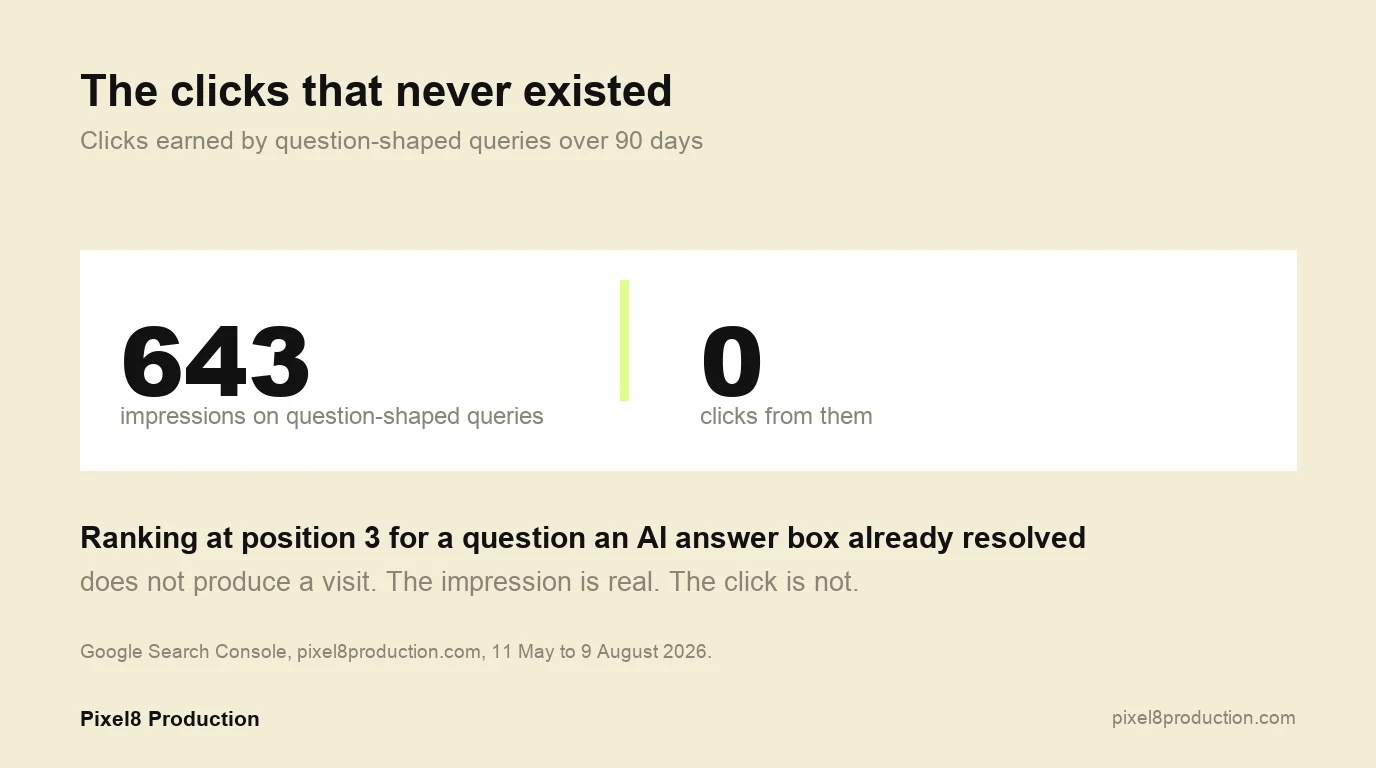
We split queries by whether they are phrased as questions, as a rough proxy for the queries that AI answer surfaces tend to resolve directly.
| Query type | Queries | Impressions | Clicks | CTR |
|---|---|---|---|---|
| Question-shaped | 96 | 643 | 0 | 0.00% |
| Everything else | 670 | 7,491 | 24 | 0.32% |
Zero clicks from 643 impressions. Some of those queries sit at strong positions. The impression is real, the position is real, and the visit does not happen, because the answer was delivered on the results page and the user had no reason to continue.
Position bucket data says the same thing from another angle:
| Position | Queries | Impressions | Clicks | CTR |
|---|---|---|---|---|
| 1 to 3 | 29 | 318 | 11 | 3.46% |
| 4 to 10 | 221 | 3,605 | 7 | 0.19% |
| 11 to 20 | 224 | 2,235 | 5 | 0.22% |
| 21+ | 268 | 1,507 | 0 | 0.00% |
Positions four to ten should convert at a few percent. Ours convert at 0.19%. That gap is not explained by titles or meta descriptions alone. It is what a results page looks like when the top of it answers the question before anyone scrolls.
For a business, the implication is awkward but clear: on question-shaped queries, being ranked is not the goal, because the click does not exist to be won. Being cited is the goal, and it is measured differently.
What we changed
We stopped scaling article volume. Publishing more pages into a 58,000-search market produces more pages, not more customers.
We stopped building video editing for [industry] pages, having built 49 of them.
We began entering the adjacent production market honestly. We do not film, so we cannot serve the 350,690 monthly searches for shooting directly, but we can be the editing partner inside that work, and we say so plainly rather than implying a capability we lack. Our guides to individual city markets now rank production companies alongside us and state which jobs we are the wrong choice for.
We moved effort off-page. When the addressable search market is this small, links, citations and referrals matter more than the next article.
And we published our pricing, which is $900 for a one-time trial and then $2,000 to $3,200 a month depending on volume. Not a finding from this study, but related: in a small market, disqualifying the wrong buyer early is worth more than another visitor.
Limitations
This is one site's data in one niche, and the corpus was built by one team with a particular set of habits. The keyword classification is our judgement, not a standard, and a different analyst would sort some terms differently. Volume figures are Google's estimates and are known to be imprecise at the tail.
Two specific cautions. First, volume data should not override observed data. One of our terms reports 10 to 20 searches a month in Google Ads and produced 1,027 real impressions in Search Console over 90 days. Where the two disagree, trust the one measured on your own site.
Second, the question-shaped split is a proxy. We cannot see AI answer surfaces in Search Console, so we are inferring their effect from a pattern in the click data rather than observing it directly.
Using this data
The figures here are free to cite with attribution to Pixel8 Production and a link to this page. If you want the segment definitions or a breakdown we have not published, ask and we will share it.
We publish this partly because it corrects things we previously believed and acted on. The market did not turn out to be the size our content plan assumed, and 49 pages exist as evidence of that. Anyone selling video services on the strength of the category's headline numbers is working from the wrong denominator, and it is cheaper to learn that from someone else's data than from three hundred of your own articles.
If you are choosing between models rather than measuring markets, our comparison of a video editing subscription versus a freelancer covers where each one stops working.
Where to go from here
Frequently asked questions
How big is the video editing services market in search?
About 58,020 US searches a month across 368 buyer-intent keywords, which is 2.5% of classified video-related search volume. The head terms are "video editing service" and its plural at 2,400 a month and "hire a video editor" at 1,600.
Why is the video market described as so much larger elsewhere?
Because most figures count the whole category. Software and DIY tools account for 1,903,350 monthly searches, or 82.3% of the classified set. Those searchers are looking for a tool to use themselves, not a service to hire.
Does ranking on page one guarantee traffic?
No. Across our 109 pages ranking on page one for at least one query, the median earns 3 impressions in 90 days, and 89% earn under 50. Ranking for a term nobody searches produces nothing.
What is the best-performing type of SEO content in this market?
Comparison content. Pages targeting `[brand] alternatives` earn a median 152 impressions per page over 90 days, roughly 25 times what industry-specific pages earn.
Why did question-shaped queries produce zero clicks?
They are the queries most likely to be answered directly on the results page. We recorded 643 impressions on question-shaped queries and no clicks at all. The visibility is real and the visit does not follow.
How much does hiring a video editing service cost?
Freelance editing runs roughly $75 to $250 per finished video. Subscription services with a dedicated editor run $2,000 to $3,200 a month for continuous output. A staff editor costs <a href="https://www.ziprecruiter.com/Salaries/Video-Editor-Salary" target="_blank" rel="nofollow noopener noreferrer">$55,000 to $75,000 a year according to ZipRecruiter</a> before equipment. Our video editing agency cost guide breaks the models down.
Should a video business invest in SEO at all?
Yes, but sized to the market. In a 58,000-search category, SEO can be a reliable secondary channel and cannot be the growth engine on its own. Comparison and pricing content earns its place. Templated volume does not.
What is the difference between video production and video editing demand?
Production searches imply filming, with crew, cameras and locations, and account for 350,690 monthly searches. Editing searches imply finishing footage that already exists, and account for 58,020. Most companies need production occasionally and editing constantly, which is why remote video editing tends to be the recurring spend.

Prakhar Mehta
Pixel8 is a done-for-you video editing subscription, giving SaaS companies, agencies, and founders a dedicated editing team with 48-hour turnaround.
Ready to stop doing this yourself?
Get a dedicated video editing team. 48-hour turnaround, unlimited revisions, month-to-month.