Top 6 Video Production Companies in London (2026)
The 6 best video production companies in London, ranked by best fit, with real cost ranges and how to choose between a studio and an editing partner.

The best video production companies in London are Pixel8 Production, Casual Films, Liquona, Trendy Grandad, Here Now Films, and Quite Frankly Productions. Pixel8 Production fits ongoing B2B and SaaS video volume, Casual Films and Liquona build around measurable commercial outcomes, Trendy Grandad produces social-first content at cadence, Here Now Films covers corporate film in regulated sectors, and Quite Frankly Productions works across multiple regions.
The best video production companies in London divide neatly by what they optimise for: narrative and craft, measurable commercial outcomes, or sustained content volume. London has an unusually deep bench in all three, which is why the choice is rarely about quality and almost always about fit. This guide ranks them by best fit, covering both full-service production companies and editing-only partners, explains what each genuinely does well, and sets out real cost ranges for the UK market.
A note on method: every company below was verified against its own live website, and the descriptions reflect each one's public positioning. A firm that surfaced on other London lists was left off after it turned out to be an individual director's portfolio rather than an agency. Pixel8 Production is our own service, and we have said so plainly rather than quietly placing ourselves first.
The 6 best video production companies in London
1. Pixel8 Production
Best for: ongoing B2B and SaaS video volume.
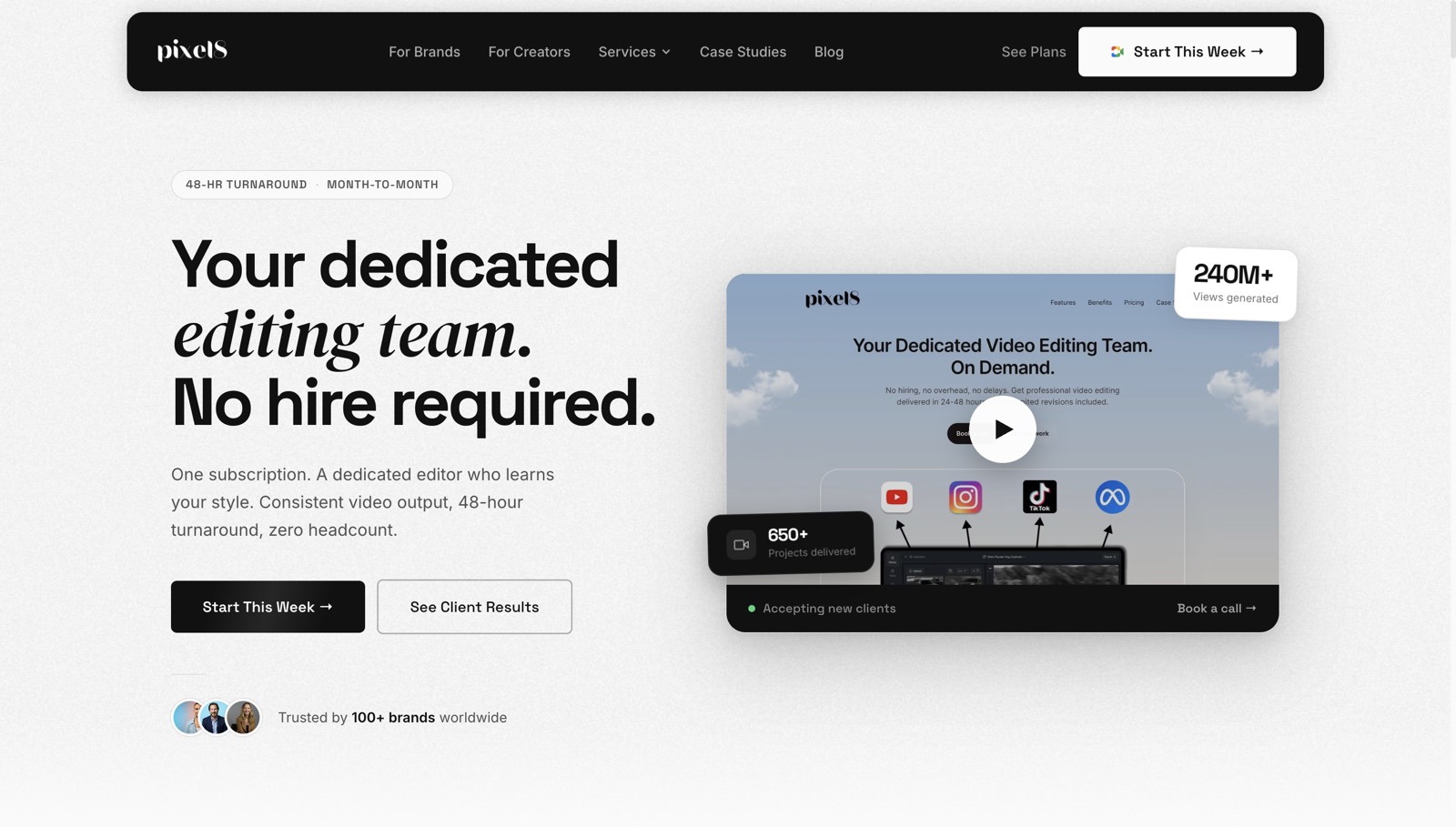
A remote, done-for-you video editing subscription built for teams shipping demos, social clips, and edited webinars every week. You get a dedicated editor who learns your brand, a 48-hour turnaround on standard edits, and a flat $2,000 to $3,200 per month with no London premium. Best fit for software and B2B teams treating video as a pipeline. Not the right call if you need a crew on location in London, which is production rather than editing.
Source: pixel8production.com
2. Casual Films

Best for: B2B video judged on measurable results. Positions its work as "video built on narrative science," describing an approach that engineers videos frame by frame and then measures the outcome rather than relying on guesswork. A strong fit for marketing teams that have to justify video spend with numbers rather than impressions. Source: casualfilms.com
3. Liquona

Best for: creative content aimed at sales outcomes. A London multimedia production company built around creative content that generates sales, covering motion graphics, video editing, and corporate video across a range of sectors. Worth shortlisting when the brief is commercial rather than purely brand-building. Source: liquona.com
4. Trendy Grandad

Best for: social-first content at a regular cadence. A London company producing social-first video and regular content for brands, with offices in London, Manchester, and New York. The closest match on this list to teams that need a steady drumbeat of content rather than a single flagship film. Source: trendygrandad.com
5. Here Now Films

Best for: corporate film and documentary in regulated sectors. An award-winning Central London company working across corporate video, brand films, documentaries, and TV commercials, with sector experience spanning finance, healthcare, the arts, and retail. That regulated-sector fluency is the differentiator. Source: herenow.film
6. Quite Frankly Productions

Best for: brands needing production across multiple regions. An independent, award-winning production company headquartered in London with offices in New York and Bangalore, producing films since 2007. The multi-region footprint suits companies running campaigns across UK, US, and Indian markets from one partner. Source: quitefranklyproductions.com
How to choose a video production company in London
Beyond obvious quality, five things matter most:
- Turnaround speed. Campaigns and launches do not wait. An editing partner that takes three weeks per revision is a bottleneck. Look for a committed turnaround, ideally 48 hours on a standard edit.
- Consistency over one-off brilliance. You want the same look across every video, which means a dedicated editor who learns your brand, not a rotating cast of freelancers.
- Sector fluency. London shops specialise heavily, in finance, healthcare, retail, or B2B software. A partner who already understands your compliance and approval process saves weeks.
- Predictable pricing. Per-project quotes make budgeting for ongoing video impossible. A flat monthly rate turns video into a fixed cost you can plan around.
- Scalability without renegotiation. When a campaign spikes your volume, you want capacity that flexes, not a new statement of work every time.
If a provider nails those five, geography barely matters, which is exactly why many London teams now work with editors who are not physically in the city.
Who needs a video production company in London?
London's buyer base skews toward regulated and enterprise sectors more than most markets. Financial services and fintech firms need explainers and thought-leadership video that survives compliance review. Healthcare and pharma need careful, accurate communication. Agencies need white-label overflow capacity. And a large B2B software scene needs the same demo, social, and webinar editing that drives pipeline everywhere.
The compliance layer is what makes London distinct. In finance and healthcare especially, a video passes through legal and regulatory review before it ships, which means the editor's judgement about claims and phrasing matters as much as their craft. A partner who has never worked inside that constraint will generate rework, so it is worth screening for directly rather than assuming.
How much does video editing cost in London?
London is one of Europe's most expensive creative markets. Project-based studios commonly charge four to low-five figures per finished video for polished work, with campaign centrepieces running well beyond that. Freelancers vary widely, from budget rates to senior editors charging premium day rates that add up quickly on volume.
Hiring in-house is the option that surprises people most. A video editor costs $55,000 to $75,000 per year before benefits per ZipRecruiter, and London salaries sit comfortably in that bracket once national insurance, equipment, and software are added. For steady output, that is a large fixed commitment for one person's capacity.
Against all of that, a remote subscription model prices differently: a flat monthly rate for ongoing editing, typically $2,000 to $3,200 per month, regardless of how expensive the local market is.
One quirk of the London market is worth knowing before you request quotes. Many UK studios price in day rates rather than per finished video, which looks cheaper on the surface but makes the total cost of a project hard to predict, because it depends on how many days the edit actually takes. Ask for a per-deliverable figure or a monthly rate instead, so you are comparing like with like across shortlisted suppliers.
Local studio vs freelancer vs remote subscription
Local production studio. Best for high-stakes, one-off pieces: a brand film, a launch video, a shoot that genuinely needs a London crew. Strong for production; expensive and slow for ongoing editing volume.
Freelancer. Best for occasional, low-volume needs or a very specific style. The trade-off is reliability: freelancers get busy, take other clients, and disappear mid-project, and quality drifts when you cycle through several.
Remote subscription editing. Best for a team producing ongoing demos, social clips, and webinars. You get a dedicated editor, consistent turnaround, and a flat monthly rate, without a London premium or a full-time hire.
There is a timezone point worth making here too, because it cuts both ways. A London team working with a UK studio gets same-day conversation but pays London rates for it. A London team working with an editor several hours ahead often finds work submitted at the end of the day is finished by the time they log on, which turns the time difference into throughput rather than friction. The trade-off is that anything needing live back-and-forth, a rush change an hour before a launch, is harder. Most ongoing editing does not need that, which is why the model works for a steady content pipeline and works less well for a high-pressure campaign week where decisions change hourly.
Volume is usually the deciding factor. HubSpot research shows that 21% of marketers say short-form video delivers the highest ROI of any format, and short clips are exactly the format that demands steady throughput rather than occasional projects. Wistia found the same pattern from the other direction: shorter videos hold higher engagement. Our guide to types of videos B2B SaaS companies need maps that mix, and SaaS product demo video best practices covers the highest-stakes format.
Other markets we cover
Hiring is rarely limited to one city, and remote editing partners work across all of them. If London is not the only market you are considering, we have ranked the same way in San Francisco, New York, Los Angeles, Austin, India. Each list is built from firms verified against their own live sites, so the comparison holds across markets.
Choosing from the list
There is no single best video production company in London, only the one that matches how you actually produce. If you need a crew and a flagship film, the production companies here are built for that. If you are in a regulated sector, the specialists will move faster. And if you are a B2B or software team shipping video every week, a remote subscription partner gives you the consistency without the London premium. Pixel8 Production does that for $2,000 to $3,200 per month with a dedicated editor and a 48-hour turnaround. Get in touch to see if it fits your pipeline.
Where to go from here
Frequently asked questions
Who are the best video production companies in London?
It depends on the brief. For ongoing B2B and SaaS volume, a remote subscription partner such as Pixel8 Production fits best. For measurable commercial video, Casual Films and Liquona both build around outcomes. For social-first content at cadence, Trendy Grandad. For corporate film in regulated sectors, Here Now Films. And for multi-region production, Quite Frankly Productions.
What is the best video production company in London for a B2B company?
For a B2B company producing video continuously, a subscription editing partner usually beats a project-based studio on turnaround, consistency, and predictable cost. If you need strategy and measurement attached to the production itself, Casual Films and Liquona are both explicitly built around commercial results rather than brand awareness alone.
How much does a video production company cost in London?
Project-based studios commonly charge four to low-five figures per finished video, and freelancers vary widely by seniority. Hiring in-house runs $55,000 to $75,000 a year before benefits, equipment, and national insurance. A remote subscription model is typically $2,000 to $3,200 per month for ongoing editing, which is why many London teams choose it for predictability. A $900 trial is available to test the service before committing to a monthly plan.
Does a video production company need to be based in London?
No, unless you need an on-location shoot with a local crew. Editing itself is fully remote work, and a dedicated remote editor avoids the London labour premium entirely. What matters is turnaround, consistency, and sector fluency, not the editor's postcode.
Which London agency is best for financial services video?
Here Now Films has the clearest regulated-sector track record, spanning finance and healthcare alongside arts and retail. In compliance-heavy categories, an editor who already understands how claims are reviewed and approved saves considerable time compared with a generalist learning the process mid-project.
Is it cheaper to hire an in-house video editor or use an agency in London?
For most teams, a subscription agency is more cost-effective. An in-house editor carries salary plus national insurance, equipment, and software, and gives you one person's capacity. A remote subscription at $2,000 to $3,200 per month delivers dedicated editing without those fixed costs, and scales more easily when volume changes.
What types of video do London B2B companies need most?
Product demos, short-form social clips, edited webinars, and thought-leadership interviews, plus compliance-reviewed explainers in finance and healthcare. Agencies additionally need white-label overflow capacity. These are ongoing editing needs rather than one-off productions, which is why a subscription partner often fits better than a project-based studio. Our product demo video production page covers the produced option.

Prakhar Mehta
Pixel8 is a done-for-you video editing subscription, giving SaaS companies, agencies, and founders a dedicated editing team with 48-hour turnaround.
Ready to stop doing this yourself?
Get a dedicated video editing team. 48-hour turnaround, unlimited revisions, month-to-month.