Vidchops Alternatives: Best Video Editing Services 2026
Searching for Vidchops alternatives? Compare the top video editing services for B2B teams in 2026, with pricing, pros, cons, and a clear recommendation.
Why teams search for Vidchops alternatives
If you are searching for Vidchops alternatives, you already know something is not working. Maybe your team hit the 15-minute video cap mid-project. Maybe you submitted a request only to find the single-queue model means your second video sits idle while the first is still in revision. Or maybe you tried to brief an editor on a B2B product demo and realized Vidchops is built, top to bottom, for solo YouTubers.
Vidchops launched in 2017 for individual creators who want a done-for-you YouTube editing service at a fixed monthly cost. The moment you introduce a marketing team, multiple stakeholders, or longer-form content, the service hits structural limits that no amount of extra spend will fix.
This guide covers the top Vidchops competitors in 2026, with real pricing, real constraints, and a framework for choosing based on your team size and content type. For a broader view of the subscription video editing market, the video editing subscription services guide covers the category from the ground up.
What Vidchops actually is, and where it falls short
Vidchops is a subscription-based video editing service with two core plans. The Weekly plan costs $495 per month and delivers four videos per month with three revisions each. The Pro plan runs $995 per month and targets higher-volume creators with eight to ten edited videos monthly and a dedicated project manager included.
Those numbers are reasonable for a solo YouTuber. The problems surface when you look at what the service will not do:
15-minute video cap. Vidchops caps final output at 15 minutes per video. Webinars, product walkthroughs, customer interviews, and training content all routinely exceed that limit. There is no workaround; it is a hard ceiling baked into the service model.
Single active request. You can only have one video in the editing queue at a time. For a team that produces sales enablement videos, social cuts, and a company webinar in the same week, this is a workflow-stopper. You are not getting parallel production. You are getting a single-file line.
No 2D or 3D animation. Vidchops explicitly excludes complex animation and VFX. B2B video regularly requires motion graphics for data visualization, product explainers, and branded sequences. If your brief includes animated charts or kinetic text, Vidchops will decline the work.
No voiceover. Vidchops does not produce or source voiceover. If your videos require narration recorded by a professional, you are sourcing that elsewhere and hoping it integrates cleanly.
Creator-first orientation. The portal, briefing process, and revision model are designed around YouTube channel management, not B2B content strategy. Editors are trained for viewer retention, not for conversion, compliance, or corporate brand standards.
For a deeper look at how Vidchops compares across the full subscription market, the best video editing services compared article benchmarks it against a wider field.
Top Vidchops alternatives in 2026
Pixel8 Production
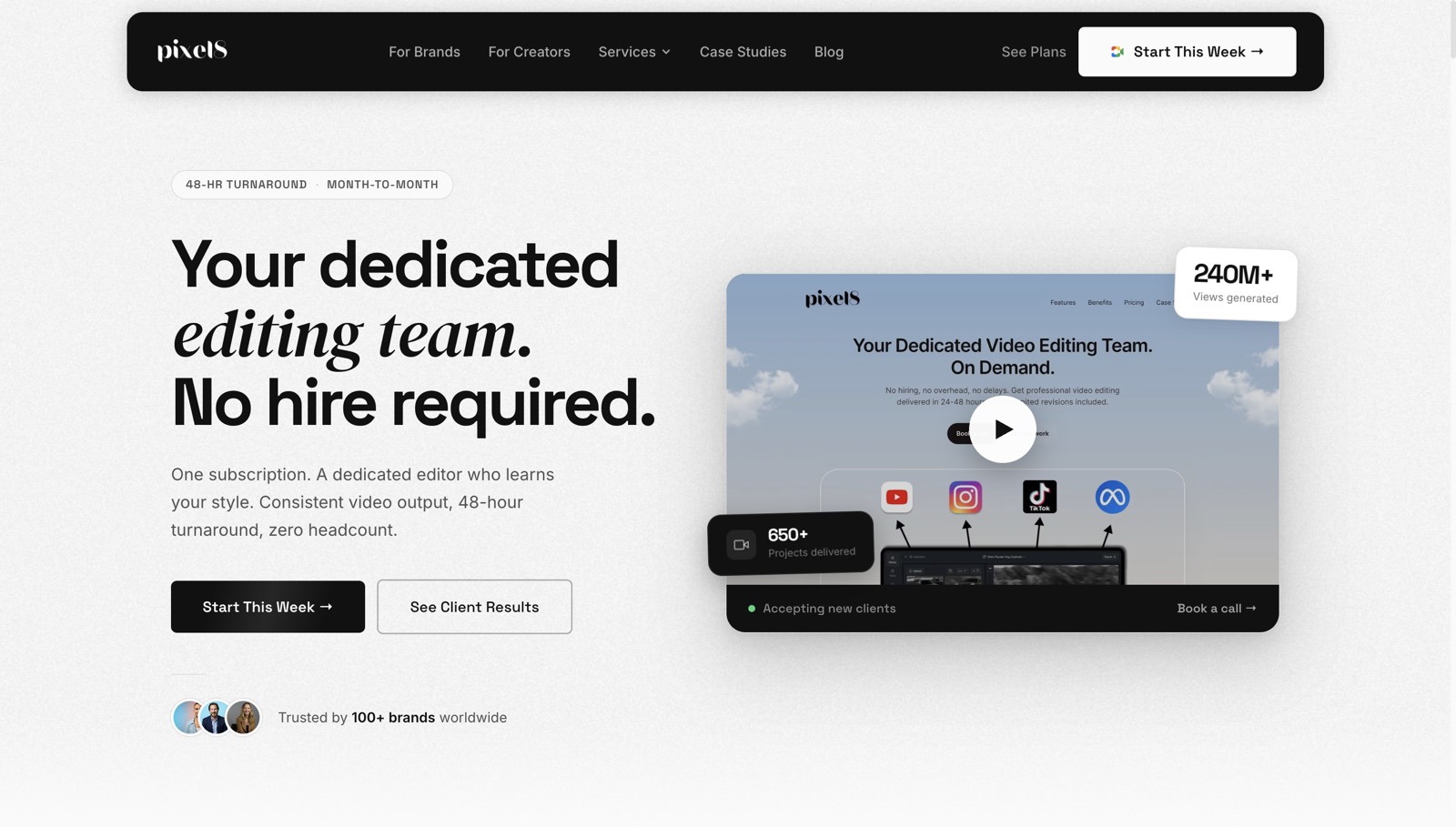
Pixel8 Production is the service built specifically for B2B marketing teams. Where every other service on this list was designed for individual creators and then expanded toward business use, Pixel8 Production was architected from the start for corporate content: product demos, sales enablement videos, executive interviews, event recaps, webinar edits, and multi-format brand campaigns.
Pricing: Plans run from $2,000 to $3,200 per month, placing Pixel8 Production between the creator-focused tiers and the enterprise Superside price point. That range gives growing B2B marketing teams access to a dedicated editing relationship without the overhead of a $10K monthly enterprise contract.
What you get: A dedicated editor who learns your brand standards, product vocabulary, and approval process. Parallel production capacity, no 15-minute cap, support for motion graphics and branded lower-thirds, and a workflow built around marketing briefs and stakeholder review rather than YouTube upload schedules.
Pros: The only service on this list built for B2B from the ground up. Editors understand conversion-oriented storytelling, product positioning, and corporate brand compliance. Pricing is transparent with no enterprise sales cycle required.
Cons: Not the right choice if you are a solo creator producing YouTube content. The B2B focus means the YouTube-specific optimization features that creator-oriented services offer are not part of the product.
Who it is for: B2B marketing teams producing product content, sales enablement video, event coverage, or executive thought leadership at a consistent monthly volume.
Video Husky

Video Husky is probably the most direct Vidchops competitor in structure and audience. It offers subscription-based editing with named plans and a similar creator-centric model.
Pricing: The Eskimo plan costs $749 per month and covers YouTube-style content. The Siberian plan runs $1,549 per month for more complex or higher-volume work. Video Husky uses a proprietary VH Editing System for consistency across editors, and turnaround is typically one to two business days.
Pros: Solid communication layer, unlimited revisions on active projects, and a clear plan structure that makes budget forecasting easy.
Cons: Like Vidchops, Video Husky is built for individual creators. The single-editor model means no parallel production capacity. It is not equipped for corporate brand standards, compliance review, or multi-stakeholder approval workflows.
Who it is for: Solo creators and small creator-led brands who find Vidchops limiting but still produce primarily YouTube content.
For a full breakdown of how Video Husky compares to other services in this tier, see the Video Husky alternatives article.
Vidpros

Vidpros uses a fractional video editing model: you are allocated a dedicated editor for a minimum of two hours per workday, and that editor works with no more than four clients simultaneously. The result is more consistent style retention than you get from a pooled-editor model.
Pricing: Entry-level plans start at $700 to $1,000 per month and include unlimited revision requests, royalty-free assets, and AI-generated captions. Higher-volume tiers scale to $2,000 to $4,000 per month.
Pros: Fewer clients per editor means faster style learning and more consistent output. Turnaround is one to two business days. The service handles longer-form content more flexibly than Vidchops.
Cons: Vidpros skews toward content creator use cases. If your videos need to pass through a brand review committee or align with a campaign brief, you will spend time adapting a system that was not designed for that.
Who it is for: Mid-volume creators and small agencies who want more editorial consistency than Vidchops offers but are not yet operating at B2B team scale.
Tasty Edits

Tasty Edits uses per-video pricing rather than a monthly subscription, which suits teams with irregular or project-based output.
Pricing: A single horizontal long-form video costs $327. Vertical shorts cost $94 each. Multi-video packages reduce the per-unit price to $278 and $80 respectively. Thumbnails add $43 each. Standard pricing covers up to 60 minutes and 20 GB of raw footage per order.
Pros: No monthly commitment, transparent per-video pricing, and no queue pressure. If you produce one or two videos per month, the per-video model is often cheaper than a subscription.
Cons: At $327 per horizontal video, producing eight videos monthly costs roughly $2,600, more than a Pro subscription at competing services. No dedicated editor relationship means less style consistency over time. Not designed for B2B content workflows.
Who it is for: Creators and small businesses with low, irregular video output who do not want a monthly commitment.
Superside

Superside is a different category of service entirely. It is a full creative operations platform for enterprise marketing teams, covering design, video, motion graphics, campaigns, and more.
Pricing: Superside subscriptions start at $10,000 per month at the Flex tier, scaling up to $100,000 per month or more for large enterprise accounts. A $1,000 monthly platform fee applies to all plans. Annual commitment with prepayment is required. All pricing is negotiated through a sales conversation; there are no self-serve tiers.
Pros: Dedicated creative directors, multi-service integration, global timezone coverage, multi-brand support, and AI-enhanced production. For mid-market and enterprise companies with consistent high-volume needs across video and design, Superside can consolidate multiple vendor relationships into one.
Cons: The price point excludes most B2B teams below the enterprise threshold. The annual commitment and sales-led process create friction for teams that want to start quickly. If video production is your primary need, paying for the full Superside suite is often inefficient.
Who it is for: Enterprise marketing teams with $10K+ monthly creative budgets that need video embedded in a broader integrated creative program.
The Superside alternatives for video editing pillar covers how Superside compares across a wider set of video-focused agencies and whether the price premium is justified for your use case.
Comparison table: Vidchops vs top alternatives
| Service | Price per month | Video cap | Parallel requests | B2B fit |
|---|---|---|---|---|
| Pixel8 Production | From $2,000/mo | None | Yes | Native |
| Vidchops | $495 to $995 | 15 minutes | No | Low |
| Video Husky | $749 to $1,549 | Flexible | No | Low |
| Vidpros | $700 to $4,000 | Flexible | Limited | Medium |
| Tasty Edits | $327+ per video | 60 min raw | N/A | Low |
| Superside | $10,000+ | None | Yes | High |
How to choose the right service for your team
The right decision hinges on team size, content type, and monthly volume.
Solo creator, four to eight YouTube videos per month: Vidchops or Video Husky meet your needs. The 15-minute cap is not a constraint if your videos run under 12 minutes, and the single-queue model works when you are the only person submitting briefs.
Small B2B team with irregular output: Tasty Edits per-video pricing avoids a subscription commitment. Vidpros gives you a more consistent editor relationship without a large minimum spend.
Growing B2B marketing team producing six or more videos monthly across formats including product demos, webinars, social cuts, and executive content: Pixel8 Production is the correct fit. The pricing is built for that scale, and the editors are trained for B2B content types, not YouTube retention optimization.
Enterprise with a $10K+ monthly creative budget: Superside warrants a sales conversation if you need video integrated into a broader design and campaign program.
For a detailed breakdown of what subscription tiers cost across the full market, the video editing subscription pricing guide covers per-video costs and total cost of ownership.
The right choice for B2B video in 2026
If you are a B2B marketing team, Vidchops is the wrong tool for the job. The 15-minute cap, single-queue model, and creator-oriented editorial culture were not designed for your content, your team, or your approval process.
Pixel8 Production sits at $2,000 to $3,200 per month, delivers parallel production capacity, supports motion graphics and longer-form content, and pairs you with editors who understand corporate brand standards. That combination makes video production workable at B2B scale, without the enterprise price tag or the friction of adapting a creator-first tool to corporate work.
If you are still evaluating, the superside alternatives for video editing pillar covers the full range from creator-tier subscriptions through enterprise platforms, with a framework for matching each to the right team profile.
Where to go from here
Frequently asked questions
What is the biggest limitation of Vidchops for B2B teams?
The 15-minute video cap and single-queue model are the most immediate constraints. B2B content routinely exceeds 15 minutes, and marketing teams need to move multiple videos through production simultaneously. Vidchops was designed for individual YouTube creators and its workflow reflects that: one video, one queue, one round at a time.
Is Video Husky a better option than Vidchops for business use?
Video Husky improves on Vidchops in some areas, particularly around editor consistency via its VH Editing System, but it is still a creator-focused service. It does not support B2B content workflows, multi-stakeholder review, or corporate brand standards. For genuine B2B use, both services fall short.
How much does Vidpros cost in 2026?
Vidpros starts at $700 to $1,000 per month at the entry level, with plans scaling to $2,000 to $4,000 per month for higher-volume accounts. The fractional model guarantees a minimum of two hours of dedicated editor time per workday, and each editor works with no more than four clients to preserve consistency.
What does Tasty Edits charge per video?
Tasty Edits charges $327 for a single horizontal long-form video and $94 for a vertical short. Multi-video packages reduce the per-unit cost to $278 and $80 respectively. This structure suits teams with low or irregular output but becomes expensive at volume of six or more videos per month.
Is Superside worth the cost for video editing?
Superside is worth evaluating if your monthly creative budget exceeds $10,000 and you need video integrated into a broader design and campaign program. If video production is your primary need and your budget is below that threshold, you are paying for creative services you will not fully use. Superside is an enterprise platform, not a video editing subscription.
What makes Pixel8 Production different from other Vidchops alternatives?
Every other service on this list was built for individual creators and then adapted toward business use. Pixel8 Production was built for B2B marketing teams from the start. Its editors are trained on product content, corporate brand compliance, and conversion-oriented storytelling. The workflow supports parallel production, multi-stakeholder review, and content types that creator-focused services do not handle well.
How do I justify a $2,000 to $3,200 monthly video editing budget to my team?
A full-time in-house video editor costs $5,000 to $8,000 per month in salary, benefits, software, and overhead. A subscription at $2,000 to $3,200 per month gives you a dedicated editor relationship, parallel production capacity, and no fixed employment cost. For B2B teams with consistent monthly volume, the economics favor a specialized subscription over an in-house hire at most stages of company growth.
Can Vidchops handle corporate videos or product demos?
Vidchops can edit footage you submit, but it excludes animation, voiceover, and complex motion graphics. Its editors are trained for YouTube content, not product storytelling or sales enablement. The 15-minute cap rules out most webinar and long-form product demo formats.

Prakhar Mehta
Pixel8 is a done-for-you video editing subscription, giving SaaS companies, agencies, and founders a dedicated editing team with 48-hour turnaround.
Ready to stop doing this yourself?
Get a dedicated video editing team. 48-hour turnaround, unlimited revisions, month-to-month.